roc-ansi lets a Roc program colour and style what it prints, move the cursor, read key presses and draw simple tables, by writing the ANSI escape sequences a terminal understands for you.
1. What roc-ansi is
A terminal changes colour, moves its cursor and reports key presses through
short byte sequences called ANSI escape codes. They are easy to get wrong and
unpleasant to read: \u(001b)[38;5;208m means "orange text". roc-ansi is a Roc
package that gives each of them a typed name, so a program says
ANSI.color("hello", { fg: C256(208), bg: Default }) and gets the right bytes.
It is a pure Roc package. It has no platform of its own and works wherever Roc does, with any platform that can write to a terminal.
1.1. What it covers
| Module | What it is for |
|---|---|
|
The entry point: colour and style text, turn any escape into a string, parse raw key presses, and draw to a screen buffer |
|
The four ways to name a colour: the terminal default, the 16 named colours, the 256-colour palette, and 24-bit RGB |
|
Bold, faint, italic, underline, strikethrough and inverted text |
|
Cursor movement, clearing the screen or a line, and scrolling |
|
Bordered grids and tables, padding and margins |
|
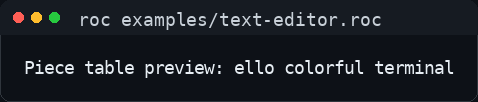
A piece table, the structure a text editor keeps its buffer in |
1.2. What it looks like

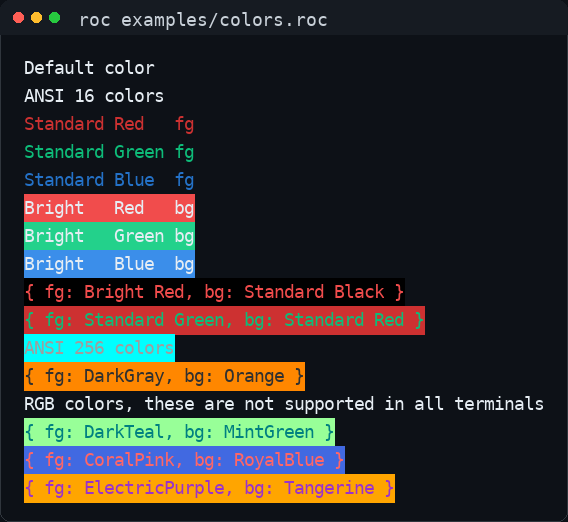
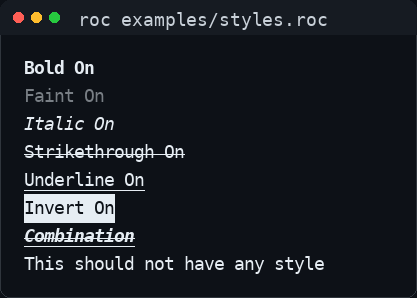
Each picture is the output of one of the programs in Learn from the examples.
1.3. What it does not do
-
It does not put the terminal into raw mode or read from standard input. Your platform does that; roc-ansi parses the bytes it hands you.
-
It does not detect what a terminal supports. A program that must work everywhere should keep to the 16 named colours.
1.4. Compatibility
Roc has no stable release yet, so a roc-ansi release is built and tested with one nightly compiler, named in its release notes. The latest release is tested against the latest nightly every day, and a failure is fixed by a patch release. Use the latest release with a current nightly.
1.5. Where to ask and report
-
Bugs and requests: GitHub issues.
-
Vulnerabilities: privately, as described in SECURITY.md.
-
roc-ansi is open source under the Universal Permissive License 1.0.
2. Get started
This chapter takes you from nothing to a program that prints coloured text. You
need a current Roc nightly
installed as roc.
2.1. Add the package
A Roc application names its packages in its header, each by the URL of a
release. Save this as hello.roc:
app [main!] {
	ansi: "https://github.com/lukewilliamboswell/roc-ansi/releases/download/0.13.2/7yixATpLmwqtNujvYk1sKvZHmgFBMm7B9y7amxVZAhAn.tar.zst",
}

import ansi.ANSI

main! = |_args| {
	echo!(ANSI.color("hello", { fg: Standard(Green), bg: Default }))
	Ok({})
}
For release 0.13.2:
-
Examples, each depending on this release
The URL ends in a hash of the package’s contents. Roc checks what it downloads against that hash, so the URL can only ever mean one thing.
2.2. Run it
roc hello.rocThe word hello is printed in green. ANSI.color wrapped it in the escape
codes that switch the colour on, and a reset that switches it off again.
2.3. Where to go next
-
Learn from the examples has a short program for each part of the package.
-
The API reference linked above lists every function of every module.
3. Learn from the examples
Each example is a short, complete program that shows one thing, with comments that walk through it. Read them top to bottom, or copy one as a starting point.
| Example | What it shows |
|---|---|
Colouring a few words inside a sentence with |
|
Every way of naming a colour, from the most portable to the least |
|
Bold, faint, italic and the other text styles, and how to switch them off |
|
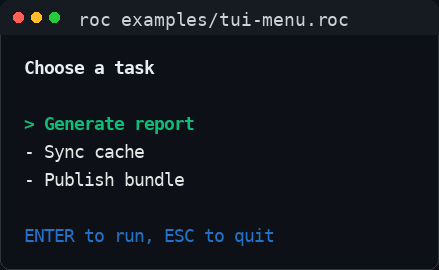
Combining colours and styles to draw a menu with one highlighted entry |
|
Editing text with a piece table |
3.1. Which copy to use
The examples exist in two places, and they are not the same.
- The examples for a release
-
Each release attaches an archive,
roc-ansi-examples-<version>.zip, linked from Add the package. Its examples depend on that release’s package URL and never change. Use these to start a project. - The examples in the repository
-
These depend on the package beside them,
ansi: "../package/main.roc", so they always match the unreleased code onmain. They may use something no release has yet. Use these when you are changing roc-ansi.
4. Contribute
This chapter is for someone changing roc-ansi: what to install, how to run the checks a pull request must pass, and where each kind of test lives.
Use issues for bugs and design discussion, and pull requests for changes. Say what behaviour changes and how you checked it. A bug fix or a new behaviour comes with a test.
4.1. Set up
You need three things:
-
Nix, with flakes enabled.
-
The
blueprintcommand from roc-blueprint, at the release named by the platform URL at the top ofBlueprint.roc. Download the binary for your system from that release and check it against the release’sblueprint.sha256, or runnix profile install github:lukewilliamboswell/roc-blueprint/<version>. -
A current Roc nightly on your
PATHasroc.
4.2. Two compilers
| Command | Chosen by | Used for |
|---|---|---|
|
You: the latest nightly |
Checking, testing, bundling and running the package and its examples |
|
The release named in |
Running the scripts under |
The package is always tested with the newest compiler, because that is what its
users install. roc-stable exists so the repository’s own tooling keeps
working on the day a nightly breaks something. It never checks or builds the
package, and it only exists inside blueprint run and blueprint shell.
Nothing pins a compiler for the package or the examples. Each script names
roc-stable’s release in its `roc header field, so that running one with a
different compiler says why it misbehaves.
4.3. Run the checks
blueprint run check      # everything a pull request must pass
blueprint shell          # or enter the environment and run scripts directly
blueprint tasks          # list every task
blueprint run check runs scripts/check_all.roc, which:
-
Fails if a compiler pin appears outside
scripts/, or a script’s pin differs fromBlueprint.roc. -
Tests, checks and formats the scripts with
roc-stable. -
Formats, checks and tests the package with
roc. -
Builds every example against the working tree, runs it, and compares its output with
tests/spec.json. -
Builds each fuzz target and replays its committed corpus.
-
Counts allocations and compares them with
tests/allocations.json. -
Bundles the package, builds the examples archive, and runs the archived examples, unchanged, against that bundle.
-
Builds the API documentation and its archive.
A pull request can fail because a new nightly arrived, with no fault in the
change. Compare with the latest run of the nightly workflow and with main
before treating a failure as yours.
4.4. Where tests live
| Kind | Where | How to add one |
|---|---|---|
Unit tests |
|
Write an |
Example output |
|
Add a case to the example’s entry, then record its output; see Change an example. |
Properties |
|
A roc-fuzz target with a small |
Allocations |
|
Add a case and its ceiling; see Keep allocations from creeping up. |
Script logic |
|
Keep effects out of the module, and add it to the list in |
4.5. Change an example
An example’s exact output is recorded, so a change to what it prints must be recorded too:
blueprint shell
scripts/test_examples.roc -- --update
That rewrites tests/spec.json from what the examples print now. Review the
diff like any other change. An example that cannot run for a reason outside
this repository is skipped in the specification with a reason and an issue
link; a skip without both is rejected.
Examples are for users of the package. Keep each one short, about one thing,
and commented for someone reading it with no other context. A test belongs in
package/ or tests/, not in examples/.
4.6. Search for inputs nobody thought of
fuzz/piece-table states a rule that must hold for every document and index,
and roc-fuzz searches for an
input that breaks it. Every pull request only builds the target and replays its
committed corpus. To search:
roc build --fuzz fuzz/piece-table/main.roc --output=piece-table
./piece-table run fuzz/piece-table/corpus --time=60
When it finds a failure, fix the bug and keep the minimised input as an
ordinary expect in the package.
4.7. Keep allocations from creeping up
A change can make an in-place update copy a whole list on every call, and
every test still passes. tests/allocations.json records the most allocations
each listed case may make, and the check fails above that.
-
A count below its ceiling passes, and the check says what to lower the ceiling to. Lower it in the same pull request, so the gain cannot be lost.
-
Raising a ceiling needs a reason in the pull request. It is not a way to make a red build green.
The counts come from tests/allocations/main.roc, built on the roc-fuzz
platform because its host counts allocations. Nothing is fuzzed there.
4.8. Build this manual
The manual is the AsciiDoc under docs/, one chapter per file, rendered by the
shared build-docs
action. Every pull request builds it, and the site can be downloaded from the
Documentation workflow run. To build it yourself you need Docker and a
checkout of roc-automation:
blueprint run install-snippet
python3 ../roc-automation/actions/build-docs/build_docs.py --workspace . --pdf-filename roc-ansi.pdf
blueprint run serve
The first command writes the parts of the manual that depend on what has been
released into docs/generated/, which needs gh to be authenticated. The
second renders the site and the PDF into .docs-out/site. The last adds the
API reference for main and serves the site on a free port, or the one named
by SITE_PORT; with FETCH_RELEASE_DOCS=1 it also restores the API reference
of every release.
5. Maintain and release
This chapter is for a maintainer: what each workflow shows, how the tooling is updated, and how a release is made. The repository follows the roc-automation manual, which gives the reasons behind each practice.
5.1. What each workflow shows
| Workflow | Runs on | What it shows |
|---|---|---|
|
Pull requests, pushes to |
The working tree passes |
|
Manual dispatch; pull requests as a dry run |
The exact bundle, examples archive and documentation proposed for publication work |
|
Daily |
The latest release’s examples archive still works on the latest nightly |
|
Pull requests, pushes to |
The manual and site build; |
The package is pure Roc, so every job runs on Linux only.
nightly.yml keeps one tracking issue: opened on the first failure, updated by
later failures, and closed by the next pass. A failure there means the latest
release needs a patch release. A published archive is never edited. A run that
fails before any example ran, such as a failed download, opens no issue.
To re-run a past combination, dispatch nightly.yml with a nightly_tag, a
release_tag, or both. Left empty, they mean the latest nightly and the latest
full release.
5.2. Update the tooling
Nothing updates the tooling automatically. Each of these is a pull request.
- Refresh the lock
-
Run
blueprint updateand commitBlueprint.lock. - Change the tooling compiler
-
Change the tag in
Command("roc-stable", …)inBlueprint.rocand therocfield of every script to the same nightly. The check fails until they agree. Runblueprint update rocif the lock predates that nightly, and fix any script the new compiler breaks. - Upgrade Blueprint
-
Change the platform URL at the top of
Blueprint.roc, and theversionandsha256-*inputs the workflows pass tosetup-blueprint, from the same roc-blueprint release. - Update a script dependency
-
Change its URL in every script header and under
RocPackagesinBlueprint.roc, then runblueprint update.
5.3. Make a release
-
Choose the version.
roc bumpcompares the package with the latest release and says how far the version must move:roc bump --old <latest release bundle URL> package/main.roc -
Write the notes in
docs/releases/<version>.adoc, add them to the top ofdocs/releases.adoc, and merge that pull request. Write them for someone deciding whether and how to upgrade. Use{package-url}wherever the release’s bundle URL belongs. -
Dispatch the Release workflow from
mainwith that version.
The workflow then:
-
Rejects a version that already exists, one with no notes, and one that
roc bump --expectsays understates the change. -
Runs
blueprint run check. -
Builds the bundle, the examples archive, the documentation archive and this manual as a PDF, and renders the notes with the real bundle URL and the versions of
rocandroc-stableit used. That record replaces a header pin as the statement of what the release was built and tested with. -
Tests the examples archive, unchanged, against the bundle.
-
Publishes. A separate job, which checks out nothing and runs no code from the repository, creates a draft release at the tested commit, uploads every asset, downloads each back and compares it with the tested file, and only then publishes.
-
Rebuilds and deploys the site, unless the version is a release candidate.
A release holds:
| Asset | Purpose |
|---|---|
|
The bundle users depend on. Its name is its content hash. |
|
The examples, depending on this bundle, with the output they printed |
|
The API reference for this version, which the site restores |
|
This manual |
No follow-up pull request is needed, because nothing on main names its own
release. A published release is never changed: if one is wrong, publish a new
version.
On a pull request the workflow builds and tests the same things under the
version 0.0.1-dry-run, renders the newest notes, and publishes nothing.
A release candidate, such as 0.14.0-rc1, goes through the same workflow. It
is marked as a prerelease, is never the latest release, and needs its own
notes file.
5.4. How the site is put together
The site is this manual, rendered by the shared build-docs action, with the
API reference added beside it by blueprint run site:
-
main/holds fresh API documentation for the working tree. -
Each release’s API documentation sits under its version, such as
0.13.1/, restored from the archive that release attached. Its address keeps working without its HTML being stored in Git, and generated documentation is never committed.
The manual leads with the latest release: its first program, its API reference
and its examples archive. Those parts are written by
blueprint run install-snippet before the manual is rendered, because a bundle
URL holds a hash nobody can write by hand.
docs.yml builds the site on every pull request and deploys it from main.
release.yml rebuilds and deploys it after publishing, since a release changes
which one is the latest.
6. Release notes
Each release has its notes in docs/releases/, newest first. Releases before
0.13.2 have theirs on the
releases page.
6.1. roc-ansi 0.13.2
This release changes nothing in the package’s API. It is the first whose examples archive records what each example prints, so the daily compatibility check compares output as well as building and running.
6.1.2. Examples
-
text-editor.rocis nowpiece-table.rocandtui-menu.rocis nowmenu.roc. Each prints one frame, and its name now says so. -
Every example carries comments that walk through it.
-
The archive
roc-ansi-examples-0.13.2.zipholdsspec.json, the exact output each example printed when this release was made.