> Documentation version: main. [HTML page](https://lukewilliamboswell.github.io/roc-ansi/index.html)
# The roc-ansi manual
roc-ansi lets a Roc program colour and style what it prints, move the cursor,
read key presses and draw simple tables, by writing the ANSI escape sequences a
terminal understands for you.
[Download this manual as a PDF](roc-ansi.pdf) ·
[View roc-ansi on GitHub](https://github.com/lukewilliamboswell/roc-ansi).
> **How to use this manual**
>
> - **Deciding whether to use roc-ansi**: Start with [What roc-ansi is](#what-roc-ansi-is).
>
>
> - **Using it for the first time**: Follow [Get started](#get-started).
>
>
> - **Looking for code to adapt**: Browse [Learn from the examples](#learn-from-the-examples).
>
>
> - **Changing roc-ansi itself**: Read [Contribute](#contribute).
>
>
> - **Releasing or looking after the repository**: Read [Maintain and release](#maintain-and-release).
>
>
> - **Upgrading**: See [Release notes](#release-notes).
## What roc-ansi is
A terminal changes colour, moves its cursor and reports key presses through
short byte sequences called ANSI escape codes. They are easy to get wrong and
unpleasant to read: ` \u(001b)[38;5;208m ` means "orange text". roc-ansi is a Roc
package that gives each of them a typed name, so a program says
` ANSI.color("hello", { fg: C256(208), bg: Default }) ` and gets the right bytes.
It is a pure Roc package. It has no platform of its own and works wherever Roc
does, with any platform that can write to a terminal.
### What it covers
| Module | What it is for |
| --- | --- |
| ` ANSI ` | The entry point: colour and style text, turn any escape into a string, parse raw key presses, and draw to a screen buffer |
| ` Color `, ` C16 `, ` C256 `, ` Rgb ` | The four ways to name a colour: the terminal default, the 16 named colours, the 256-colour palette, and 24-bit RGB |
| ` Style ` | Bold, faint, italic, underline, strikethrough and inverted text |
| ` Control ` | Cursor movement, clearing the screen or a line, and scrolling |
| ` Layout `, ` Spacing ` | Bordered grids and tables, padding and margins |
| ` PieceTable ` | A piece table, the structure a text editor keeps its buffer in |
### What it looks like

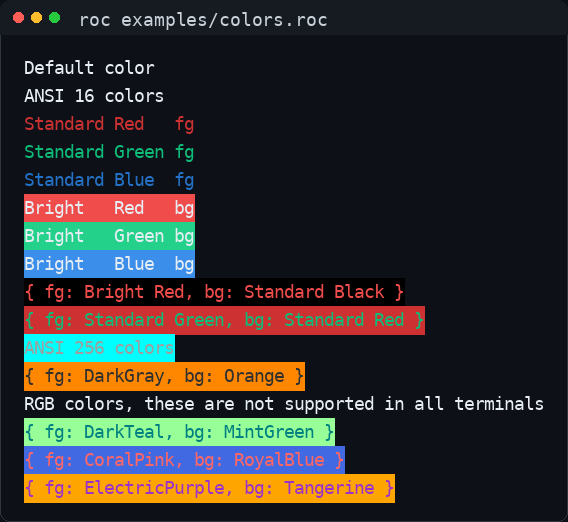
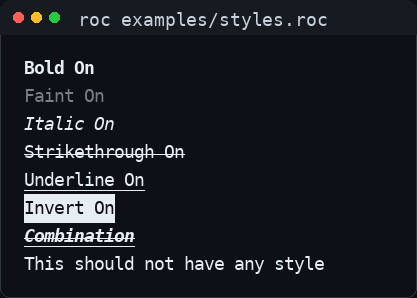
Each picture is the output of one of the programs in
[Learn from the examples](#learn-from-the-examples).
### What it does not do
- It does not put the terminal into raw mode or read from standard input. Your
platform does that; roc-ansi parses the bytes it hands you.
- It does not detect what a terminal supports. A program that must work
everywhere should keep to the 16 named colours.
### Compatibility
Roc has no stable release yet, so a roc-ansi release is built and tested with
one nightly compiler, named in its release notes. The latest release is tested
against the latest nightly every day, and a failure is fixed by a patch
release. Use the latest release with a current
[nightly](https://github.com/roc-lang/nightlies/releases).
### Where to ask and report
- Bugs and requests: [GitHub issues](https://github.com/lukewilliamboswell/roc-ansi/issues).
- Vulnerabilities: privately, as described in
[SECURITY.md](https://github.com/lukewilliamboswell/roc-ansi/blob/main/SECURITY.md).
- roc-ansi is open source under the
[Universal Permissive License 1.0](https://github.com/lukewilliamboswell/roc-ansi/blob/main/LICENSE).
## Get started
This chapter takes you from nothing to a program that prints coloured text. You
need a current Roc [nightly](https://github.com/roc-lang/nightlies/releases)
installed as ` roc `.
### Add the package
A Roc application names its packages in its header, each by the URL of a
release. Save this as ` hello.roc `:
**The latest release is 0.13.4**
``` roc
app [main!] {
ansi: "https://github.com/lukewilliamboswell/roc-ansi/releases/download/0.13.4/BioPdu7WjVhTB2j1HaomKMi8htxsuwqwr79GbXY5nAUf.tar.zst",
}
import ansi.ANSI
main! = |_args| {
echo!(ANSI.color("hello", { fg: Standard(Green), bg: Default }))
Ok({})
}
```
For release 0.13.4:
- [API reference](https://lukewilliamboswell.github.io/roc-ansi/0.13.4/)
- [Examples](https://github.com/lukewilliamboswell/roc-ansi/releases/download/0.13.4/roc-ansi-examples-0.13.4.zip), each depending on this release
- [Release notes](https://github.com/lukewilliamboswell/roc-ansi/releases/tag/0.13.4)
The URL ends in a hash of the package’s contents. Roc checks what it downloads
against that hash, so the URL can only ever mean one thing.
### Run it
``` sh
roc hello.roc
```
The word ` hello ` is printed in green. ` ANSI.color ` wrapped it in the escape
codes that switch the colour on, and a reset that switches it off again.
### Where to go next
- [Learn from the examples](#learn-from-the-examples) has a
short program for each part of the package.
- The API reference linked above lists every function of every module.
### API reference for every version
Each release keeps its own API reference, so the pages for the version you
depend on never change under you.
- [main](https://lukewilliamboswell.github.io/roc-ansi/main/), which is not released yet
- [0.13.4](https://lukewilliamboswell.github.io/roc-ansi/0.13.4/)
- [0.13.3](https://lukewilliamboswell.github.io/roc-ansi/0.13.3/)
- [0.13.2](https://lukewilliamboswell.github.io/roc-ansi/0.13.2/)
- [0.13.1](https://lukewilliamboswell.github.io/roc-ansi/0.13.1/)
- [0.13.0](https://lukewilliamboswell.github.io/roc-ansi/0.13.0/)
- [0.12.0](https://lukewilliamboswell.github.io/roc-ansi/0.12.0/)
- [0.11.0](https://lukewilliamboswell.github.io/roc-ansi/0.11.0/)
- [0.10.0](https://lukewilliamboswell.github.io/roc-ansi/0.10.0/)
- [0.8.0](https://lukewilliamboswell.github.io/roc-ansi/0.8.0/)
## Verify the source bundle
The release workflow generates supply-chain evidence for the exact Roc source
bundle it publishes. Releases before 0.13.3 do not carry this evidence. Keep the
bundle and its evidence together when admitting roc-ansi into your own build.
### What the evidence covers
From 0.13.4, each source bundle has these sidecars:
- ` .spdx.json `: SPDX 3.0.1.
- ` .spdx-2.3.json `: SPDX 2.3 for compatibility with existing consumers.
- ` .cdx.json `: CycloneDX 1.7, from the same inventory.
- ` .sbom-manifest.json `: Blueprint’s manifest binding the SPDX 3.0.1
and CycloneDX sidecars to subject bytes and inventory.
GitHub stores build-provenance attestations for the tested release files,
including these sidecars. The shared release workflow signs them; the source
is this repository’s ` main ` at the release commit. The inventory, archive-member
list, evidence envelope and ` .sigstore.json ` bundles are not release assets.
The source inventory is independent of a CPU target. It covers the shipped
first-party modules and their declared UPL-1.0 license. Archive membership and
bytes are checked against the committed package source. Every bundled module
carries the copyright and license notice; the release also supplies ` LICENSE `.
The recipe verifies that Roc reports no external package dependencies and
refuses that claim if the dependency closure changes.
The compiler is a build dependency, identified by its version and actual
executable SHA-256. Its native dependency closure is explicitly incomplete;
this source inventory does not establish a complete compiler/toolchain
inventory or the composition of an executable compiled downstream. The examples,
API archive and PDF are separate deliverables with their own provenance;
this source SBOM does not describe their contents.
### Verify a release before using it
Select the bundle filename from the GitHub release. Its Roc content-hash name
and its SHA-256 are different identities: use the SHA-256 in the SBOM to check
the delivered archive bytes. The shared workflow revision below is the one
reviewed for 0.13.4; review a later release’s workflow pin before changing it.
``` sh
repo=lukewilliamboswell/roc-ansi
version=0.13.4
bundle=''
commit=$(gh api "repos/$repo/commits/$version" --jq .sha)
automation=2f8bd90acbfba5b1e6e8a50a0ba3c29a7816f25d
signer=lukewilliamboswell/roc-automation/.github/workflows/release-package.yml
gh release download "$version" --repo "$repo" \
--pattern "$bundle" --pattern "$bundle.spdx-2.3.json" \
--pattern "$bundle.sbom-manifest.json" \
--pattern "$bundle.spdx.json" --pattern "$bundle.cdx.json"
for asset in "$bundle" "$bundle.spdx-2.3.json" \
"$bundle.sbom-manifest.json" "$bundle.spdx.json" "$bundle.cdx.json"; do
gh attestation verify "$asset" --repo "$repo" \
--signer-workflow "$signer" --signer-digest "$automation" \
--source-ref refs/heads/main --source-digest "$commit" \
--deny-self-hosted-runners || exit 1
done
expected=$(jq -r '.packages[] | select(.SPDXID == "SPDXRef-Subject") | .checksums[] | select(.algorithm == "SHA256") | .checksumValue' "$bundle.spdx-2.3.json")
actual=$(shasum -a 256 "$bundle" | cut -d ' ' -f 1)
test "$actual" = "$expected"
```
Read the coverage statements as well as verifying signatures. Keep your own
admitted copy, expected signer policy and verification results. A signature
binds the bytes to the producer; the declared source coverage still needs review.
### Chain into your own inventory
Preserve roc-ansi’s immutable source location, release version, bundle SHA-256,
license and upstream document identity. Import the verified supplier graph,
including its coverage gaps. Pin the consumed file by SHA-256 and bind the
supplier SBOM to that exact artifact; checking only the SBOM’s own checksum does
not bind it to a package. Keep build-only dependencies distinct from included
code and from dependencies fetched later.
Blueprint 0.8 accepts a source supplier into source and native inventories,
while preserving its ` source ` identity and checking exact supplier hashes and
versions. Native architecture compatibility checks remain strict. The regression
fixture in ` tests/supply-chain/blueprint-source-import/ ` covers source-to-source,
source-to-Linux-x86\_64 and source-to-Linux-arm64 admission, plus integrity refusals.
Keep source archives as build inputs and describe the resulting executable’s
included code/assets and native closure separately.
## Learn from the examples
Each example is a short, complete program that shows one thing, with comments
that walk through it. Read them top to bottom, or copy one as a starting point.
| Example | What it shows |
| --- | --- |
| [` animals.roc `](https://github.com/lukewilliamboswell/roc-ansi/blob/main/examples/animals.roc) | Colouring a few words inside a sentence with ` ANSI.color ` |
| [` colors.roc `](https://github.com/lukewilliamboswell/roc-ansi/blob/main/examples/colors.roc) | Every way of naming a colour, from the most portable to the least |
| [` styles.roc `](https://github.com/lukewilliamboswell/roc-ansi/blob/main/examples/styles.roc) | Bold, faint, italic and the other text styles, and how to switch them off |
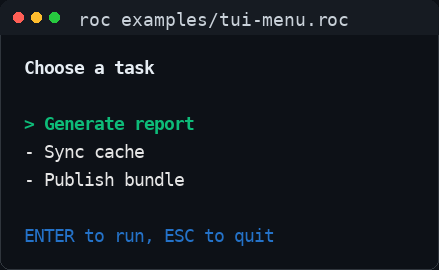
| [` menu.roc `](https://github.com/lukewilliamboswell/roc-ansi/blob/main/examples/menu.roc) | Combining colours and styles to draw a menu with one highlighted entry |
| [` piece-table.roc `](https://github.com/lukewilliamboswell/roc-ansi/blob/main/examples/piece-table.roc) | Editing text with a piece table |
### Which copy to use
The examples exist in two places, and they are not the same.
- **The examples for a release**: Each release attaches an archive,
` roc-ansi-examples-.zip `, linked from
[Add the package](#add-the-package). Its examples depend
on that release’s package URL and never change. Use these to start a project.
- **The examples in the repository**: These depend on the package beside them,
` ansi: "../package/main.roc" `, so they always match the unreleased code on
` main `. They may use something no release has yet. Use these when you are
changing roc-ansi.
### What the output looks like
**` menu.roc `**
**` piece-table.roc `**
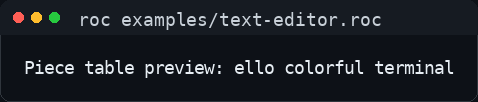
The archive also holds ` spec.json `, which records exactly what each example
printed when the release was made.
## Contribute
This chapter is for someone changing roc-ansi: what to install, how to run the
checks a pull request must pass, and where each kind of test lives.
Use [issues](https://github.com/lukewilliamboswell/roc-ansi/issues) for bugs and
design discussion, and pull requests for changes. Say what behaviour changes
and how you checked it. A bug fix or a new behaviour comes with a test.
### Set up
You need three things:
- The ` blueprint ` command from
[roc-blueprint](https://github.com/lukewilliamboswell/roc-blueprint), at the
release named by the platform URL at the top of ` Blueprint.roc `. Download the
binary for your system from that release and check it against the release’s
` blueprint.sha256 `, make it executable and put it on ` PATH `.
- A current Roc [nightly](https://github.com/roc-lang/nightlies/releases) on your
` PATH ` as ` roc `.
- The host tools listed in ` Expect ` in ` Blueprint.roc `: ` chmod `, ` gh `, ` git `,
` gzip `, ` realpath `, ` sh `, ` shasum `, ` tar `, ` test `, ` touch `, ` unzip ` and ` zip `.
Nix is not needed. The file and archive tools supplied by Linux and macOS
work; GNU coreutils is not required. Install GitHub CLI (` gh `) separately.
Blueprint downloads the pinned tooling compiler and its Roc packages on first
use. Run ` blueprint update ` after changing its declarations, and commit the
lock file. A checkout already has the lock it needs.
### Two compilers
| Command | Chosen by | Used for |
| --- | --- | --- |
| ` roc ` | You: the latest nightly | Checking, testing, bundling and running the package and its examples |
| ` roc-stable ` | The release named in ` Blueprint.roc ` | Running the scripts under ` scripts/ ` |
The package is always tested with the newest compiler, because that is what its
users install. ` roc-stable ` exists so the repository’s own tooling keeps
working on the day a nightly breaks something. It never checks or builds the
package, and it only exists inside ` blueprint run ` and ` blueprint shell `.
Nothing pins a compiler for the package or the examples. Each script names
` roc-stable `’s release in its ` roc ` header field, so that running one with a
different compiler says why it misbehaves.
The released SBOM utility is a checksum-locked native executable from Blueprint
0.8.0. ` blueprint run prepare-sbom ` checks the source and prepares reviewed
composition. The release workflow uses the shared ` sbom-sidecars ` action to
generate and check the sidecars; ` blueprint run sbom-tool ` exposes the native
tool for local inspection. Blueprint embeds its configuration compiler.
### Run the checks
``` sh
blueprint run check # everything a pull request must pass
blueprint shell # or enter the environment and run scripts directly
blueprint tasks # list every task
```
` blueprint run check ` runs ` scripts/check_all.roc `, which:
1. Fails if a compiler pin appears outside ` scripts/ `, or a script’s pin differs
from ` Blueprint.roc `.
2. Tests, checks and formats the scripts with ` roc-stable `.
3. Formats, checks and tests the package with ` roc `.
4. Builds each fuzz target and replays its committed corpus.
5. Counts allocations and compares them with ` tests/allocations.json `.
6. Builds the API documentation site.
The examples, the bundle and the archives are checked by the shared release
workflow that ` release.yml ` calls, on every pull request: it runs every example
against the working tree and compares its output with ` tests/spec.json `, then
bundles the package, builds the examples archive and runs the archived
examples, unchanged, against that bundle.
A pull request can fail because a new nightly arrived, with no fault in the
change. Compare with the latest run of the nightly workflow and with ` main `
before treating a failure as yours.
### Where tests live
| Kind | Where | How to add one |
| --- | --- | --- |
| Unit tests | ` expect ` beside the code in ` package/ ` | Write an ` expect ` in the module. ` roc test package/main.roc ` runs them all. |
| Example output | ` tests/spec.json ` | Add a case to the example’s entry, then record its output; see [Change an example](#change-an-example). |
| Properties | ` fuzz//main.roc ` | A [roc-fuzz](https://lukewilliamboswell.github.io/roc-fuzz/) target with a small ` corpus/ `; see [Search for inputs nobody thought of](#search-for-inputs-nobody-thought-of). |
| Allocations | ` tests/allocations.json ` | Add a case and its ceiling; see [Keep allocations from creeping up](#keep-allocations-from-creeping-up). |
| Script logic | ` expect ` in the modules under ` scripts/src/ ` | Keep effects out of the module, and add it to the list in ` check_scripts! `. |
### Change an example
An example’s exact output is recorded, so a change to what it prints must be
recorded too:
``` sh
blueprint run release-package -- test-examples --update
```
This rewrites ` tests/spec.json ` from what the examples print now. Review the diff
like any other change. An example that cannot run for a reason outside
this repository is skipped in the specification with a ` reason ` and an ` issue `
link; a skip without both is rejected.
Examples are for users of the package. Keep each one short, about one thing,
and commented for someone reading it with no other context. A test belongs in
` package/ ` or ` tests/ `, not in ` examples/ `.
### Search for inputs nobody thought of
` fuzz/piece-table ` states a rule that must hold for every document and index,
and [roc-fuzz](https://lukewilliamboswell.github.io/roc-fuzz/) searches for an
input that breaks it. Every pull request only builds the target and replays its
committed corpus. To search:
``` sh
roc build --fuzz fuzz/piece-table/main.roc --output=piece-table
./piece-table run fuzz/piece-table/corpus --time=60
```
When it finds a failure, fix the bug and keep the minimised input as an
ordinary ` expect ` in the package.
### Keep allocations from creeping up
A change can make an in-place update copy a whole list on every call, and
every test still passes. ` tests/allocations.json ` records the most allocations
each listed case may make, and the check fails above that.
- A count below its ceiling passes, and the check says what to lower the
ceiling to. Lower it in the same pull request, so the gain cannot be lost.
- Raising a ceiling needs a reason in the pull request. It is not a way to make
a red build green.
The counts come from ` tests/allocations/main.roc `, built on the roc-fuzz
platform because its host counts allocations. Nothing is fuzzed there.
### Build this manual
The manual is the AsciiDoc under ` docs/ `, one chapter per file, rendered by the
shared [build-docs](https://lukewilliamboswell.github.io/roc-automation/#build-docs)
action. Every pull request builds it, and the site can be downloaded from the
` Documentation ` workflow run. Blueprint provisions the locked native renderer
named in ` Blueprint.roc `; no container or sibling checkout is needed:
``` sh
blueprint run install-snippet
blueprint run docs -- --docs-version main
blueprint run serve
```
The first command writes the parts of the manual that depend on what has been
released into ` docs/generated/ `, which needs ` gh ` to be authenticated. The
second renders HTML and chapter Markdown into ` .docs-out/site `, and the PDF
into ` .docs-out/roc-ansi.pdf `. The last adds the
API reference for ` main ` and serves the site on a free port, or the one named
by ` SITE_PORT `; with ` FETCH_RELEASE_DOCS=1 ` it also restores the API reference
of every release.
### Write documentation
Write for a current user or contributor task. Remove superseded explanations
and keep release changes with their release. Follow the
[shared documentation guidance](https://lukewilliamboswell.github.io/roc-automation/documentation.html#write-project-documentation).
## Maintain and release
This chapter is for a maintainer: what each workflow shows, how the tooling is
updated, and how a release is made. The repository follows the
[roc-automation manual](https://lukewilliamboswell.github.io/roc-automation/),
which gives the reasons behind each practice.
### What each workflow shows
| Workflow | Runs on | What it shows |
| --- | --- | --- |
| ` release.yml ` | Manual dispatch; pull requests as a dry run | The working tree passes ` blueprint run check ` and its examples on the latest nightly, and the exact bundle, examples archive, documentation and SBOM sidecars proposed for publication work |
| ` nightly.yml ` | Daily | The latest release’s examples archive still works on the latest nightly |
| ` docs.yml ` | Pull requests, pushes to ` main `, published releases | The manual and site build; ` main ` and a final release deploy them |
` release.yml ` is a thin caller of roc-automation’s shared
[release workflow](https://lukewilliamboswell.github.io/roc-automation/workflows.html#the-shared-release-workflow-for-a-pure-package)
at a full commit SHA. The shared workflow owns the jobs; this repository owns
its package, examples, ` tests/spec.json `, notes and the Blueprint tasks the
workflow calls: ` check `, ` prepare-sbom `, ` install-snippet ` and ` docs-path `.
The required status checks are ` Release / Build and test the source ` and
` Release / Test the release candidate `.
The package is pure Roc, so CI uses Linux without Nix. The local setup action
pins the reviewed roc-automation revision and selects Blueprint 0.8.0 from the platform
URL. The shared installer verifies and caches the CLI by release, system and
executable digest. Blueprint embeds its configuration compiler; the separate
` roc-stable ` script compiler remains pinned, and the package nightly floats.
Downloaded utilities and compiler archives use Blueprint’s verified artifact
cache, keyed by workflow, job, Blueprint release and lock. Extracted trees are
recreated and verified, while Roc package sources have a separate cache. A cold
job downloads the locked utilities; a warm job restores and verifies them.
Changing the lock invalidates the corresponding cache key. The floating nightly
may still need a fresh download when its version changes.
SBOM generation uses the shared ` sbom-sidecars ` action. The ` prepare-sbom `
task checks the bundle against the committed source and writes the reviewed
composition; the shared action owns native generation and binding. The local
` sbom-tool ` helper is provisioned through Blueprint’s artifact cache.
The documentation jobs use ` blueprint-tool ` to resolve ` docs-path ` to the
verified renderer in the store. CI reports executable digest and bytes,
provisioning duration, native rendering time and peak RSS, output file sizes,
and separate preparation and API generation timings. Rendering uses a
precompiled Roc binary rather than an Asciidoctor Docker image. The site’s HTML,
PDF, Markdown and ` llms.txt ` come from the same AsciiDoc sources.
` nightly.yml ` delegates to roc-automation’s pinned published-release workflow
on one Linux runner, without Blueprint or Nix prerequisites. Release 0.13.3 is
the first archive with the canonical examples specification required by this
runner. ` schema_version ` identifies the JSON format; examples have no separate
version and are captured with the package release. Earlier archives remain
immutable and cannot be tested by this runner.
The shared runner verifies the release asset’s identity, validates its declared
bundle dependencies, and preserves stdout and stderr from successful compiler
commands. Only complete evidence from every declared runner establishes a
compatibility pass. Setup failures, timeouts and missing results cannot close
the tracking issue. The shared workflow serializes runs and isolates issue
write permissions from example execution.
Dispatch ` nightly.yml ` with ` nightly-tag `, ` release-tag `, or both to reproduce a
specific final release/compiler pair. Empty inputs resolve the latest pair.
Exact overrides are diagnostic runs and do not update the tracking issue.
The shared workflow runs only from the default branch; dispatching a PR branch
is not a compatibility test. Inspect selection, per-target diagnostics and the
aggregate result artifacts on the completed run.
### Update the tooling
Nothing updates the tooling automatically. Each of these is a pull request.
- **Refresh the lock**: Run ` blueprint update ` and commit ` Blueprint.lock `.
- **Change the tooling compiler**: Change the tag in ` Fetch("roc-stable", Recipes.roc_nightly(...)) ` in
` Blueprint.roc ` and the ` roc ` field of every script to the same nightly. The
check fails until they agree. Run ` blueprint update roc-stable ` and fix any
script the new compiler breaks.
- **Upgrade Blueprint**: Change the platform URL at the top of ` Blueprint.roc `, and
the pinned shared setup action in ` .github/actions/setup-blueprint/action.yml `.
Use a shared revision that records that release’s checksums, or supply reviewed
` sha256-* ` overrides in the local action when adopting a release ahead of its
registry. Remove overrides when the shared registry covers the release.
Run ` blueprint update ` and review ` blueprint lock show --json ` (format 2)
as well as the lock diff.
- **Update a script dependency**: Change its URL in every script header and under
` RocPackages ` in ` Blueprint.roc `. Task-only Roc bundles are content-addressed
and are not recorded in the lock.
### Make a release
1. Choose the version. ` roc bump ` compares the package with the latest release
and says how far the version must move:
``` sh
roc bump --old package/main.roc
```
2. Write the notes in ` docs/releases/.adoc `, add them to the top of
` docs/releases.adoc `, and merge that pull request. Write them for someone
deciding whether and how to upgrade. Use ` {package-url} ` wherever the
release’s bundle URL belongs.
3. Dispatch the **Release** workflow from ` main ` with that version.
The workflow then:
1. Runs ` blueprint run check `, then rejects a version that already exists, one
with no notes, and one that ` roc bump --expect ` says understates the change.
2. Runs the examples against the working tree and compares them with
` tests/spec.json `.
3. Builds the bundle, the examples archive, the documentation archive, the SBOM
sidecars and this manual as a PDF, and renders the notes with the real
bundle URL and the ` roc ` it used. That record replaces a header pin as the
statement of what the release was built and tested with.
4. Tests the examples archive, unchanged, against the bundle, in a job that has
no copy of this repository.
5. Publishes. A separate job, which checks out nothing from this repository and
runs none of its code, attests the tested files, creates a draft release at
the tested commit, uploads every asset, downloads each back and compares it
with the tested file, and only then publishes.
6. The caller dispatches ` docs.yml ` from ` main ` to rebuild and deploy the site,
unless the version is a release candidate. An explicit dispatch is needed
because a release created with ` GITHUB_TOKEN ` does not trigger workflows.
A release holds:
| Asset | Purpose |
| --- | --- |
| ` .tar.zst ` | The bundle users depend on. Its name is its content hash. |
| ` roc-ansi-examples-.zip ` | The examples, depending on this bundle, with the output they printed |
| ` roc-ansi-docs-.zip ` | The API reference for this version, which the site restores |
| ` roc-ansi-.pdf ` | This manual |
| Bundle SBOM sidecars | Files beside ` .tar.zst `, with suffixes ` .spdx.json `, ` .spdx-2.3.json `, ` .cdx.json ` and ` .sbom-manifest.json `: SPDX 3.0.1/2.3 and CycloneDX 1.7, with the manifest that binds them to the bundle |
| ` LICENSE ` | Copyright and UPL-1.0 terms, also referenced inside each source module |
Build provenance for every asset is an attestation GitHub stores for the
repository, not a release asset: ` gh attestation verify --repo lukewilliamboswell/roc-ansi ` checks a downloaded file against it.
A published release is never changed: if one is wrong, publish a new version.
On a pull request the workflow builds and tests the same things under the
version ` 0.0.1-dryrun `, renders the newest notes, and publishes nothing.
A release candidate, such as ` 0.14.0-rc1 `, goes through the same workflow. It
is marked as a prerelease, is never the latest release, and needs its own
notes file.
### How the site is put together
The site is this manual, rendered by the shared build-docs action, with the
API reference added beside it by ` blueprint run site `:
- ` main/ ` holds fresh API documentation for the working tree.
- Each release’s API documentation sits under its version, such as ` 0.13.1/ `,
restored from the archive that release attached. Its address keeps working
without its HTML being stored in Git, and generated documentation is never
committed.
The manual leads with the latest release: its first program, its API reference
and its examples archive. Those parts are written by
` blueprint run install-snippet ` before the manual is rendered, because a bundle
URL holds a hash nobody can write by hand.
` docs.yml ` builds the site on every pull request and deploys it from ` main `
and after a final release is published, since a release changes which one is
the latest.
## Release notes
Choose a [published release](https://github.com/lukewilliamboswell/roc-ansi/releases)
for its package URL, compiler requirement, examples and upgrade instructions.
Release assets are immutable; adopt a newer release to obtain a fix.