> Documentation version: 4.0.0. [HTML page](https://lukewilliamboswell.github.io/roc-parser/index.html)
# roc-parser: A manual for parsing text and data in Roc
Parse text and data in Roc. roc-parser gives you small parsers that combine
into larger ones, and ready-made parsers for CSV, YAML, XML, JSON, Markdown
and HTTP/1.1 built from the same pieces.
[Browse the API reference](https://lukewilliamboswell.github.io/roc-parser/api/) ·
[Download this manual as a PDF](roc-parser.pdf).
## Choose a path
- **New to roc-parser**: Read [What roc-parser is](#overview), then [Getting started](#getting-started), then
[Your first parser](#combinator-primer).
- **Parsing a format roc-parser already supports**: Go to its guide: [Read CSV data](#csv),
[Read YAML configuration and frontmatter](#yaml), [Read XML documents](#xml), [Read and write JSON](#json), [Markdown](#markdown) or [HTTP messages](#http).
- **Writing your own parser**: Read [Combinators by task](#combinators), [Parse a format of your own](#custom-format) and
[Report parse errors](#errors).
- **Looking something up**: [Modules](#modules), [Conformance](#conformance), [Performance](#performance), [Compatibility](#compatibility) and
[Glossary](#glossary).
- **Not sure whether you need a parser**: Read [Choosing how to read your input](#choosing-an-approach).
- **Contributing to roc-parser**: Start with [Contributing to roc-parser](#contributing).
- **Curious where the design comes from**: Read [Where the design comes from](#background).
# Start here
## What roc-parser is
roc-parser turns text into typed [Roc](https://www.roc-lang.org/) values. You
give it a string, such as the contents of a CSV file, a YAML configuration, or
an HTTP request, and it gives back either a Roc value you can use directly or
an error that says what was wrong with the input.
It is written in pure Roc, so it works with any platform, and it comes in two
layers:
- Ready-made parsers for common formats. You call one function and get a
document tree, or, for CSV and YAML, your own record type: the compiler
infers the type from your annotation and decodes straight into it.
- The small building blocks those parsers are made from, called *parser
combinators*. You use them to read a format of your own, from a one-line
` key=value ` setting to a complete file format.
This manual is for Roc programmers. You do not need to know anything about
parsing theory.
### The problem it solves
Most programs start by reading text that someone else wrote. Splitting a line
on commas, or matching it with a regular expression, works until the input
contains a quoted comma, a missing field, or a value of the wrong kind. Then
the code either crashes, silently produces wrong data, or grows a pile of
special cases.
A parser describes the shape of valid input once, as a Roc value, and checks
every input against it. With roc-parser:
- The result is typed. A CSV row becomes ` { name : Str, moons : U64 } `, not a
list of strings you still have to convert.
- Runtime parsing returns invalid input as an ` Err ` value. The ready-made parsers
follow their published specifications, including the awkward corners, and
report where the problem is.
- [Checked quotations and imported constants](#compile-time-parsing) turn invalid
source into compiler errors, with configurable checks and typed decoding.
- A parser is built from smaller parsers, so each piece can be tested on its
own with ` expect `.
Compared with a regular expression, a combinator parser is longer to write
for a one-off match, but it can describe nested structure (a regular
expression cannot match balanced brackets), it produces a value rather than
a list of captured substrings, and it reads as ordinary Roc code.
### What a first success looks like
This program decodes a CSV file with a header row into typed records and
prints them.
[Getting started](#getting-started) walks through it.
``` roc
import cli.Stdout
import parser.CSV
Planet : { name : Str, moons : U64 }
input =
\\name,moons
\\Mercury,0
\\Earth,1
\\Mars,2
planets : Str -> Try(List(Planet), [InvalidCsv(CSV.Error), MissingRequiredField(Str)])
planets = |text| CSV.parse(text)
describe : Str -> Str
describe = |text| {
match planets(text) {
Ok(rows) => Str.join_with(rows.map(|p| "${p.name}: ${p.moons.to_str()} ${if (p.moons == 1) "moon" else "moons"}"), "\n")
Err(InvalidCsv(error)) => "line ${error.line.to_str()}: ${error.message}"
Err(MissingRequiredField(name)) => "no ${name} column"
}
}
main! = |_args| {
Stdout.line!(describe(input))
}
```
Output:
``` text
Mercury: 0 moons
Earth: 1 moon
Mars: 2 moons
```
### Supported formats
Each module follows a published specification. Where a module implements only
part of one, its chapter says which part, and input outside that part is
rejected with an error rather than misread.
| Module | Reads | Specification |
| --- | --- | --- |
| ` CSV ` | Comma-separated rows decoded into your own record type | [RFC 4180](https://www.rfc-editor.org/rfc/rfc4180), with the usual relaxations (any line ending, rows of different lengths) |
| ` Yaml ` | Configuration files and Markdown frontmatter, as a tree or your own record type | A documented subset of [YAML 1.2](https://yaml.org/spec/1.2.2/): one document, no anchors, aliases or tags |
| ` Xml ` | A whole XML document as a tree | [XML 1.0 (Fifth Edition)](https://www.w3.org/TR/xml/) well-formedness, without document type declarations or namespaces |
| ` JsonValue ` | A JSON document of any shape as a lossless tree, and JSON written back out | [RFC 8259](https://www.rfc-editor.org/rfc/rfc8259), with opt-in relaxations (comments, trailing commas, a byte order mark, ` NaN ` and ` Infinity `) and opt-in checks (size limits, the top-level shape, I-JSON numbers) |
| ` Markdown ` | A Markdown document as a syntax tree | [CommonMark 0.31.2](https://spec.commonmark.org/0.31.2/) with [GitHub Flavored Markdown](https://github.github.com/gfm/) tables, task lists and strikethrough |
| ` HTTP ` | One HTTP/1.x request or response | [RFC 9112](https://www.rfc-editor.org/rfc/rfc9112) message syntax and [RFC 9110](https://www.rfc-editor.org/rfc/rfc9110) field syntax |
| ` Parser `, ` Utf8 ` | Anything you describe with combinators | Not applicable |
The format chapters describe each module’s exact behaviour. The
[API reference](https://lukewilliamboswell.github.io/roc-parser/api/) lists every public function.
### How the pieces fit together
A combinator is a function that takes parsers and returns a new parser. The
` Utf8 ` module provides parsers for the smallest pieces of text, such as one
byte, a digit, or an exact word. The ` Parser ` module combines them: one after
another, one of several alternatives, repeated, or with the result
transformed. Each format module also exposes its parser as a ` Parser ` value,
so your own parsers and the library’s can be mixed.
**Small parsers combine into larger ones**
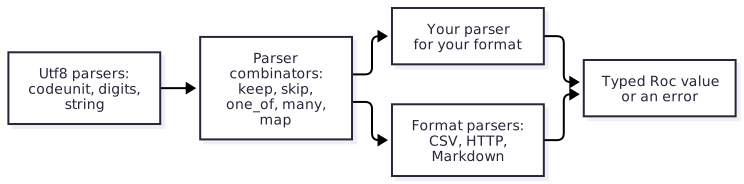
[Your first parser](#combinator-primer) teaches the combinators by building a small parser one
step at a time.
### When to choose something else
roc-parser fits programs that read text formats of moderate size completely
into memory and want typed results with clear errors. Consider something else
when:
- You need full YAML, with anchors, aliases, tags or several documents in one
stream, or XML with document type declarations, namespaces or schema
validation. These modules reject such input on purpose.
- You need to parse a stream incrementally as it arrives, such as a very large
log file or a network connection. Every parser here works on a complete
input held in memory.
- You want to render Markdown to HTML, or serialize values back to text in
a format other than JSON. Only ` JsonValue ` writes its format back out.
- You want to decode JSON straight into your own record type. Roc’s builtin
` Json ` does that; ` JsonValue ` is for JSON whose shape a record cannot
describe (see [Read and write JSON](#json)).
- You need TOML, JSON5, or another format this package does not include. You
can write it with the combinators, but a dedicated package may already
exist.
### Stability
roc-parser tracks recent nightly builds of the Roc compiler. Because Roc is
still changing, the package’s API may change between releases. Each release
names the compiler build it was tested with, and the release notes describe
any changes you need to make when upgrading.
## Getting started
In this chapter you add roc-parser to a Roc app and use it to read three lines
of CSV into typed records. At the end the app prints one line per record. You
need a terminal, an internet connection, and a little Roc: how to write a
function, a record, and a ` match `.
### Before you start
You need:
- The Roc compiler, as a recent *nightly* build. Roc is still changing, so
each roc-parser release is tested with one specific nightly, which its
release notes name. Download that build from the
[Roc nightlies page](https://github.com/roc-lang/nightlies/releases) and put
the ` roc ` executable on your ` PATH `.
- A platform for your app. The examples in this manual use
[basic-cli](https://github.com/roc-lang/basic-cli) 0.26.0, which provides
` main! ` and printing to the terminal. roc-parser itself is pure Roc and
works with any platform.
Check the compiler:
``` sh
roc version
```
It prints the name of the nightly build, which should match the one in the
release notes:
``` text
Roc compiler version nightly--
```
### Add the package
A Roc app names each package it uses by URL in its header. The compiler
downloads the package the first time it builds the app and checks it against
the hash in the URL.
1. Open the [roc-parser releases page](https://github.com/lukewilliamboswell/roc-parser/releases) and choose the newest
release.
2. Under **Assets**, find the file ending in ` .tar.zst ` and copy its link.
3. Put that link in your app’s header under a short name. This manual uses
` parser `.
Create a file named ` main.roc ` with this header, replacing the ` parser ` URL
with the one you copied:
``` roc
app [main!] {
cli: platform "https://github.com/roc-lang/basic-cli/releases/download/0.26.0/GddgvsGjiNXrHFW6au5i5dUDbTs8FinQdrgE2Gqmw53t.tar.zst",
parser: "https://github.com/lukewilliamboswell/roc-parser/releases/download//.tar.zst",
}
```
The examples in this manual are tested against the package source in the
repository, so their headers say ` parser: "../../package/main.roc" ` instead.
Everything else in them is the same.
For complete programs to start from, download
` roc-parser-examples-.zip ` from the same release. Its apps are already
pinned to that release; unzip it and follow the ` README.md ` inside, which runs
them with ` roc .roc ` from its ` examples/ ` directory.
### Read CSV into records
Add the rest of the program below the header:
``` roc
import cli.Stdout
import parser.CSV
Planet : { name : Str, moons : U64 }
input =
\\name,moons
\\Mercury,0
\\Earth,1
\\Mars,2
planets : Str -> Try(List(Planet), [InvalidCsv(CSV.Error), MissingRequiredField(Str)])
planets = |text| CSV.parse(text)
describe : Str -> Str
describe = |text| {
match planets(text) {
Ok(rows) => Str.join_with(rows.map(|p| "${p.name}: ${p.moons.to_str()} ${if (p.moons == 1) "moon" else "moons"}"), "\n")
Err(InvalidCsv(error)) => "line ${error.line.to_str()}: ${error.message}"
Err(MissingRequiredField(name)) => "no ${name} column"
}
}
main! = |_args| {
Stdout.line!(describe(input))
}
```
Run it:
``` sh
roc main.roc
```
Output:
``` text
Mercury: 0 moons
Earth: 1 moon
Mars: 2 moons
```
The first run takes longer while the compiler downloads the platform and the
package.
### What the program does
` import parser.CSV ` makes the ` CSV ` module from the package named ` parser `
available.
` Planet ` is the record type each row becomes. The first line of the input is
a header row, and each field of ` Planet ` reads the column with the same name.
` planets ` calls ` CSV.parse `, which splits the text into rows and decodes each
row into a record. ` CSV.parse ` does not take the row type as an argument: the
compiler infers it from the type annotation on ` planets `, and finds the
decoding code through the static dispatch method ` parser_for `, which every
record type has. Change the annotation and the same call decodes a different
record.
The result is ` Ok ` with a list of ` Planet ` records, or ` Err ` with one of two
tags:
- ` InvalidCsv(error) ` when the text is not valid CSV or a cell does not fit
its field. ` error ` says which record and field failed, where it starts in
the text, and why.
- ` MissingRequiredField(name) ` when the header has no column for a field.
The compiler adds this tag to the error type of every type-directed
decoder, so the annotation must name it.
` describe ` handles all three cases with a ` match `. Nothing is printed until
every row has been read successfully.
To see the error path, change ` Mars,2 ` to ` Mars,two ` and run the program
again. It prints a message that names line 4 and quotes ` two `. Rename the ` moons `
column and it prints ` no moons column `. [Report parse errors](#errors) shows how to report every
kind of failure, and [Read CSV data](#csv) shows optional columns, empty cells and
hand-built row parsers that match columns by position.
### Next steps
- [Your first parser](#combinator-primer) teaches the building blocks by writing a parser for a
small settings format.
- The format chapters show how to read CSV, YAML, XML, JSON, Markdown and
HTTP, and how to write JSON back out.
- [Parse a format of your own](#custom-format) shows how to build and test a parser for a format of your
own.
## Choosing how to read your input
Roc gives you four ways to turn text into values, and roc-parser provides two
of them. This chapter helps you pick one before you write any code. In short:
1. **Decode into your own type** when the input is a standard format and you
already know the shape you want. The record type is the specification, and
there is almost no code to write.
2. **Read a document tree** with one of roc-parser’s format modules when you do
not know the shape in advance, or you need what a record would throw away.
3. **Build a parser with combinators** when the format is your own, or you need
control over exactly what is accepted and what the errors say.
4. **Use no parser at all** when a ` Str ` function does the job, or when the
input is too large or too hot for any of these.
The examples come from
[choosing-approaches.roc](https://github.com/lukewilliamboswell/roc-parser/blob/main/docs/examples/choosing-approaches.roc);
every ` expect ` in it passes.
### Decode into your own type
Roc has type-directed decoding built in. A *format* (such as the builtin
` Json `) knows how to read strings, numbers, lists and records. Your *type*
knows which of those it is made of. The compiler combines the two, so the
annotation alone decides what is accepted:
``` roc
# (a) Type-directed decoding: the record type is the whole specification.
Service : { name : Str, port : U64 }
decode_service : Str -> Try(Service, [InvalidJson(Str), MissingRequiredField(Str)])
decode_service = |json| Json.parse(json)
expect decode_service("{\"name\": \"web\", \"port\": 8080}") == Ok({ name: "web", port: 8080 })
expect decode_service("{\"name\": \"web\"}") == Err(MissingRequiredField("port"))
```
The [parsers chapter of the language reference](https://github.com/roc-lang/roc/blob/main/docs/langref/parsers.md) describes
the mechanism. Every type has a ` parser_for ` method, which the compiler
derives for records, lists and tuples, and a format is a type module whose
methods read one value at a time. Static dispatch joins the two. A field of type ` Try(_, [Missing]) ` is
optional, a missing required field is reported by name, and when the parser
is a top-level constant it is assembled at compile time.
Choose this when:
- the input is a format with a ` parser_for ` implementation, and
- the mapping from the format to your type is the obvious one: object keys
are field names, arrays are lists, and so on.
The builtin ` Json ` is such a format, for JSON whose shape you know in
advance. For dynamic JSON, whose keys are not Roc identifiers or whose arrays
mix shapes, or that must keep member order and every digit of its numbers,
read a document tree with roc-parser’s ` JsonValue ` instead (see [Read and write JSON](#json)).
roc-parser’s ` CSV ` and ` Yaml ` modules are formats for this mechanism.
` CSV.parse ` reads a file with a header row into a list of records, matching
columns to fields by name, and ` Yaml.decode ` reads a document into a record.
Neither takes the type as an argument: the annotation chooses it. A required
field with no column or key fails with ` MissingRequiredField(name) `, a tag
the compiler adds to the error type, so the annotation names it alongside
the format’s own error:
``` roc
# roc-parser's CSV and Yaml modules are formats for the same mechanism.
Planet : { name : Str, moons : U64, rings : Try(Bool, [Missing]) }
planets : Str -> Try(List(Planet), [InvalidCsv(CSV.Error), MissingRequiredField(Str)])
planets = |text| CSV.parse(text)
expect planets("name,moons\nMars,2\n") == Ok([{ name: "Mars", moons: 2, rings: Err(Missing) }])
expect planets("name\nMars\n") == Err(MissingRequiredField("moons"))
service : Str -> Try(Service, [InvalidYaml(Yaml.Error), MissingRequiredField(Str)])
service = |text| Yaml.decode(text)
expect service("name: web\nport: 8080\n") == Ok({ name: "web", port: 8080 })
expect service("name: web\n") == Err(MissingRequiredField("port"))
```
Its limits come from the same design. The format decides the representation,
so you cannot ask it to accept ` yes ` as a boolean or to read a date in your
own layout. Where a wrong value is depends on the format: ` CSV.parse ` reports
the record, field, line and column, and ` Yaml.decode ` the line and column. And the type must be known when you compile.
### Read a document tree
roc-parser’s ` Yaml `, ` Xml `, ` JsonValue ` and ` Markdown ` modules read a whole
document into a tree that mirrors the format, and ` HTTP ` reads a message into
a record of its parts. You then walk the tree with pattern matching, or with
the tree methods such as ` get_path ` and ` as_i64 ` on a ` Yaml ` or ` JsonValue `
value and ` attribute ` and ` children_named ` on an ` Xml.Node `:
``` roc
# (b) A ready-made format parser: read the whole tree, then decide what to
# do with each key, whatever keys the file happens to contain.
top_level_keys : Str -> Try(List(Str), [NotAMapping, InvalidYaml(Yaml.Error)])
top_level_keys = |text| {
match Yaml.parse_str(text)? {
Mapping(entries) => Ok(entries.map(|entry| entry.key))
_ => Err(NotAMapping)
}
}
expect top_level_keys("name: web\nport: 8080\nextra: [1, 2]") == Ok(["name", "port", "extra"])
# The tree methods follow a path without a match per level.
port_of : Str -> Try(I64, [Missing, WrongType, InvalidYaml(Yaml.Error)])
port_of = |text| Yaml.parse_str(text)?.get_path(["server", "port"])?.as_i64()
expect port_of("server:\n port: 8080\n") == Ok(8080)
expect port_of("server: {}\n") == Err(Missing)
```
Choose this when:
- the shape is not known in advance: any key may appear, keys vary between
files, or you are writing a tool that works on every document, such as a
linter or a converter;
- you need what a record type cannot hold: the order of mapping keys, the
exact text of a JSON number, the mix of text and child elements in XML, or
the block structure of a Markdown document;
- you want a precise error with a line and column from a parser that follows
the format’s specification, and you check the content yourself afterwards.
The format modules drop comments, so a tool that must preserve them needs a
parser of its own.
The cost is code: you write the walk, and a missing or mistyped key is
something you check, not something the type system checks for you. The
format chapters ([Read YAML configuration and frontmatter](#yaml), [Read XML documents](#xml), [Read and write JSON](#json), [Markdown](#markdown) and [HTTP messages](#http)) show
helper functions that keep the walk short.
### Build a parser with combinators
When no format module reads your input, write a parser from the ` Parser ` and
` Utf8 ` combinators. A parser is a value made of smaller parsers, so the
code has the shape of the grammar:
``` roc
# (c) A parser of your own: a legacy "host:port" line, where the port must
# be digits and the grammar is yours to define.
Endpoint : { host : Str, port : U64 }
endpoint : Parser(Utf8.Bytes, Endpoint)
endpoint =
Parser.const(|host| |port| { host, port })
.keep(Parser.chomp_while(|b| b != ':').map(Str.from_utf8_lossy))
.skip(Utf8.codeunit(':'))
.keep(Utf8.digits)
expect Utf8.parse_str(endpoint, "example.com:443") == Ok({ host: "example.com", port: 443 })
expect Utf8.parse_str(endpoint, "example.com:https").is_err()
```
Choose this when:
- the format is your own or a legacy one: a log line, a configuration
dialect, a wire protocol, or a small language such as a query or a
template;
- the grammar is defined by more than a record shape: alternatives, nesting,
repetition with separators, or a part whose length is given earlier in the
input;
- you want to reject invalid values while parsing, so that a port of
` 70000 ` or a date of ` 2026-02-30 ` fails at the right place with your own
message;
- you want to read only the start of the input and keep the rest, such as one
message from a buffer that holds several (` Utf8.parse_str_partial `).
Combinators are also how you extend a format module. ` CSV.record ` and
` CSV.field ` are combinators, every format module has a ` parser ` value to
embed, and you can mix ` Utf8 ` parsers into any parser of your own. A
combinator parser’s failure is the furthest failure, with a byte offset. [Your first parser](#combinator-primer) teaches the method and [Parse a format of your own](#custom-format)
applies it to a real format.
### Use no parser at all
Parser combinators are not always the right tool, and roc-parser’s own
format modules show where the line falls.
- **The input has no structure worth a grammar**: One separator, no quoting and
no nesting is a job for ` Str.split_on `, ` Str.trim ` and friends. A parser
would be longer and no clearer:
``` roc
# (d) No parser at all: one separator and no nesting is a job for `Str`.
fields : Str -> List(Str)
fields = |line| line.split_on("\t")
expect fields("a\tb\tc") == ["a", "b", "c"]
```
- **The input is very large or arrives as a stream**: Every parser in this
package reads a complete input held in memory, and the result holds copies of
the text it read. For a multi-gigabyte log or a network connection, read and
process one record at a time with a hand-written loop over the bytes, or use a
streaming library.
- **The parser is on a hot path**: Each combinator adds a function call and an
intermediate ` Try `. That is cheap for configuration files and messages, but
[Add a format module](#adding-a-format) records that the CSV, XML, HTTP and Markdown modules
moved their document-level parsing to byte scanners with an explicit stack,
to stay linear and avoid deep recursion; the JSON module was written that way
from the start. Do the same when profiling shows the parser matters.
[Performance](#performance) compares the built-in parsers with Go, Rust and Python
libraries.
- **The grammar is ambiguous or left-recursive**: Combinators take the first
alternative that succeeds and cannot handle a rule that starts with itself,
such as ` expr = expr "-" term `. A large grammar written for a parser
generator, such as an existing yacc or ANTLR grammar, is often better served
by a generator, which checks the grammar for conflicts before any input is
read. [Where the design comes from](#background) explains these limits.
### Decision table
| You need | Decode into a type | Document tree | Combinators | No parser |
| --- | --- | --- | --- | --- |
| A standard format (CSV, YAML) into known records, with little code | Best | Possible | Possible | No |
| Any keys or structure, discovered at run time | No | Best | Possible | No |
| Mapping key order or XML mixed content kept | No | Yes | Yes | No |
| Line and column in errors | Yes for ` CSV ` and ` Yaml ` | Yes | A byte offset | No |
| Your own or a legacy format, a protocol or a small language | No | No | Best | If trivial |
| Values validated while parsing, with your own messages | No | Afterwards | Best | By hand |
| Read one message and keep the rest | No | ` HTTP.parse_request ` returns the ` rest ` | Yes | By hand |
| Very large or streaming input, or a hot path | No | No | No | Best |
| Ambiguous or left-recursive grammar | No | No | No | Use a parser generator |
### Decision flow
The same choice as a sequence of questions:
**Choosing how to read your input**
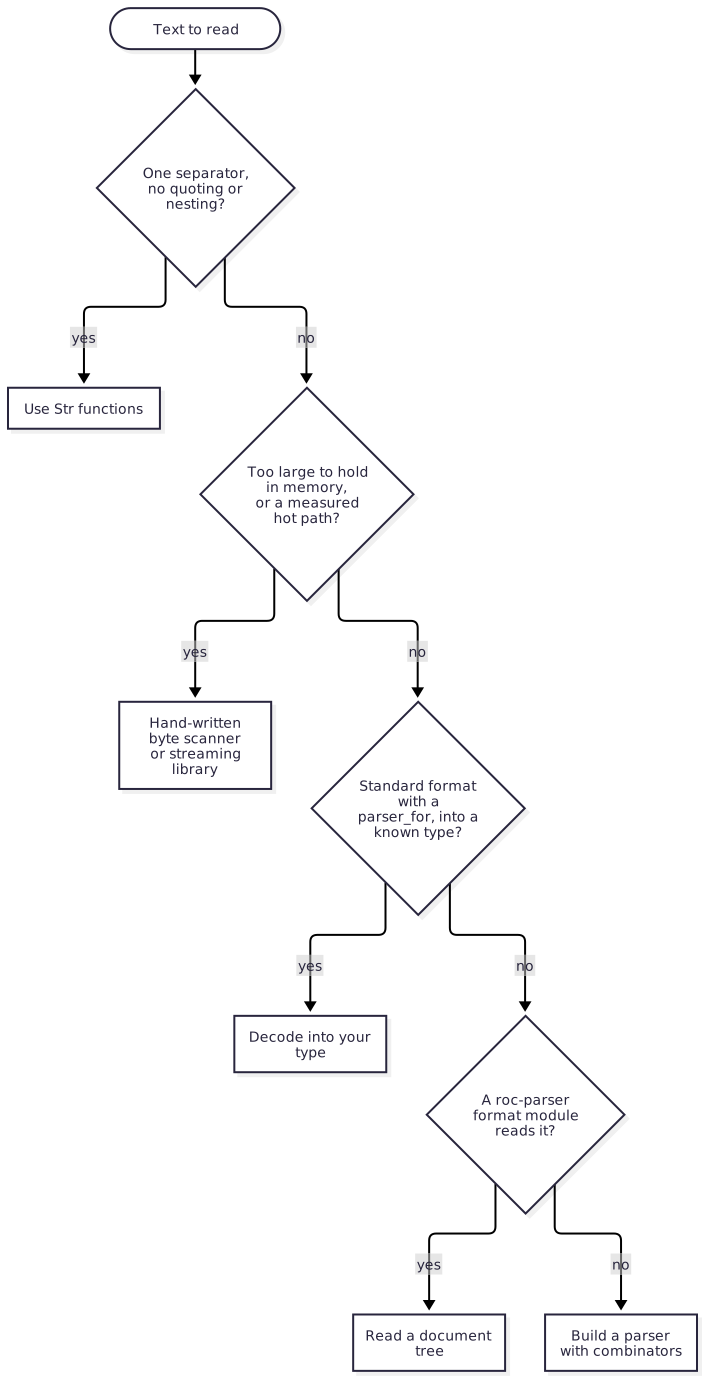
The questions are ordered from least code to most. You can also combine
answers: read a Markdown file as a tree, read its frontmatter as a YAML tree,
and parse one custom field inside it with a combinator.
## Your first parser
In this tutorial you write a parser for a small settings format, one line per
setting:
``` text
name="demo"
port=8080
debug=true
```
By the end you have a parser that turns that text into a list of typed
records, and you know how to read its errors. Along the way you meet the
combinators that every parser in this package is built from.
You need the setup from [Getting started](#getting-started). Each step is a complete program
in the repository’s ` docs/examples ` directory; the step’s heading names the
file. Run a step with ` roc ` and its tests with ` roc test `.
### Step 1: read a key
[combinator-primer-step1.roc](https://github.com/lukewilliamboswell/roc-parser/blob/main/docs/examples/combinator-primer-step1.roc)
A key is one or more lowercase letters or underscores. Start with a parser
for one such byte, repeat it, and turn the bytes into a ` Str `:
``` roc
is_key_byte : U8 -> Bool
is_key_byte = |b| (b >= 'a' and b <= 'z') or b == '_'
key : Parser(Utf8.Bytes, Str)
key =
Utf8.codeunit_satisfies(is_key_byte)
.one_or_more()
.map(Str.from_utf8_lossy)
```
Three ideas appear here:
- A ` Parser(Utf8.Bytes, Str) ` reads from UTF-8 bytes (` Utf8.Bytes ` is
` List(U8) `) and produces a ` Str `. Every parser has an input type and a
result type.
- ` Utf8.codeunit_satisfies(is_key_byte) ` reads one byte if ` is_key_byte `
accepts it, and fails otherwise.
- ` .one_or_more() ` repeats a parser until it fails and collects the results
in a list. ` .map(f) ` transforms the result with an ordinary function; here
` Str.from_utf8_lossy ` turns the bytes into a ` Str `.
` Utf8.parse_str ` runs a parser on a whole string. These tests pass:
``` roc
expect Utf8.parse_str(key, "name") == Ok("name")
expect Utf8.parse_str(key, "Name").is_err()
```
The second fails because ` N ` is not a lowercase letter, so not even one key
byte can be read.
### Step 2: read a whole setting
[combinator-primer-step2.roc](https://github.com/lukewilliamboswell/roc-parser/blob/main/docs/examples/combinator-primer-step2.roc)
A setting is a key, an ` = `, and a value. For now, the value is everything up
to the end of the line:
``` roc
value : Parser(Utf8.Bytes, Str)
value =
Parser.chomp_while(|b| b != '\n')
.map(Str.from_utf8_lossy)
Entry : { key : Str, value : Str }
entry : Parser(Utf8.Bytes, Entry)
entry =
Parser.const(|k| |v| { key: k, value: v })
.keep(key)
.skip(Utf8.codeunit('='))
.keep(value)
```
This is the pattern for reading things in sequence:
1. ` Parser.const(f) ` is a parser that reads nothing and produces ` f `, the
function that builds the result. ` f ` takes its arguments one at a time
(` |k| |v| ... `), because they arrive one at a time.
2. ` .keep(p) ` runs ` p ` next and passes its result to the function.
3. ` .skip(p) ` runs ` p ` next and throws its result away. The ` = ` must be there,
but you do not need it in the record.
` Parser.chomp_while(pred) ` reads bytes while ` pred ` accepts them. It always
succeeds, even when it reads nothing, which is why ` "empty=" ` gives an empty
value:
``` roc
expect Utf8.parse_str(entry, "name=roc") == Ok({ key: "name", value: "roc" })
expect Utf8.parse_str(entry, "empty=") == Ok({ key: "empty", value: "" })
```
Running the step prints:
``` text
Ok({ key: "name", value: "roc" })
```
### Step 3: choose between kinds of value
[combinator-primer-step3.roc](https://github.com/lukewilliamboswell/roc-parser/blob/main/docs/examples/combinator-primer-step3.roc)
A value is a number, ` true ` or ` false `, or text in double quotes. Write one
parser for each kind, then try them in order with ` Parser.one_of `:
``` roc
Value : [Number(U64), Flag(Bool), Text(Str)]
number : Parser(Utf8.Bytes, Value)
number = Utf8.digits.map(|n| Number(n))
flag : Parser(Utf8.Bytes, Value)
flag =
Parser.one_of([
Parser.const(Flag(Bool.True)).skip(Utf8.string("true")),
Parser.const(Flag(Bool.False)).skip(Utf8.string("false")),
])
text : Parser(Utf8.Bytes, Value)
text =
Parser.chomp_while(|b| b != '"')
.map(|bytes| Text(Str.from_utf8_lossy(bytes)))
.between(Utf8.codeunit('"'), Utf8.codeunit('"'))
value : Parser(Utf8.Bytes, Value)
value = Parser.one_of([number, flag, text])
```
` Parser.one_of ` tries each parser on the same input and returns the first
success. If one fails part-way through, the next one starts again from the
beginning, so ` text ` does not see input already examined by ` number ` or
` flag `.
` Utf8.digits ` reads a whole number as a ` U64 `, and ` Utf8.string("true") `
reads exactly that text. ` .between(open, close) ` reads ` open `, the parser,
and ` close `, and keeps only the middle result.
``` roc
expect Utf8.parse_str(value, "8080") == Ok(Number(8080))
expect Utf8.parse_str(value, "true") == Ok(Flag(Bool.True))
expect Utf8.parse_str(value, "\"hello world\"") == Ok(Text("hello world"))
expect Utf8.parse_str(value, "maybe").is_err()
```
The ` entry ` parser from step 2 now uses this ` value `. Running the step prints:
``` text
Ok({ key: "port", value: Number(8080) })
```
### Step 4: read every line, and read the errors
[combinator-primer-step4.roc](https://github.com/lukewilliamboswell/roc-parser/blob/main/docs/examples/combinator-primer-step4.roc)
A settings file is entries separated by line breaks. ` sep_by ` reads that
shape and drops the separators:
``` roc
config : Parser(Utf8.Bytes, List(Entry))
config = entry.sep_by(Utf8.codeunit('\n'))
```
``` roc
expect
Utf8.parse_str(config, "port=8080\ndebug=true")
== Ok([{ key: "port", value: Number(8080) }, { key: "debug", value: Flag(Bool.True) }])
```
` Utf8.parse_str ` returns one of three results, and a real program should
handle each:
``` roc
report : Str -> Str
report = |source| {
match Utf8.parse_str(config, source) {
Ok(entries) => "parsed ${entries.len().to_str()} entries"
Err(ParseError({ message, offset })) => "failed at byte ${offset.to_str()}: ${message}"
}
}
report_entry : Str -> Str
report_entry = |source| {
match Utf8.parse_str(entry, source) {
Ok(_) => "parsed one entry"
Err(ParseError({ message, offset })) => "failed at byte ${offset.to_str()}: ${message}"
}
}
main! = |_args| {
Stdout.line!(report("name=\"demo\"\nport=8080\ndebug=true"))?
Stdout.line!(report("name=\"demo\"\nport=eighty"))?
Stdout.line!(report("name=\"demo\"\n"))?
Stdout.line!(report_entry("port=eighty"))
}
```
Output:
``` text
parsed 3 entries
failed at byte 17: expected char `"`
failed at byte 12: expected a codeunit satisfying a condition, but input was empty.
failed at byte 5: expected char `"`
```
Each line of output shows one outcome:
1. The whole input matched: ` Ok `.
2. ` port=eighty ` is not a valid entry, so ` sep_by ` stopped after the first
entry and did not reach the end of the input. ` parse_str ` reports the
furthest failure instead: none of the value parsers accepted ` eighty `, at
byte 17.
3. The trailing line break is a separator with no entry after it, so the
parse fails at the end of the input, where a key was expected. Real files
often end with a line break; [Parse a format of your own](#custom-format) shows one way to accept it.
4. Parsing a single bad entry directly gives the same failure, at byte 5.
The second line is worth remembering. A repetition such as ` sep_by ` or ` many `
stops at the first element it cannot read, but that element’s failure is
kept, so a mistake in the middle of a file is reported where it is.
[Report parse errors](#errors) explains how to get better messages.
### What you have learned
- A parser has an input type and a result type, and ` Utf8.parse_str ` runs
one on a whole string.
- ` Parser.const(f).keep(a).skip(b).keep(c) ` reads things in sequence.
- ` .map(f) ` transforms a result; ` Parser.one_of ` chooses between
alternatives; ` one_or_more `, ` many ` and ` sep_by ` repeat.
- A parse ends in ` Ok ` or a ` ParseError ` with a message and a byte ` offset `.
[Combinators by task](#combinators) covers the remaining combinators and the rules for
alternatives and repetition in more depth.
# Guides
## Read CSV data
This chapter shows how to turn comma-separated text into Roc values: as
records chosen by the type you ask for, as tuples when the file has no
header, as raw fields, and with hand-built record parsers when a column needs
custom handling. It also shows how to tell the user which row was wrong. It
is for Roc programmers who have added ` parser ` to their app’s dependencies.
Every example on this page comes from
[` docs/examples/csv-guide.roc `](https://github.com/lukewilliamboswell/roc-parser/blob/main/docs/examples/csv-guide.roc), which
CI runs, and imports ` parser.CSV `, ` parser.Parser ` and ` parser.Utf8 `.
### Decode rows into records
When the first row names the columns, ` CSV.parse ` decodes every other row
into the record type you annotate. Each field reads the column whose header
is exactly its name, so the column order does not matter:
``` roc
Product : { name : Str, quantity : U64, price : Dec }
products : Str -> Try(List(Product), [InvalidCsv(CSV.Error), MissingRequiredField(Str)])
products = |text| CSV.parse(text)
```
``` roc
print_products! : Str => Try({}, _)
print_products! = |text| {
match products(text) {
Ok(found) =>
for p in found {
Stdout.line!("${p.name}: ${p.quantity.to_str()} at ${p.price.to_str()}")?
}
Err(InvalidCsv({ line, column, message, record: _, field: _ })) =>
Stdout.line!("line ${line.to_str()}, column ${column.to_str()}: ${message}")?
Err(MissingRequiredField(name)) =>
Stdout.line!("no column named ${name}")?
}
Ok({})
}
```
Running it on a good file, on a file without a ` quantity ` column, and on a
file whose second data row is short:
``` roc
print_products!("name,price,quantity\nbolt,0.15,250\nnut,.05,+40\n")?
print_products!("name,price\nbolt,0.15\n")?
print_products!("name,price,quantity\nbolt,0.15,250\nnut,0.05\n")?
```
**Output**
``` text
bolt: 250 at 0.15
nut: 40 at 0.05
no column named quantity
line 3, column 1: the record has 2 fields, fewer than the 3 columns
```
` MissingRequiredField(name) ` is not declared by ` CSV.parse `: the compiler adds
it to the error type of any decoder whose record has required fields, so
include it in your annotation. Columns that no field names are ignored, and
when two columns share a name the last one wins.
A cell decodes according to its field’s type:
| Type | Accepted cell text |
| --- | --- |
| ` Str ` | Any text, kept exactly, including leading and trailing spaces. |
| ` Bool ` | ` true ` or ` false ` in any letter case. |
| ` U8 ` … ` U128 `, ` I8 ` … ` I128 ` | ASCII digits with an optional leading \`\` (or ` - ` for signed types) that fit in the type. Spaces, ` _ ` and ` 0x ` prefixes are rejected. |
| ` Dec ` | An optional sign, digits and an optional fraction: ` 1.50 `, ` -2 `, ` .5 `. |
| ` F32 `, ` F64 ` | An optional sign, then ` inf `, ` infinity ` or ` nan ` in any letter case, or a decimal number with an optional fraction and exponent: ` 12 `, ` 1.5 `, ` .5 `, ` 5. `, ` 1e-3 `, ` 2.5E+10 `. Values too large become infinity and values too small become zero. |
| Tags without payloads | The tag name, such as ` Active `. |
These match Rust’s ` from_str ` for each number type. A field that is a
record, a tuple or a tag with a payload fails with an ` InvalidCsv ` error
when it is decoded; a field that is a list or a dictionary is a compile-time
error, because a CSV cell cannot hold one.
#### Optional columns, empty cells and header spelling
A field of type ` Try(a, [Missing]) ` is ` Err(Missing) ` when the file has no
such column. A field of type ` Try(a, [Null]) ` is ` Err(Null) ` when its cell is
empty. ` CSV.parse_normalized ` matches header names after trimming spaces,
lowercasing ASCII letters and turning runs of spaces, ` - ` and ` _ ` into one
` _ `, so ` First Name `, ` first-name ` and ` FIRST_NAME ` all fill ` first_name `:
``` roc
Contact : {
name : Str,
email : Try(Str, [Missing]),
age : Try(U64, [Null]),
status : [Active, Inactive],
}
contacts : Str -> Try(List(Contact), [InvalidCsv(CSV.Error), MissingRequiredField(Str)])
contacts = |text| CSV.parse_normalized(text)
describe_contact : Contact -> Str
describe_contact = |{ name, email, age, status }| {
email_text =
match email {
Ok(address) => address
Err(Missing) => "no email column"
}
age_text =
match age {
Ok(years) => years.to_str()
Err(Null) => "age not given"
}
status_text =
match status {
Active => "active"
Inactive => "inactive"
}
"${name} (${email_text}, ${age_text}, ${status_text})"
}
```
For ` "Name,Age,Status\nAda,36,Active\nAlan,,Inactive\n" ` this prints:
**Output**
``` text
Ada (no email column, 36, active)
Alan (no email column, age not given, inactive)
```
#### Row width and blank lines
Blank lines are skipped. Every other row must have exactly as many fields as
the header: a shorter row and a longer row are both an ` InvalidCsv ` error
naming the row, so that a misplaced comma cannot shift values into the wrong
columns. A header with no data rows, and empty input, decode to an empty list.
### Files without a header
` CSV.parse_headerless ` decodes every row into a tuple, one element per
column, with the same cell rules. Every row must have as many fields as the
tuple has elements:
``` roc
points : Str -> Try(List((Str, F64, F64)), [InvalidCsv(CSV.Error)])
points = |text| CSV.parse_headerless(text)
```
**Output**
``` text
Ok([("home", -33.87, 151.21), ("work", -33.86, 151.2)])
```
### Read every field as raw bytes
Use ` CSV.parse_records ` when the columns vary or you want to inspect rows
yourself. It returns one ` CSV.Record `, a ` List(List(U8)) `, per row:
``` roc
raw_records : Str -> Str
raw_records = |text| {
match CSV.parse_records(text) {
Ok(records) =>
Str.join_with(records.map(|fields| Str.join_with(fields.map(Str.from_utf8_lossy), " | ")), "\n")
Err(InvalidCsv({ message, line, column, record: _, field: _ })) =>
"not valid CSV at ${line.to_str()}:${column.to_str()}: ${message}"
}
}
```
Given a header row, a quoted field containing ` "" ` and ` , `, and a row whose
last field is empty:
``` roc
Stdout.line!(raw_records("name,note\r\nwidget,\"says \"\"hi\"\", twice\"\nempty,"))?
```
**Output**
``` text
name | note
widget | says "hi", twice
empty |
```
` CSV.split_header ` separates the first record as column names:
``` roc
column_names : Str -> Str
column_names = |text| {
match CSV.parse_records(text) {
Ok(records) => {
{ header, rows } = CSV.split_header(records)
"${Str.join_with(header, ", ")}; ${rows.len().to_str()} rows"
}
Err(_) => "not valid CSV"
}
}
```
**Output**
``` text
sku, count; 2 rows
```
` CSV.parser ` is the same reader as a ` Parser(Utf8.Bytes, List(CSV.Record)) `,
for use inside larger parsers. It accepts any bytes.
### Hand-built record parsers
When a column needs custom handling, such as a list stored in one cell,
describe one row with ` CSV.record `, giving it a function that takes one
argument per column, then add one ` .keep(CSV.field(...)) ` per column in
order. A field parser is any ` Parser(Utf8.Bytes, a) `; ` CSV.string `,
` CSV.u64 ` and ` CSV.f64 ` read cells with the rules above:
``` roc
Movie : { title : Str, year : U64, cast : List(Str) }
cast : Parser(Utf8.Bytes, List(Str))
cast = CSV.string.map(|text| Str.split_on(text, ";"))
movie : Parser(CSV.Record, Movie)
movie =
CSV.record(|title| |year| |actors| { title, year, cast: actors })
.keep(CSV.field(CSV.string))
.keep(CSV.field(CSV.u64))
.keep(CSV.field(cast))
```
Run it on text with ` CSV.parse_with `, or on records you already have with
` CSV.decode `. Columns are matched by position, and the record parser must
read every field in the row: a row with more fields than ` .keep ` calls fails,
and so does a row with fewer.
### Report which row failed
Every function stops at the first problem and returns ` InvalidCsv(error) `.
The ` CSV.Error ` record says where the problem is:
| Field | Meaning |
| --- | --- |
| ` record `, ` field ` | The one-based record and field numbers. Records count every record of the input, including the header row and blank lines. |
| ` line `, ` column ` | The one-based line and byte column where the field (or, when the field does not exist, the record) starts. They are ` 0 ` from ` CSV.decode `, which does not see the text. |
| ` message ` | What is wrong. It quotes at most a short excerpt of the field, so it is safe to show for any input. |
``` roc
describe : Str -> Str
describe = |text| {
match CSV.parse_with(movie, text) {
Ok(movies) => "${movies.len().to_str()} movies"
Err(InvalidCsv({ record, field, line, column, message })) =>
"record ${record.to_str()}, field ${field.to_str()} (line ${line.to_str()}, column ${column.to_str()}): ${message}"
}
}
```
``` roc
Stdout.line!(describe("Airplane!,1980,Robert Hays;Julie Hagerty"))?
Stdout.line!(describe("Airplane!,1980,Robert Hays\nCaddyshack,soon,Bill Murray"))?
Stdout.line!(describe("Airplane!,1980,Robert Hays,extra"))?
```
**Output**
``` text
1 movies
record 2, field 2 (line 2, column 12): expected a U64, found `soon`
record 1, field 4 (line 1, column 28): the record has 4 fields, but the parser read only 3
```
### Which CSV files are accepted
The dialect is RFC 4180 with the relaxations that Python’s ` csv ` module (in
strict mode) and Rust’s ` csv ` crate also accept:
- Fields are separated by ` , `. Records end with CRLF, LF or a lone CR, and the
line break after the last record is optional.
- An unquoted field is any run of bytes other than ` , `, CR and LF. A ` " `
inside an unquoted field is an ordinary character.
- A field that starts with ` " ` is quoted. It may contain ` , `, CR and LF, and
` "" ` stands for one ` " `. The closing quote must be followed by ` , `, a line
break or the end of input; an unterminated quoted field is an error.
- Spaces and tabs are kept as part of the field.
- Empty input has no records. A blank line in the middle of the input is a
record with one empty field.
- Rows may have different numbers of fields (the typed decoders then check
the width).
``` roc
Stdout.line!(raw_records("size,6\" pipe\rcount,"))?
Stdout.line!(raw_records("bolt,\"250"))?
Stdout.line!("empty input: ${Str.inspect(CSV.parse_records(""))}")?
```
**Output**
``` text
size | 6" pipe
count |
not valid CSV at 1:6: unterminated quoted field
empty input: Ok([])
```
### Limitations
- The separator is always ` , `. Tab- or semicolon-separated files are not
supported.
- A UTF-8 byte order mark is not removed; it becomes part of the first field.
- The whole input is parsed before decoding starts, so very large files are
held in memory.
For every function and type in the module, see the
[CSV API reference](https://lukewilliamboswell.github.io/roc-parser/api/CSV).
### Performance
Reading every field as a string runs at 120–150 MB/s on an Apple M2, from
a 1.6 KB export to a 1 MiB file: on par with Rust’s ` csv ` crate, about 2.3
times slower than Go’s ` encoding/csv ` and nearly twice as fast as Python’s C
` csv ` module. Delimiters and quotes are found 16 bytes at a time with SIMD,
and fields without doubled quotes are slices of the input.
The parser is a byte scanner and stays linear on very wide rows and long runs
of escaped quotes. Decoding typed columns adds the cost of each conversion.
The whole file and every field are held in memory: about 12 MiB of peak
memory for a 1 MiB file. See [Performance](#performance) for the method and caveats.
## Read YAML configuration and frontmatter
This chapter shows how to read a YAML configuration file or the frontmatter
at the top of a Markdown post into a Roc value, pull settings out of it, and
report mistakes with a line and column. It is for Roc programmers who have
added ` parser ` to their app’s dependencies and know the YAML they want to
read.
The parser handles the YAML that configuration files and frontmatter use in
practice, and rejects the rest with an error instead of guessing. If your
files use anchors, tags or several documents in one file, read
[what is rejected](#yaml-unsupported) first.
The decoding examples come from
[` docs/examples/yaml-guide.roc `](https://github.com/lukewilliamboswell/roc-parser/blob/main/docs/examples/yaml-guide.roc);
the source-highlighting example comes from
[` docs/examples/yaml-source-guide.roc `](https://github.com/lukewilliamboswell/roc-parser/blob/main/docs/examples/yaml-source-guide.roc).
CI checks, tests and runs both against the package beside this manual.
Both import ` parser.Yaml `.
### Decode a document into a record
` Yaml.decode ` reads a document straight into your own Roc type. You do not
pass the type: it is inferred from how the result is used, usually from a
type annotation. This configuration, held in a Roc multi-line string (each
` \\ ` starts one line of the file):
``` roc
config_text =
\\# deployment settings
\\name: web
\\replicas: 3
\\debug: false
\\ports: [80, 443]
\\owners:
\\ - name: Ada
\\ email: ada@example.com
\\ - name: Grace
```
is read by:
``` roc
Owner : { name : Str, email : Try(Str, [Missing]) }
Config : {
name : Str,
replicas : U8,
debug : Bool,
ports : List(U16),
owners : List(Owner),
}
## The record type tells `Yaml.decode` what to expect.
load_config : Str -> Try(Config, [InvalidYaml(Yaml.Error), MissingRequiredField(Str)])
load_config = |text| Yaml.decode(text)
summarize : Str -> Try(Str, [InvalidYaml(Yaml.Error), MissingRequiredField(Str)])
summarize = |text| {
config = load_config(text)?
owner_names = config.owners.map(|owner| owner.name)
Ok("${config.name}: ${config.replicas.to_str()} replicas, owners ${Str.join_with(owner_names, " and ")}")
}
```
` summarize(config_text) ` returns:
**Output**
``` text
web: 3 replicas, owners Ada and Grace
```
The rules that map YAML onto Roc types:
- A mapping decodes into a record, matching keys to field names, or into a
` Dict ` with ` Str ` or integer keys. Keys the record does not have are
skipped.
- A sequence decodes into a ` List `, or into a tuple when it has exactly as
many items as the tuple.
- A plain (unquoted) scalar is resolved for the type that reads it, with the
YAML 1.2 core schema (see [how plain values are typed](#yaml-scalars)).
A ` Str ` field takes any scalar except a null, so ` version: 1.10 ` gives
` "1.10" ` rather than a float; a ` U8 ` field takes ` 0x1F `; a ` Bool ` field
takes ` true ` or ` FALSE `, but not the string ` "true" `.
- A tag union without payloads, such as ` [Debug, Info] `, takes the tag’s name.
- A null (` ~ `, ` null ` or an empty value) decodes as an empty list, dict or
record, and as ` Err(Null) ` in a ` Try(_, [Null]) ` field.
- A ` Try(_, [Missing]) ` field is ` Err(Missing) ` when its key is absent, like
` email ` for Grace above.
A value of the wrong shape or out of range fails with ` InvalidYaml ` at that
value’s line and column, the same error invalid YAML gives. A required field
whose key is absent fails with ` MissingRequiredField(name) `. Your code does
not declare that tag: the compiler adds it to the error type of every decoder
of a record with required fields, so name it in the annotation:
``` roc
Stdout.line!(Str.inspect(load_config("name: web\nreplicas: 300\n")))?
Stdout.line!(Str.inspect(load_config("name: web\nreplicas: 3\ndebug: no\n")))?
Stdout.line!(Str.inspect(load_config("name: web\nreplicas: 3\ndebug: false\nports: []\n")))?
```
**Output**
``` text
Err(InvalidYaml({ column: 11, line: 2, message: "integer `300` is outside the range of U8" }))
Err(InvalidYaml({ column: 8, line: 3, message: "expected a boolean, found `no`" }))
Err(MissingRequiredField("owners"))
```
#### Other key spellings and unknown keys
` Yaml.decoder ` builds a decoder with other conventions. ` keys ` says how YAML
spells Roc’s ` snake_case ` field names: ` SnakeCase ` (as written), ` KebabCase `
(` user-id `) or ` CamelCase ` (` userId `). ` unknown_keys: Reject ` turns a key the
record does not have into an ` InvalidYaml ` error, which catches typos in
hand-written configuration:
``` roc
decode_strict = Yaml.decoder({ keys: KebabCase, unknown_keys: Reject })
load : Str -> Try({ user_id : U64 }, [InvalidYaml(Yaml.Error), MissingRequiredField(Str)])
load = |text| decode_strict(text)
```
Build the decoder once, as a top-level constant, and call it for each
document. To write your own generic function over decodable types, require
` a.Yaml.Parseable(errors) ` in its ` where ` clause, the way ` Yaml.decode ` does.
### Explore a document as a tree
When the shape is not known in advance, ` Yaml.parse_str ` returns a ` Yaml `
tree:
``` roc
Yaml := [
Null,
Bool(Bool),
Int(I64),
Float(F64),
Text(Str),
Sequence(List(Yaml)),
Mapping(List({ key : Str, value : Yaml })),
]
```
A mapping keeps its entries in source order. ` get ` looks up a key, ` at ` an
index, and ` get_path ` follows several of them, using decimal strings such as
` "0" ` for sequence indexes. Each returns ` Err(Missing) ` when there is nothing
there. ` as_str `, ` as_i64 `, ` as_bool ` and ` as_list ` unwrap one variant or
return ` Err(WrongType) `:
``` roc
## Explore a document without a record type.
first_owner : Str -> Try(Str, [InvalidYaml(Yaml.Error), Missing, WrongType])
first_owner = |text| {
config = Yaml.parse_str(text)?
name = config.get_path(["owners", "0", "name"])?
name.as_str()
}
```
For ` config_text `, and then for ` "owners: []" `:
**Output**
``` text
Ok("Ada")
Err(Missing)
```
Empty input, or a document holding only comments, parses as ` Null `. To
combine YAML with other parsers, ` Yaml.parser ` is a ` Parser(Utf8.Bytes, Yaml) `
that reads the rest of its input; its ` ParseError ` offset is the byte offset
of the error’s line and column.
### Read Markdown frontmatter
Frontmatter is a YAML document between two ` --- ` lines at the start of a
Markdown file. Split the text at the closing ` --- ` and parse the first part.
The parser accepts the opening ` --- ` (and a closing ` ... `) as document
markers, so you do not need to strip them:
``` roc
## Split a Markdown file into its YAML frontmatter and body.
frontmatter : Str -> Try({ meta : Yaml, body : Str }, [NoFrontmatter, InvalidYaml(Yaml.Error)])
frontmatter = |markdown| {
match Str.split_on(markdown, "\n---\n") {
[header, .. as rest] if Str.starts_with(header, "---\n") =>
Ok({ meta: Yaml.parse_str(header)?, body: Str.join_with(rest, "\n---\n") })
_ => Err(NoFrontmatter)
}
}
```
For ` "---\ntitle: Hello\ntags: [roc, yaml]\n---\n# Hello\n" `, printing
` Yaml.to_inspect(meta) ` and then the body gives:
**Output**
``` text
Mapping([{ key: "title", value: Text("Hello") }, { key: "tags", value: Sequence([Text("roc"), Text("yaml")]) }])
# Hello
```
` Yaml.decode ` works on the same text when you know the frontmatter’s fields.
### How plain values are typed
In a ` Yaml ` tree, an unquoted value is resolved with the YAML 1.2 core
schema. Anything that matches none of these forms is ` Text `:
| Written as | Becomes |
| --- | --- |
| ` ~ `, ` null `, ` Null `, ` NULL `, or nothing | ` Null ` |
| ` true `, ` True `, ` TRUE `, ` false `, ` False `, ` FALSE ` | ` Bool ` |
| Decimal digits with an optional sign; unsigned ` 0x ` hexadecimal or ` 0o ` octal | ` Int ` (an ` I64 `; a value outside its range is an error) |
| Decimal with a fraction or exponent; ` .inf `, ` -.inf `, ` .nan ` in the three letter cases | ` Float ` |
``` roc
show!("[~, null, true, FALSE, 42, -7, 0x1F, 0o17, 1.5, 6.02e23, .inf, -.Inf, .nan, 1.2.3, 1_000, 'true', 2026-10-01]")
```
**Output**
``` text
Sequence([Null, Null, Bool(True), Bool(False), Int(42), Int(-7), Int(31), Int(15), Float(1.5), Float(6.02e23), Float(inf), Float(-inf), Float(nan), Text("1.2.3"), Text("1_000"), Text("true"), Text("2026-10-01")])
```
The last four values show what stays text: a version number such as ` 1.2.3 `,
a number with ` _ ` separators, anything in quotes, and dates (YAML 1.2 has no
timestamp type). ` tRUE ` and ` 0X1 ` are text too, because the core schema
allows only the spellings in the table. In a tree, quote a value whenever it
must stay text; ` Yaml.decode ` reads any non-null plain scalar into a ` Str `
field as written.
` Yaml.to_inspect ` prints a tree in Roc notation, escaping line breaks, tabs
and other control characters so each value stays on one line.
### Write multi-line text
Use a block scalar for text that spans lines. ` | ` (literal) keeps line
breaks; ` > ` (folded) joins lines with spaces and keeps a blank line as a
paragraph break. A chomping indicator controls the final line break: none
keeps one, ` - ` removes it, and \`\` keeps every trailing blank line. A digit
sets the content indentation, so the text can start with spaces:
``` roc
show!(
\\literal: |
\\ line one
\\ line two
\\folded: >
\\ joined
\\ into one line
\\
\\ new paragraph
\\stripped: |-
\\ no final newline
\\kept: |+
\\ trailing blank lines kept
\\
\\indented: |2
\\ starts with two spaces
)
```
**Output**
``` text
Mapping([{ key: "literal", value: Text("line one\nline two\n") }, { key: "folded", value: Text("joined into one line\nnew paragraph\n") }, { key: "stripped", value: Text("no final newline") }, { key: "kept", value: Text("trailing blank lines kept\n\n") }, { key: "indented", value: Text(" starts with two spaces") }])
```
### Write lists
A sequence item may start with a mapping on the same line as its ` - `
(compact), may hold another sequence the same way, and may sit at the same
indentation as its parent key (indentless):
``` roc
show!(
\\steps:
\\- run: build
\\ name: compile
\\- - nested
\\ - compact
)
```
**Output**
``` text
Mapping([{ key: "steps", value: Sequence([Mapping([{ key: "run", value: Text("build") }, { key: "name", value: Text("compile") }]), Sequence([Text("nested"), Text("compact")])]) }])
```
Short lists and mappings can also use flow style on one line, as in
` ports: [80, 443] ` or ` labels: { tier: web } `.
### Quote strings
A single-quoted string has no escapes except ` '' ` for one quote. A
double-quoted string supports every YAML 1.2 escape, including ` \t `, ` \n `,
` \xXX `, ` \uXXXX ` and ` \UXXXXXXXX `. A ` # ` inside quotes is text; outside quotes
and after a space it starts a comment:
``` roc
show!(
\\single: 'it''s # not a comment'
\\plain: text # this is a comment
)
show!(
"double: \"tab\\there, \\u00e9, \\x41\"",
)
```
**Output**
``` text
Mapping([{ key: "single", value: Text("it's # not a comment") }, { key: "plain", value: Text("text") }])
Mapping([{ key: "double", value: Text("tab\there, é, A") }])
```
### Highlight the original source
Use ` Yaml.tokenize_str(text) ` when you need to display YAML as written.
Unlike a decoded tree, its result retains whitespace, comments, quotes,
line endings and punctuation. ` Yaml.tokenize_bytes(bytes) ` also accepts
arbitrary bytes, including invalid UTF-8. Both return this shape:
``` roc
{
source : List(U8),
tokens : List(Yaml.Token),
diagnostics : List(Yaml.Diagnostic),
status : [Complete, Recovered, Limited],
}
```
Each token has ` kind `, ` start `, ` end `, ` role ` and ` scalar ` fields. ` start `
and ` end ` are ` U64 ` byte offsets into ` source `, with ` start ` included and
` end ` excluded. They are byte coordinates, not character indexes: a UTF-8
` é ` occupies two bytes and CRLF occupies two bytes. Nonempty tokens cover
the entire input in order without gaps or overlap; empty input has no
tokens. There is no synthetic end-of-file token. Concatenating the slices
reproduces the input byte for byte, including malformed bytes.
The scanner distinguishes these token kinds:
| Source | Kinds |
| --- | --- |
| Trivia | ` Whitespace `, ` Comment ` |
| Scalar text | ` PlainScalar `, ` SingleQuotedScalar `, ` DoubleQuotedScalar ` |
| Block scalars | ` BlockScalarHeader `, ` BlockScalarContent ` |
| Block punctuation | ` MappingValue `, ` SequenceEntry `, ` ExplicitKey ` |
| Flow punctuation | ` FlowSequenceStart `, ` FlowSequenceEnd `, ` FlowMappingStart `, ` FlowMappingEnd `, ` FlowEntry ` |
| Names and stream markers | ` Anchor `, ` Alias `, ` Tag `, ` Directive `, ` DocumentStart `, ` DocumentEnd ` |
| Recovery | ` Invalid ` |
` role ` is ` Key `, ` Value ` or ` Other `. ` scalar ` is ` Text `, ` Boolean `, ` Null `
or ` Number `; it describes lexical spelling without constructing a semantic
value or imposing the tree parser’s integer range. Quoted and block scalar
contents stay text. Plain scalars follow YAML 1.2 spelling: ` on ` is text,
` false ` is boolean, and ` null ` is null. A mapping key’s role takes precedence
for highlighting, so ` on: ` and ` true: ` both get ` PropertyName `.
` Yaml.highlight_category(token) ` maps a token to ` Trivia `, ` CommentText `,
` PropertyName `, ` StringText `, ` NumericLiteral `, ` BooleanLiteral `,
` NullLiteral `, ` Symbol `, ` Name `, ` TypeName ` or ` InvalidText `. Use these
categories as theme keys in either HTML or PDF output. The helper returns
no rendered markup; your output writer copies the original slices and
escapes or encodes them for its own output format.
This example uses CRLF and non-ASCII text, a workflow key, a URL fragment,
and a shell script in a block scalar:
``` roc
workflow = "# CI\r\non: [push]\r\nname: 'Check café'\r\nurl: https://example.com/manual#setup\r\ncontinue-on-error: false\r\nrun: |-\r\n # Shell text, not a YAML comment\r\n echo ok\r\n"
# Each piece retains bytes from the original source, including whitespace.
# Both an HTML writer and a PDF writer can consume these same pieces.
source_pieces = |tokenized| tokenized.tokens.map(
|token| {
category: Yaml.highlight_category(token),
bytes: tokenized.source.sublist({ start: token.start, len: token.end - token.start }),
},
)
copy_source = |tokenized| source_pieces(tokenized).fold([], |bytes, piece| bytes.concat(piece.bytes))
```
Passing each piece to an output writer keeps the same category and byte
range in both renderers. ` copy_source ` is a minimal sink that discards the
theme and joins the original bytes; a production writer can stream each
slice directly. Inspecting a few categories:
``` roc
tokenized = Yaml.tokenize_str(workflow)
Stdout.line!("preserved: ${Str.inspect(copy_source(tokenized) == workflow.to_utf8())}")?
for token in tokenized.tokens {
bytes = tokenized.source.sublist({ start: token.start, len: token.end - token.start })
if bytes == "on".to_utf8() or bytes == "false".to_utf8() or bytes == "https://example.com/manual#setup".to_utf8() {
Stdout.line!("${Str.from_utf8(bytes) ?? ""}: ${Str.inspect(Yaml.highlight_category(token))}")?
}
}
```
**Output**
``` text
preserved: True
on: PropertyName
https://example.com/manual#setup: StringText
false: BooleanLiteral
```
` # ` starts a comment only in a YAML comment position. Quoted ` # `, a URL’s
` #setup ` fragment, and the shell comment inside ` run: |- ` stay scalar
content. Literal ` | `, folded ` > `, and chomping or indentation indicators
remain in their original spelling. GitHub Actions ` ${{ ... }} ` expressions
remain YAML scalar text; an application can add expression colouring as a
second overlay within the returned spans.
#### Recovery and semantic validation
Tokenization does not require successful decoding. It recognizes anchors,
aliases, tags and stream markers even where the semantic parser rejects
them. ` Complete ` means the lexical scan completed without a diagnosed
problem; it does not establish that the YAML is semantically valid.
Duplicate keys and unsupported decoding features still need a semantic
check when you intend to load configuration.
Each diagnostic has a ` code ` and half-open ` start `/` end ` byte coordinates.
Codes are ` UnclosedQuote `, ` InvalidEscape `, ` UnclosedCollection `,
` UnexpectedDelimiter `, ` InvalidIndentation `, ` InvalidBlockHeader `,
` InvalidCharacter `, ` InvalidUtf8 ` and ` ResourceLimit `. ` Recovered ` reports
lexical problems while keeping usable tokens and all original bytes.
` Limited ` reports more than 256 simultaneously open flow collections.
The scanner emits an ` Invalid ` token covering the remaining input and a
` ResourceLimit ` diagnostic, so callers can display those bytes unchanged.
This lexical limit is separate from semantic decoding’s 100-level nesting
limit. An unclosed quoted scalar retains the bytes through end of input as
one quoted token and reports ` UnclosedQuote `. Invalid escapes stay inside
the quoted token with diagnostics. Unmatched closing flow delimiters remain
punctuation tokens; unclosed collections report their opening spans through
end of input. These recovery choices keep a broken example displayable;
they do not repair it or supply a valid semantic value.
``` roc
# Tokenization succeeds as a source operation even when decoding cannot.
broken = Yaml.tokenize_str("name: \"unfinished")
invalid_utf8 = Yaml.tokenize_bytes([0xFF, 0x0D, 0x0A])
expect copy_source(broken) == broken.source
expect !broken.diagnostics.is_empty()
expect copy_source(invalid_utf8) == [0xFF, 0x0D, 0x0A]
expect !invalid_utf8.diagnostics.is_empty()
```
If a renderer cannot use a token’s category, it can always copy its source
slice with the default text style. Keep ` source ` as bytes when exact
preservation matters: converting invalid UTF-8 to a string with replacement
characters changes those bytes. A text output format may instead show a
replacement glyph while retaining the original byte coordinates for
reporting diagnostics.
### What semantic decoding rejects
The following are outside the supported subset. Each one is an
` InvalidYaml ` error, never a silently different value:
- anchors (` &name `), aliases (` *name `) and tags (` !!str `);
- directives (` %YAML `) and complex keys (` ? key `);
- more than one document in a file;
- a flow collection (` [...] ` or ` {...} `) that continues onto another line;
- a quoted or plain string that continues onto another line (use a block
scalar instead);
- tabs used for indentation;
- duplicate keys in one mapping;
- nesting deeper than 100 levels, counting flow collections;
- in a ` Yaml ` tree, integers outside the ` I64 ` range (decode them into a
wider type such as ` U64 `, ` I128 ` or ` Str ` instead);
- control characters other than tab and line breaks.
Mapping keys are kept as their source text, not resolved like values. ` 1 ` and
` 01 ` are different keys, and ` true ` is the string key ` "true" `.
### Show where an error is
` InvalidYaml ` carries a ` Yaml.Error ` record: a one-based ` line ` and ` column `
and a message. Columns count bytes from the start of the line:
``` roc
report : Str -> Str
report = |text| {
match Yaml.parse_str(text) {
Ok(value) => Yaml.to_inspect(value)
Err(InvalidYaml({ line, column, message })) => "line ${line.to_str()}, column ${column.to_str()}: ${message}"
}
}
```
``` roc
Stdout.line!(report("server:\n\tport: 80"))?
Stdout.line!(report("base: &defaults\n port: 80"))?
Stdout.line!(report("one: 1\n---\ntwo: 2"))?
Stdout.line!(report("name: a\nname: b"))?
Stdout.line!(report("list: [1,\n 2]"))?
Stdout.line!(report("1: one\n01: zero-one"))?
```
**Output**
``` text
line 2, column 1: tabs may not be used for YAML indentation
line 1, column 7: anchors, aliases, and tags are not supported by this YAML subset
line 2, column 1: multiple YAML documents are not supported
line 2, column 1: duplicate mapping key `name`
line 1, column 7: unterminated flow collection
Mapping([{ key: "1", value: Text("one") }, { key: "01", value: Text("zero-one") }])
```
For the full module interface, see the
[Yaml API reference](https://lukewilliamboswell.github.io/roc-parser/api/Yaml).
### Performance
Parsing takes time linear in the size of the document, at about 51–55 MB/s on
an Apple M2 from 4 KiB to 1 MiB: a 4 KiB configuration in under 0.1 ms and a
1 MiB one in about 20 ms. That is about as fast as yaml-rust2 (Rust), 1.6
times faster than serde\_yaml, 2.6 times faster than Go’s yaml.v3 and seven
times faster than PyYAML with libyaml. Nesting is limited to 100 levels. Decoding
into a record builds the same document first, then walks it once. See
[Performance](#performance) for the measurements and the comparison with other
libraries.
## Read XML documents
This chapter shows how to parse an XML document into a tree, find elements,
attributes and text in it, and report malformed input with a line and column.
It is for Roc programmers who have added ` parser ` to their app’s dependencies
and need data out of XML such as feeds, SVG files or configuration.
The parser checks that a document is well-formed according to XML 1.0 and
gives you the tree after the usual XML clean-up: references replaced by their
text, line endings normalised, comments dropped. It does not validate against
a schema or DTD, and it rejects documents that contain a ` `; see
[what is not supported](#xml-unsupported) before using it on documents from
other tools.
Every example on this page comes from
[` docs/examples/xml-guide.roc `](https://github.com/lukewilliamboswell/roc-parser/blob/main/docs/examples/xml-guide.roc), which
CI runs, and imports ` parser.Xml `.
### Parse a document and find elements
` Xml.parse_str ` takes the whole document and returns an ` Xml ` record with
the document’s ` root ` element and its ` declaration `. Each node in the tree
is one of:
``` roc
Node := [
Element({ name : Str, attributes : List(Attribute), children : List(Node) }),
Text(Str),
]
```
An ` Element ` holds its name, its attributes in source order, and its
children. There is no query language, but ` Xml.Node ` has four helpers for
the common lookups, and you can pattern match on the tree for anything else:
- ` node.name() ` is ` Ok(name) ` for an element and ` Err(NotAnElement) ` for text.
- ` node.attribute(name) ` is the attribute’s value, or ` Err(Missing) `.
- ` node.children_named(name) ` lists the direct child elements with that name.
- ` node.text() ` joins all text inside the node, like the DOM’s ` textContent `.
``` roc
describe_entry : Xml.Node -> Str
describe_entry = |entry| {
id = entry.attribute("id") ?? "?"
titles = Str.join_with(entry.children_named("title").map(|title| title.text()), "")
"entry ${id}: ${titles}"
}
```
Given this document:
``` roc
feed_text =
\\
\\
\\
\\ Fish & Chips
\\ <![CDATA[<Hello>]]> 😀
\\
```
parse it and describe each ` entry ` element under the root:
``` roc
match Xml.parse_str(text) {
Ok(xml) =>
for entry in xml.root.children_named("entry") {
# Keep the displayed output portable across documentation fonts.
Stdout.line!(describe_entry(entry).replace_each("\u(1F600)", "\\u(1F600)"))?
}
Err(InvalidXml(problem)) => Stdout.line!("invalid XML: ${problem.message}")?
}
```
**Output**
``` text
entry 2: Fish & Chips
entry 1: \u(1F600)
```
The whitespace between elements is kept as ` Text ` nodes; ` children_named `
skips them because it only returns elements. ` & `, the CDATA section and the
character reference ` 😀 ` have already been turned into ordinary text.
### What the tree contains
The tree is what an XML processor reports, not the literal source:
- The five predefined entities ` < ` ` > ` ` & ` ` ' ` ` " ` and
decimal (` A `) or hexadecimal (` B `) character references are
replaced by their characters, in text and in attribute values.
- CDATA sections become text, and adjacent text, including text on both
sides of a comment, is merged into one ` Text ` node.
- Line endings (` \r\n ` and lone ` \r `) become ` \n `.
- In attribute values, tabs and line breaks become spaces.
- Comments and processing instructions are checked and then dropped.
- The XML declaration is available as ` declaration `: ` Ok({ version, encoding }) ` or ` Err(Missing) `. The version is a record such as
` { major: 1, minor: 0 } `, and the encoding is ` Err(Missing) ` when the
declaration does not name one.
This document has every one of these in a single element:
``` roc
print_tree!("
x < y AB\r\n]]>z
")?
```
Printing the root with ` Str.inspect ` gives:
**Output**
``` text
Element({ attributes: [{ name: "class", value: "a b" }], children: [Text("x < y AB
z"), Element({ attributes: [], children: [], name: "br" })], name: "p" })
```
### Report malformed input
When a document is not well-formed, ` Xml.parse_str ` returns
` InvalidXml({ line, column, message }) `. Lines and columns are one-based, and
columns count UTF-8 bytes, so a column after non-ASCII text is larger than the
number of characters a user sees.
``` roc
check : Str -> Str
check = |text| {
match Xml.parse_str(text) {
Ok(_) => "well-formed"
Err(InvalidXml({ line, column, message })) => "${line.to_str()}:${column.to_str()}: ${message}"
}
}
```
``` roc
Stdout.line!(check("\n \n"))?
Stdout.line!(check(""))?
Stdout.line!(check(""))?
Stdout.line!(check(""))?
Stdout.line!(check(""))?
```
**Output**
``` text
3:1: end tag does not match start tag
1:4: undeclared entity
1:10: duplicate attribute x
1:5: unexpected content after the root element
1:1: document type declarations are not supported
```
If you are combining XML with other parsers, ` Xml.parser ` is the same
parser as a ` Parser(Utf8.Bytes, Xml) `. It leaves any input after the document
for the next parser. Its failures are ` ParseError({ message, offset }) `, with
the same message as ` Xml.parse_str ` and the byte offset of the problem.
### What is not supported
These limits are by design:
- **Document type declarations**: A ` ` is rejected. As a result only
the five predefined entities exist, and any other reference, such as
` `, is an error. Replace HTML entities with character references
(` `) before parsing.
- **Namespaces**: Names are kept exactly as written. ` svg:path ` is an element
named ` "svg:path" `, and ` xmlns ` declarations are ordinary attributes; prefixes
are not resolved to URIs.
- **Declared encodings**: The input is a Roc ` Str `, which is already UTF-8. An
` encoding="..." ` in the declaration is reported in ` declaration ` but not
used. Convert other encodings to UTF-8 before parsing.
- **Validation**: Only well-formedness is checked. Required elements, attribute
types and schemas are not.
For the full module interface, see the [Xml API reference](https://lukewilliamboswell.github.io/roc-parser/api/Xml).
### Performance
` Xml.parse_str ` builds the tree at about 120–135 MB/s on an Apple M2, and the
rate stays flat from 4 KiB to 1 MiB documents: the parser is linear in the
input size. On the generated documents that is about 2.2 times as fast as
Go’s ` encoding/xml `, and 1.4–2 times slower than Rust’s quick-xml and
roxmltree. Character data and attribute values are found 16 bytes at a time
with SIMD, the input is validated as UTF-8 once, and names, text and
attribute values with nothing to unescape are slices of the input string,
so they keep the input alive.
Elements are parsed with an explicit stack, so 5,000 levels of nesting are
safe, and duplicate-attribute checks are linear: an element with 5,000
attributes parses 19 times faster than with the Rust libraries. See
[Performance](#performance) for the measurements and caveats.
## Read and write JSON
This chapter shows how to read a JSON document into a value whose shape you
do not have to know in advance, walk it, report mistakes with a line and
column, choose how strict to be, and write a value back out. It is for Roc
programmers who have added ` parser ` to their app’s dependencies and need to
handle JSON that a record type cannot describe: software bills of materials,
JSON Schema files, configuration with comments, or data that must pass
through unchanged.
By default the parser is strict: it accepts only the JSON of
[RFC 8259](https://www.rfc-editor.org/rfc/rfc8259), and also rejects repeated
keys and nesting deeper than 128 levels. Options relax it for common
variants, such as comments, trailing commas and a byte order mark, and add
checks, such as size limits and I-JSON numbers. It reads complete documents
held in memory; see [what is not supported](#json-unsupported).
Every example on this page comes from
[` docs/examples/json-guide.roc `](https://github.com/lukewilliamboswell/roc-parser/blob/main/docs/examples/json-guide.roc),
which CI checks and runs, and imports ` parser.JsonValue `.
### The builtin ` Json ` or ` JsonValue `
Roc auto-imports a builtin module named ` Json `. It decodes a document
straight into a record, list or other type that you name in an annotation,
in the way [Choosing how to read your input](#choosing-an-approach) describes. Use it when you know the
shape of the document and a Roc type can hold all of it.
Use ` JsonValue ` when a record type cannot describe the document, or would
lose part of it:
- keys that are not Roc identifiers, such as JSON-LD’s ` @context ` or
CycloneDX’s ` bom-ref `;
- arrays whose items differ in shape, such as a licence that is either an
SPDX id or an SPDX expression;
- documents of any shape, such as JSON Schema files, or a tool that works on
every document;
- data that must pass through unchanged: the order of members, every digit
of a number, and a definite answer for repeated keys.
The module is called ` JsonValue ` because the builtin already has the name
` Json `: ` import parser.Json ` would leave the alias unbound. Its error tag is
` InvalidJsonValue ` for the same reason. The builtin reports invalid input as
` InvalidJson ` with a ` Str `, and one tag cannot carry two payload types, so
the different name lets one function use ` ? ` on both modules.
### Parse a document and walk it
` JsonValue.parse_str ` reads a whole document and returns a ` JsonValue `, or
` InvalidJsonValue ` with the position of the first problem. A ` JsonValue ` is one
of:
``` roc
JsonValue := [
Null,
Bool(Bool),
Number(Str),
String(Str),
Array(List(JsonValue)),
Object(List({ key : Str, value : JsonValue })),
]
```
An ` Object ` keeps its members in source order. A ` Number ` holds the
number’s text exactly as written; [Numbers keep their text](#json-numbers) explains why and how to
convert it. ` JsonValue ` has methods for the common lookups:
- ` get(key) ` is the value of the first member named ` key `, ` at(index) ` the
item at a zero-based index, and ` get_path(path) ` follows a list of keys and
indexes, with indexes written as decimal strings such as ` "0" `. Each
returns ` Err(Missing) ` when there is nothing there.
- ` keys() ` lists an object’s keys in order, and is empty for anything else.
- ` as_str `, ` as_bool `, ` as_list ` and ` as_object ` unwrap one variant or
return ` Err(WrongType) `. ` as_i64 `, ` as_u64 ` and ` as_dec ` convert a number.
This CycloneDX bill of materials gives each component’s licence either as an
SPDX id or as an expression, and names its components with a ` bom-ref ` key
that no Roc record field could have:
``` roc
sbom_text =
\\{
\\ "bomFormat": "CycloneDX",
\\ "specVersion": "1.6",
\\ "components": [
\\ {
\\ "bom-ref": "pkg:roc/parser@2.1.0",
\\ "name": "roc-parser",
\\ "version": "2.1.0",
\\ "licenses": [{ "license": { "id": "UPL-1.0" } }]
\\ },
\\ {
\\ "bom-ref": "pkg:roc/unicode@4.3.0",
\\ "name": "unicode",
\\ "version": "4.3.0",
\\ "licenses": [{ "expression": "UPL-1.0 OR MIT" }]
\\ }
\\ ]
\\}
```
These functions list the components with their licences, trying both shapes:
``` roc
## A component's licence: an SPDX id, or an SPDX expression.
licence : JsonValue -> Str
licence = |component| {
match component.get_path(["licenses", "0", "license", "id"]) {
Ok(String(id)) => id
_ =>
match component.get_path(["licenses", "0", "expression"]) {
Ok(String(expression)) => expression
_ => "no licence"
}
}
}
## One line per component of a CycloneDX document.
components : Str -> Try(List(Str), [InvalidJsonValue(JsonValue.Error), Missing, WrongType])
components = |text| {
bom = JsonValue.parse_str(text)?
found = bom.get("components")?
list = found.as_list()?
Ok(
list.map(
|component| {
name = component.get("name") ?? Null
version = component.get("version") ?? Null
"${name.as_str() ?? "?"} ${version.as_str() ?? "?"}: ${licence(component)}"
},
),
)
}
```
``` roc
print_components!(sbom_text)?
Stdout.line!(Str.inspect(JsonValue.parse_str(sbom_text).map_ok(JsonValue.keys)))?
```
**Output**
``` text
roc-parser 2.1.0: UPL-1.0
unicode 4.3.0: UPL-1.0 OR MIT
Ok(["bomFormat", "specVersion", "components"])
```
` get_path ` uses each key as it is written, so a key that contains ` / `, ` . `
or ` ~ ` needs no escaping. A segment applied to an array must be a decimal
index without a sign or leading zeros, as in a JSON Pointer.
For anything the methods do not cover, match on the variants. This function
collects every string in a document with the keys and indexes that lead to
it:
``` roc
## Every string in a value, with the keys and indexes that lead to it.
strings : JsonValue, Str -> List(Str)
strings = |value, path| {
match value {
String(text) => ["${path} = ${text}"]
Array(items) => {
var $found = []
var $index = 0.U64
for item in items {
$found = $found.concat(strings(item, "${path}/${$index.to_str()}"))
$index = $index + 1
}
$found
}
Object(members) => {
var $found = []
for member in members {
$found = $found.concat(strings(member.value, "${path}/${member.key}"))
}
$found
}
Null | Bool(_) | Number(_) => []
}
}
```
Keeping only the lines that mention ` bom-ref ` prints:
**Output**
``` text
/components/0/bom-ref = pkg:roc/parser@2.1.0
/components/1/bom-ref = pkg:roc/unicode@4.3.0
```
### Show where an error is
` InvalidJsonValue ` carries a ` JsonValue.Error ` record: a one-based ` line ` and
` column ` and a message. Columns count bytes from the start of the line, and
a line ends at LF, CR or CRLF. The position is the start of the problem: the
first character of a bad number or literal, the comma before a closing
bracket, the slash of a comment, or the opening quote of a repeated key.
``` roc
report : Str -> Str
report = |text| {
match JsonValue.parse_str(text) {
Ok(_) => "valid"
Err(InvalidJsonValue({ line, column, message })) => "${line.to_str()}:${column.to_str()}: ${message}"
}
}
```
``` roc
Stdout.line!(report("{\n \"name\": \"web\",\n \"port\": 08080\n}"))?
Stdout.line!(report("[\"café\", tru]"))?
Stdout.line!(report("{\"name\": 'web'}"))?
Stdout.line!(report("[1, 2,]"))?
Stdout.line!(report("// settings\n{}"))?
Stdout.line!(report("{\"a\": 1} {\"b\": 2}"))?
Stdout.line!(report("\"\\ud800\""))?
```
**Output**
``` text
3:11: leading zeros are not allowed in numbers
1:11: invalid literal: expected true, false or null
1:10: expected a JSON value
1:6: trailing comma is not allowed
1:1: comments are not allowed
1:10: unexpected content after the JSON value
1:2: unpaired surrogate in \u escape
```
The second error is at column 11 although ` tru ` is the tenth character,
because ` é ` is two bytes in UTF-8. JSON has no single-quoted strings and no
comments, and a document holds exactly one value, so text after the first
value is an error rather than a second document; [Combine with other parsers](#json-compose) shows how to
read several values. The last input is a ` \u ` escape for half of a UTF-16
surrogate pair, with no other half. RFC 8259 leaves such escapes to the
implementation. A Roc ` Str ` cannot hold one, so ` JsonValue ` rejects it
unless you ask for U+FFFD instead (see [Choose how strict to be](#json-options)).
### Numbers keep their text
JSON does not limit the size or precision of numbers, and parsers disagree
about what ` 18446744073709551616 ` or ` 0.1000000000000000055511151231257827 `
means: many turn every number into a 64-bit float and lose digits.
` JsonValue ` does not decide for you. A ` Number ` holds the text from the
input, so a number read and written back keeps every digit, its sign and
the spelling of its exponent. Convert it when you need arithmetic:
- ` as_i64 ` and ` as_u64 ` accept only JSON integers, without a fraction or an
exponent: ` 1.0 ` and ` 1e3 ` are ` Err(WrongType) `, and an integer outside the
type’s range is ` Err(OutOfRange) `. ` -0 ` is zero.
- ` as_dec ` converts any JSON number, with or without a fraction or an
exponent, that fits a ` Dec `. A number outside the ` Dec ` range, or one that
needs more than 18 decimal places, is ` Err(OutOfRange) `.
- For a floating-point value, pass the text to ` F64.from_str `, which rounds
it to an ` F64 `.
``` roc
## How each accessor reads a number's text.
convert : JsonValue -> Str
convert = |value| {
text =
match value {
Number(lexeme) => lexeme
_ => "not a number"
}
"${text}: as_i64 ${Str.inspect(value.as_i64())}, as_u64 ${Str.inspect(value.as_u64())}, as_dec ${Str.inspect(value.as_dec())}"
}
```
``` roc
for text in ["42", "-0", "1.50", "1e3", "18446744073709551616", "1e400"] {
Stdout.line!(convert(JsonValue.parse_str(text) ?? Null))?
}
Stdout.line!(Str.inspect(JsonValue.parse_str("1.50") == JsonValue.parse_str("1.5")))?
Stdout.line!(Str.inspect(F64.from_str("1.50")))?
```
**Output**
``` text
42: as_i64 Ok(42), as_u64 Ok(42), as_dec Ok(42.0)
-0: as_i64 Ok(0), as_u64 Ok(0), as_dec Ok(0.0)
1.50: as_i64 Err(WrongType), as_u64 Err(WrongType), as_dec Ok(1.5)
1e3: as_i64 Err(WrongType), as_u64 Err(WrongType), as_dec Ok(1000.0)
18446744073709551616: as_i64 Err(OutOfRange), as_u64 Err(OutOfRange), as_dec Ok(18446744073709551616.0)
1e400: as_i64 Err(WrongType), as_u64 Err(WrongType), as_dec Err(OutOfRange)
False
Ok(1.5)
```
Because values compare by their text, ` 1.50 ` and ` 1.5 ` are different
` JsonValue ` values, as the last line but one shows. Convert both with
` as_dec ` to compare them as numbers.
### Repeated keys
RFC 8259 says that the names within an object should be unique, and leaves
open what a repeated name means. Readers differ: most keep the last value,
some keep the first, and some reject the document. Two programs can then
read different data from the same file, so by default ` JsonValue ` rejects a
repeated key. Keys are compared after their escapes are decoded, so
` "extension" ` and ` "\u0065xtension" ` are the same key.
The ` duplicates ` option chooses what a repeated key means:
- **` Reject `**: The default. Any repeated key is an error, reported at the
repeated key.
- **` CollapseIdentical `**: Keep one member when every copy has an equal value,
and report an error when the values differ. Values are compared as
` JsonValue ` values: numbers by their text and objects member by member in
order, so ` 1 ` and ` 1.0 `, or the same members in another order, differ.
- **` KeepFirst `**: Keep the first member and ignore later copies.
- **` KeepLast `**: Keep the first member’s position with the last copy’s value, as
JavaScript’s ` JSON.parse ` and Python’s ` json.loads ` do.
``` roc
## Read `text` with each duplicate mode, and write what each one kept.
modes : Str -> List(Str)
modes = |text| {
options : List((Str, JsonValue.Options))
options = [
("Reject", {}),
("CollapseIdentical", { duplicates: CollapseIdentical }),
("KeepFirst", { duplicates: KeepFirst }),
("KeepLast", { duplicates: KeepLast }),
]
options.map(
|(name, chosen)| {
match JsonValue.parse_with(text, chosen) {
Ok(value) => "${name}: ${JsonValue.to_str(value) ?? "?"}"
Err(InvalidJsonValue({ line, column, message })) => "${name}: ${line.to_str()}:${column.to_str()}: ${message}"
}
},
)
}
```
``` roc
print_lines!(modes("{\"id\": 1, \"name\": \"web\", \"id\": 2}"))?
print_lines!(modes("{\"extension\": {\"a\": 1}, \"\\u0065xtension\": {\"a\": 1}}"))?
```
**Output**
``` text
Reject: 1:26: duplicate key "id"
CollapseIdentical: 1:26: duplicate key "id" with a different value
KeepFirst: {"id":1,"name":"web"}
KeepLast: {"id":2,"name":"web"}
Reject: 1:25: duplicate key "extension"
CollapseIdentical: {"extension":{"a":1}}
KeepFirst: {"extension":{"a":1}}
KeepLast: {"extension":{"a":1}}
```
` CollapseIdentical ` exists for documents that repeat a key by mistake
without changing its meaning. The published
[SPDX 3.0.1 JSON schema](https://spdx.org/schema/3.0.1/spdx-json-schema.json)
is one: it defines ` extension ` and ` prop_Element_extension ` twice in the
same object, with equal values each time. Strict parsing rejects it;
` CollapseIdentical ` reads it and would still report a copy with a different
value. The conformance review reads the pinned schema this way (see
[JSON](#conformance-json)).
### Choose how strict to be
` JsonValue.parse_with(text, options) ` takes a ` JsonValue.Options ` record
whose fields all have defaults, so you pass only the fields you change.
` parse_str(text) ` is ` parse_with(text, {}) `: strict RFC 8259, no repeated
keys, and at most 128 levels of nesting. A limit or check that fails is
reported as an ` InvalidJsonValue ` error at the offending value, like any other
error.
**Limits**
| Field | Default | Effect |
| --- | --- | --- |
| ` max_bytes ` | no limit | The most bytes in the supplied input, including surrounding whitespace and any BOM. Checked before constructing a value. The parser combinator applies this limit to its entire supplied buffer, including any unconsumed suffix. |
| ` max_depth ` | ` 128 ` | The most arrays and objects nested inside each other. A document that is a single number or string has depth 0. |
| ` max_items ` | no limit | The most items in one array or members in one object, counted as written, before repeated keys are handled. |
| ` max_string_bytes ` | no limit | The most UTF-8 bytes in one string or key, after its escapes are decoded. |
| ` max_number_digits ` | no limit | The most characters in one number, counting the sign, the decimal point and the exponent. |
**Relaxations**
| Field | Default | Effect |
| --- | --- | --- |
| ` comments ` | ` False ` | Accept ` // ` line comments and ` /* */ ` block comments wherever whitespace may appear. Comments are not kept. |
| ` trailing_commas ` | ` False ` | Accept a comma after the last item of an array or the last member of an object. |
| ` bom ` | ` False ` | Skip a byte order mark (U+FEFF) at the very start of the document. |
| ` non_finite ` | ` False ` | Accept ` NaN `, ` Infinity ` and ` -Infinity `, kept as ` Number ` text. |
| ` control_characters ` | ` False ` | Accept unescaped characters U+0000 to U+001F, such as a tab, inside strings and keys. |
| ` lone_surrogates ` | ` Reject ` | With ` Replace `, a ` \u ` escape for half of a surrogate pair becomes U+FFFD instead of an error. A complete pair is always decoded. |
**Checks**
| Field | Default | Effect |
| --- | --- | --- |
| ` duplicates ` | ` Reject ` | What a repeated key means; see [Repeated keys](#json-duplicates). |
| ` top_level ` | ` Any ` | ` ObjectOrArray ` or ` Object ` requires the document to be that shape. |
| ` interoperable_numbers ` | ` False ` | Refuse numbers that an IEEE 754 double cannot hold, as I-JSON ([RFC 7493](https://www.rfc-editor.org/rfc/rfc7493)) requires: integers whose magnitude exceeds ` 2^53 - 1 `, more than 17 significant digits, and values that overflow or that underflow to zero. |
The parser keeps its nesting on an explicit stack, so a higher ` max_depth `
cannot overflow the call stack while parsing. Other operations do recurse
over a value: comparing values with ` == ` or ` CollapseIdentical `, hashing,
and ` Str.inspect `. The writer refuses more than 128 levels. Raise the limit
only as far as your documents need.
#### Read JSON with comments
Configuration files such as ` tsconfig.json ` and editor settings use JSON
with comments and trailing commas, often called JSONC:
``` roc
tsconfig_text =
\\{
\\ // Compiler options for the example project.
\\ "compilerOptions": {
\\ "target": "ES2022", /* modern output */
\\ "strict": true,
\\ },
\\ "include": ["src/**/*.ts",],
\\}
## JSON with comments, as in `tsconfig.json` and editor settings.
read_jsonc : Str -> Try(JsonValue, [InvalidJsonValue(JsonValue.Error)])
read_jsonc = |text| JsonValue.parse_with(text, { comments: True, trailing_commas: True })
```
Reading ` tsconfig_text ` with ` read_jsonc `, and then strictly with
` parse_str `, and writing the first result with ` to_str `:
**Output**
``` text
{"compilerOptions":{"target":"ES2022","strict":true},"include":["src/**/*.ts"]}
2:3: comments are not allowed
```
` /* ` inside a string, as in ` "src/**/*.ts" `, is text, not a comment. An
unterminated block comment is reported where it opens. These two options
do not make the parser read JSON5; see [What is not supported](#json-unsupported).
#### Read files with a byte order mark
Some Windows editors start a UTF-8 file with a byte order mark. ` parse_str `
rejects it, at line 1, column 1. ` bom: True ` skips it, and only at the start
of the document. This reader also requires the document to be an object, as
a configuration file must be:
``` roc
## A configuration file that may start with a byte order mark, as files
## saved by some Windows editors do, and must hold an object.
read_config : Str -> Try(JsonValue, [InvalidJsonValue(JsonValue.Error)])
read_config = |text| JsonValue.parse_with(text, { bom: True, top_level: Object })
```
``` roc
show!(read_config("\u(FEFF){\"port\": 8080}"))?
show!(JsonValue.parse_str("\u(FEFF){\"port\": 8080}"))?
show!(read_config("[8080]"))?
```
**Output**
``` text
{"port":8080}
1:1: byte order mark is not allowed
1:1: top-level value must be an object
```
#### Read ` NaN ` and ` Infinity `
Python’s ` json.dumps ` writes ` NaN `, ` Infinity ` and ` -Infinity ` for floats
that JSON cannot express, unless it is told not to. ` non_finite: True ` reads
them as ` Number ` text. They are not numbers that ` as_dec `, ` as_i64 ` or
` as_u64 ` can convert, and the writer refuses them, so what ` to_str ` writes is
always strict JSON:
``` roc
## Read metrics written by Python's `json.dumps`, which writes `NaN` and
## `Infinity` for floats that JSON cannot express.
print_loss! : Str => Try({}, _)
print_loss! = |text| {
match JsonValue.parse_with(text, { non_finite: True }) {
Ok(metrics) => {
loss = metrics.get("loss") ?? Null
Stdout.line!(Str.inspect(loss))?
Stdout.line!(Str.inspect(loss.as_dec()))?
Stdout.line!(Str.inspect(JsonValue.to_str(metrics)))?
}
Err(_) => Stdout.line!("invalid JSON")?
}
Ok({})
}
```
For ` {"loss": NaN, "best": -Infinity} ` this prints:
**Output**
``` text
Number("NaN")
Err(OutOfRange)
Err(InvalidNumber("NaN"))
```
#### Limit untrusted input
A document from the network can be built to make a reader do too much work
or hold too much memory. Set limits that suit your documents, require the
top-level shape you expect, and keep repeated keys rejected:
``` roc
## Options for documents from an untrusted source.
untrusted : JsonValue.Options
untrusted = {
max_depth: 32,
max_items: 1000,
max_string_bytes: 4096,
max_number_digits: 40,
top_level: Object,
interoperable_numbers: True,
}
```
``` roc
show!(JsonValue.parse_with("{\"ids\": [1, 2, 3]}", untrusted))?
show!(JsonValue.parse_with("{\"id\": 9007199254740993}", untrusted))?
show!(JsonValue.parse_with("{\"a\": \"${Str.repeat("x", 5000)}\"}", untrusted))?
show!(JsonValue.parse_with("[1, 2, 3]", untrusted))?
```
**Output**
``` text
{"ids":[1,2,3]}
1:8: number 9007199254740993 is not interoperable: it is an integer beyond 2^53-1 in magnitude
1:7: string exceeds the limit of 4096 bytes
1:1: top-level value must be an object
```
` 9007199254740993 ` is a valid JSON number, but a JavaScript program would
read it as ` 9007199254740992 `; ` interoperable_numbers ` refuses it so that
every reader agrees. The options do not limit the size of the whole document:
check ` Str.count_utf8_bytes ` before parsing if you need to.
### Write JSON
` JsonValue.to_str ` writes a value as compact JSON, and
` JsonValue.to_str_with ` takes ` JsonValue.WriteOptions `:
- ` indent ` greater than zero puts each item and member on its own line,
indented by that many spaces per level, with a space after each ` : `. Empty
arrays and objects are written ` [] ` and ` {} `.
- ` sort_keys: True ` writes the members of every object in the byte order of
their keys, which is Unicode code point order. Otherwise members keep their
order.
Set ` max_bytes ` in ` WriteOptions ` to bound the exact UTF-8 output size,
including escaped strings, keys and indentation. It defaults to no limit.
The writer checks the size before allocating its output and returns
` TooLarge(max_bytes) ` if the budget would be exceeded. It adds no final
newline: reserve one byte from your budget if the calling protocol appends one.
``` roc
expect JsonValue.parse_with("null", { max_bytes: 4 }) == Ok(Null)
expect JsonValue.to_str_with(String("é"), { max_bytes: 4 }) == Ok("\"é\"")
expect JsonValue.to_str_with(String("é"), { max_bytes: 3 }) == Err(TooLarge(3))
```
For example, a downstream SBOM tool can use a 16 MiB budget for both parsing
and writing while keeping its own depth and component limits. Number text
is preserved, so large identifiers and precise decimal values do not pass
through floating point.
Numbers are written as their text. In strings, only the quote, the backslash
and control characters are escaped: ` \b `, ` \f `, ` \n `, ` \r ` and ` \t ` for
those characters and ` \u00XX ` (lowercase) for the rest. Other characters,
including ` / ` and non-ASCII text, are written as they are. The output is
byte for byte what Python’s
` json.dumps(value, ensure_ascii=False, sort_keys=..., indent=...) ` writes, with
the separators ` (",", ":") ` when compact and ` (",", ": ") ` when indented, for
the same number text; the conformance review checks this.
``` roc
release : JsonValue
release = Object([
{ key: "name", value: String("roc-parser \"JSON\" café") },
{ key: "version", value: String("2.2.0") },
{ key: "sizes", value: Array([Number("1.50"), Number("2E3")]) },
{ key: "draft", value: Bool(False) },
{ key: "assets", value: Object([]) },
])
```
``` roc
Stdout.line!(JsonValue.to_str(release) ?? "not writable")?
Stdout.line!(JsonValue.to_str_with(release, { indent: 2, sort_keys: True }) ?? "not writable")?
Stdout.line!(Str.inspect(JsonValue.to_str(Array([Number("0x10")]))))?
Stdout.line!(Str.inspect(JsonValue.to_str(Object([{ key: "a", value: Null }, { key: "a", value: Null }]))))?
```
**Output**
``` text
{"name":"roc-parser \"JSON\" café","version":"2.2.0","sizes":[1.50,2E3],"draft":false,"assets":{}}
{
"assets": {},
"draft": false,
"name": "roc-parser \"JSON\" café",
"sizes": [
1.50,
2E3
],
"version": "2.2.0"
}
Err(InvalidNumber("0x10"))
Err(DuplicateKey("a"))
```
A value built in your code can hold something that JSON cannot express, and
the writer refuses it rather than write text that would read back as
something else:
- **` InvalidNumber(text) `**: A ` Number ` whose text is not a JSON number, such as
` 0x10 `, ` +1 `, ` 1. ` or text with spaces around it, including ` NaN ` and
` Infinity `.
- **` DuplicateKey(key) `**: A key repeated in one object.
- **` TooDeep `**: More than 128 levels of nesting.
- **` TooLarge(max_bytes) `**: The serialized output would exceed the byte budget.
So what the writer returns always reads back with ` parse_str ` as the value
you wrote, or, with ` sort_keys `, as its sorted copy. It does not keep the
input’s layout: comments, whitespace and the spelling of escapes are gone,
so ` "\u00e9" ` is written ` "é" `.
### Check JSON during compilation
Annotate a string literal with the ` JsonValue ` type, and the compiler calls
` JsonValue.from_quote ` on it while compiling your program. The literal must
be strict JSON; anything else is a compiler error, and the constant needs no
parsing at run time:
``` roc
lock : JsonValue
lock =
\\{"name": "app",
\\ "checksum": 340282366920938463463374607431768211455,
\\ "greeting": "caf\\u00e9 \\ud83d\\ude00"}
```
In a Roc string literal a backslash starts a Roc escape, in multi-line
strings too, so write each backslash of a JSON escape twice: JSON’s
` \u00e9 ` is ` \\u00e9 `, and ` \n ` is ` \\n `. A single ` \u00e9 ` is a compiler
error, because Roc’s own escape is written ` \u(E9) `; a single ` \n ` puts a
real line break inside the JSON string, which strict JSON rejects.
For a file, import its text as a ` Str ` and require a checked conversion in a
top-level declaration, as [Parse and validate during compilation](#compile-time-parsing) describes:
``` roc
import "assets/json-guide-settings.jsonc" as settings_text : Str
settings : JsonValue
settings = Literal.require(
JsonValue.validate({
source: settings_text,
name: "json-guide-settings.jsonc",
options: { comments: True, trailing_commas: True },
}),
)
```
` JsonValue.validate ` takes ` source `, a ` name ` used in errors (default
` "" `), and ` options `, the same ` JsonValue.Options ` that
` parse_with ` takes (default ` {} `). JSON has no separate lint checks: its
extra checks are these options. There is no ` validate_as `; to decode JSON
into a record, use the builtin ` Json `.
``` roc
Stdout.line!(Str.inspect(lock.get("checksum")))?
# Display the non-BMP scalar as an escape while keeping its decoded value.
Stdout.line!(Str.inspect(lock.get("greeting")).replace_each("\u(1F600)", "\\u(1F600)"))?
Stdout.line!(Str.inspect(settings.get_path(["files.exclude", "**/.roc-parser-tmp"])))?
Stdout.line!(Str.inspect(JsonValue.validate({ source: "{\"a\": [1,]}", name: "list.json" })))?
```
**Output**
``` text
Ok(Number("340282366920938463463374607431768211455"))
Ok(String("café \u(1F600)"))
Ok(Bool(True))
Err(BadQuotedBytes("list.json:1:9: JSON: trailing comma is not allowed"))
```
The last line shows the message a failed check gives, which the compiler
reports with the name, line and column.
### Combine with other parsers
` JsonValue.parser ` is a ` Parser(Utf8.Bytes, JsonValue) ` for use with the
combinators. It reads the whitespace before a value, one strict JSON value,
and the whitespace after it, and leaves the rest of the input for the next
parser. ` JsonValue.parser_with(options) ` takes the same options as
` parse_with `. Failures are ` ParseError({ message, offset }) `, with the same
message as ` parse_str ` and the byte offset of the problem.
JSON Lines (newline-delimited JSON) logs hold one value per line, which
` Parser.many ` reads:
``` roc
## Every value of a JSON Lines (newline-delimited JSON) log.
json_lines : Str -> Try(List(JsonValue), [ParseError({ message : Str, offset : U64 })])
json_lines = |text| Utf8.parse_str(Parser.many(JsonValue.parser), text)
```
``` roc
Stdout.line!(Str.inspect(json_lines("{\"event\": \"start\"}\n{\"event\": \"stop\"}\n")))?
Stdout.line!(Str.inspect(json_lines("{\"event\": \"start\"}\n{\"event\": }\n")))?
```
**Output**
``` text
Ok([Object([{ key: "event", value: String("start") }]), Object([{ key: "event", value: String("stop") }])])
Err(ParseError({ message: "expected a JSON value", offset: 29 }))
```
Because each value takes the whitespace after it, this reader also accepts
several values on one line; it does not check that each value has a line of
its own.
### What is not supported
These limits are by design:
- **Streaming**: The parser reads a complete document held in memory and returns
a tree; there is no event or token interface. Numbers, and strings without
escapes, share the input’s memory instead of being copied, so a value keeps
the whole input alive while any part of it is in use.
- **JSON5**: Only the relaxations listed in [Choose how strict to be](#json-options) are available.
Single-quoted strings, unquoted keys, hexadecimal numbers, leading or
trailing decimal points, a leading \`\`, and line breaks escaped inside
strings are always errors.
- **Type-directed decoding**: There is no ` JsonValue.decode ` or ` validate_as `.
To decode JSON into your own record type, use the builtin ` Json `.
- **Other encodings**: The input is UTF-8. ` JsonValue.parser `, which takes bytes,
rejects a value that contains bytes that are not UTF-8. Convert UTF-16 and
UTF-32 documents first.
- **Queries and schemas**: ` get_path ` takes a list of keys and indexes, not a JSON
Pointer string, and there is no JSONPath or JSON Schema validation.
- **Preserved layout**: Comments, whitespace and the spelling of escapes are
dropped, and the writer has no option to escape non-ASCII text.
For the full module interface, see the
[JsonValue API reference](https://lukewilliamboswell.github.io/roc-parser/api/JsonValue).
### Performance
The parser scans the input bytes once, keeping its nesting on an explicit
stack as the XML parser does, so deep nesting cannot overflow the call stack.
Repeated keys are found by comparing keys in objects of up to 16 members and
with a hash table in larger ones. The module’s tests parse an object with
20,000 members and an array of 100,000 numbers, and the fuzz targets run with
a time limit per input, to catch quadratic behaviour. Number text, and
strings without escapes, are slices of the input string rather than copies.
The benchmark harness compares ` JsonValue.parse_str ` with serde\_json, Go’s
` encoding/json ` and Python’s ` json `; see [Benchmarks](#benchmarks) and
[Compare equivalent work](#performance-fairness).
## Markdown
This chapter shows how to turn Markdown text into a tree of Roc values and how
to walk that tree to produce your own output, such as HTML or a table of
contents. It is a set of how-to guides for readers who already know basic Roc
and have added roc-parser to an app. By the end you can parse a document, read
its blocks and inline content, pull out YAML frontmatter, and write a renderer.
The ` Markdown ` module follows CommonMark 0.31.2 plus the GitHub Flavored
Markdown (GFM) extensions for tables, task list items, strikethrough and
extended autolinks. It also reads a leading ` --- ` frontmatter block.
> **WARNING**
>
> Raw HTML in the source passes through unchanged as ` HtmlBlock ` and
> ` HtmlInline ` values. The parser does not apply the GFM tagfilter and does not
> check link destinations, so a ` javascript: ` URL is kept as written. If you
> render Markdown you did not write, sanitise the HTML you produce or drop those
> nodes and unsafe URLs. See [Walk the tree to produce output](#markdown-render).
### Parse a document into blocks
Parse a whole document with ` Markdown.parse_str `. It returns a
` List(Markdown) `: one value per top-level block, in document order.
Markdown has no syntax errors. Every input is a valid document, so
` Markdown.parse_str ` returns the blocks directly rather than a ` Try `; text that
looks like broken syntax becomes ordinary paragraph text. To use the document
parser inside your own combinators, ` Markdown.parser ` is the same parser as a
` Parser(Utf8.Bytes, List(Markdown)) `.
The following app parses a document that uses each kind of block and prints
each block with ` Str.inspect `, which shows what the parser produced.
```` roc
source =
\\# Shopping
\\
\\Buy these *today*:
\\
\\- [x] apples
\\- [ ] pears
\\
\\> Quoted
\\
\\```roc
\\main = 1
\\```
\\
\\| Item | Qty |
\\| :--- | --: |
\\| pear | 2 |
\\
\\***
\\
\\
raw
main! = |_args| {
blocks = Markdown.parse_str(source)
for block in blocks {
Stdout.line!(Str.inspect(block))?
}
loose_list!()
}
````
A list in which no items are separated by blank lines is *tight*; otherwise it
is *loose*. The ` loose ` field records this, which matters when you render
HTML: a tight list normally shows its item paragraphs without `
")
ListBlock({ kind: Ordered({ start: 3 }), loose: True, items: [{ blocks: [Paragraph([Text("first")])], task: NoTask }, { blocks: [Paragraph([Text("second")])], task: NoTask }] })
```
The block variants are:
| Variant | Contents |
| --- | --- |
| ` Heading({ level, content }) ` | An ATX (` # `) or Setext (underlined) heading. ` level ` is ` One ` to ` Six `; ` level.to_str() ` gives ` "1" ` to ` "6" `. |
| ` Paragraph(inlines) ` | A paragraph’s inline content. |
| ` Blockquote(blocks) ` | The blocks inside a ` > ` quote. |
| ` ListBlock({ kind, loose, items }) ` | ` kind ` is ` Unordered ` or ` Ordered({ start }) `. Each item has ` blocks ` and a ` task ` of ` NoTask `, ` Unchecked ` (` [ ] `) or ` Checked ` (` [x] ` or ` [X] `). Item text is always wrapped in ` Paragraph `, even in a tight list. |
| ` Code({ info, pre }) ` | A fenced or indented code block. ` info ` is the info string after the opening fence (empty for indented code); ` pre ` is the literal content, ending in a newline. |
| ` ThematicBreak ` | A ` *** `, ` --- ` or ` ___ ` line. |
| ` Table({ header, align, rows }) ` | A GFM table. Each cell is a ` List(Inline) `. ` align ` holds one ` Default `, ` Left `, ` Center ` or ` Right ` per column. |
| ` HtmlBlock(raw) ` | Raw HTML, including its trailing newline, exactly as written. |
| ` Frontmatter(raw) ` | The raw text of a leading frontmatter block; only ever the first block. See [Read frontmatter](#markdown-frontmatter). |
Block quotes and lists nest at most 1,000 levels deep. Deeper ` > ` and list
markers are read as paragraph text. Emphasis, strikethrough, links and images
also nest at most 1,000 levels deep (counted separately); the delimiters and
brackets of deeper ones are read as text. Code that walks the tree
recursively therefore cannot run out of stack on hostile input.
The syntax tree types support ` == ` and hashing, so blocks and inlines can be
` Dict ` keys and ` Set ` elements.
Link reference definitions (` [label]: /url `) do not appear in the tree. The
parser resolves them into the links that use them.
### Parse inline content
Inline content is the text inside a paragraph, heading or table cell. When you
already have a single line or fragment, such as a title from a database, parse
it directly with ` Markdown.parse_inlines `, which returns a ` List(Inline) `.
` Markdown.inline_parser ` is the same parser for use in combinators.
``` roc
show_inlines! = |text| {
inlines = Markdown.parse_inlines(text)
for inline in inlines {
Stdout.line!(Str.inspect(inline))?
}
Ok({})
}
```
``` roc
show_inlines!("*em* **strong** ~~gone~~ `x + 1`")?
show_inlines!("[Roc](https://roc-lang.org \"Home\") and ")?
show_inlines!(" www.example.com me@example.com")?
show_inlines!("one\ntwo \nthree")?
```
Output:
``` text
Emphasis([Text("em")])
Text(" ")
Strong([Text("strong")])
Text(" ")
Strikethrough([Text("gone")])
Text(" ")
InlineCode("x + 1")
Link({ label: [Text("Roc")], target: { href: "https://roc-lang.org", title: Ok("Home") } })
Text(" and ")
Image({ alt: [Text("a cat")], target: { href: "cat.png", title: Err(Missing) } })
Link({ label: [Text("https://example.com")], target: { href: "https://example.com", title: Err(Missing) } })
Text(" ")
Link({ label: [Text("www.example.com")], target: { href: "http://www.example.com", title: Err(Missing) } })
Text(" ")
Link({ label: [Text("me@example.com")], target: { href: "mailto:me@example.com", title: Err(Missing) } })
Text("one
two")
HardBreak
Text("three")
```
The output shows these rules:
- ` ** ` and ` __ ` produce ` Strong `, ` * ` and ` _ ` produce ` Emphasis `, and ` ~ ` or
` ~~ ` produce ` Strikethrough `.
- Autolinks in angle brackets and GFM extended autolinks (` www. `, ` http:// `,
` https:// ` and email addresses written as plain text) become ordinary ` Link `
values. The parser adds ` http:// ` to ` www. ` links and ` mailto: ` to email
links.
- A *soft line break*, a plain newline inside a paragraph, stays as ` "\n" `
inside ` Text `. A *hard line break*, two trailing spaces or a backslash
before the newline, becomes ` HardBreak `.
- Backslash escapes and entity references such as ` & ` are decoded, so
` Text ` holds the characters the reader sees, not the source.
- Inline HTML such as ` ` becomes ` HtmlInline(raw) `.
- A link’s ` target ` is ` { href, title } `, where ` title ` is ` Ok(text) ` or
` Err(Missing) `.
#### Reference links need the whole document
A reference link such as ` [the guide][guide] ` points to a definition elsewhere
in the document. ` Markdown.parse_inlines ` sees only the fragment you give it,
so it cannot resolve the reference and leaves the brackets as text. Parse the
whole document with ` Markdown.parse_str ` instead:
``` roc
document =
\\See [the guide][guide] and ![logo][].
\\
\\[guide]: https://example.com/guide "The guide"
\\[logo]: /logo.png
```
``` roc
blocks = Markdown.parse_str(document)
for block in blocks {
Stdout.line!(Str.inspect(block))?
}
```
Output:
``` text
Paragraph([Text("See "), Link({ label: [Text("the guide")], target: { href: "https://example.com/guide", title: Ok("The guide") } }), Text(" and "), Image({ alt: [Text("logo")], target: { href: "/logo.png", title: Err(Missing) } }), Text(".")])
```
Reference labels match case-insensitively using Unicode case folding, so
` [Straße] ` matches a definition labelled ` [STRASSE] `.
### Read frontmatter
Many static-site tools put metadata at the top of a Markdown file between two
` --- ` lines. When the document’s first line is exactly ` --- ` and a later line
is exactly ` --- `, ` Markdown.parse_str ` returns the lines between them as the
first block, ` Frontmatter(raw) `, and parses the rest as Markdown.
` Markdown.frontmatter(blocks) ` returns that text, or ` Err(Missing) ` when the
document has none. The parser does not interpret the text. Pass it to the YAML
parser (see [Read YAML configuration and frontmatter](#yaml)) to read the fields:
``` roc
post =
\\---
\\title: Hello
\\draft: false
\\---
\\# Hello
\\
\\First post.
main! = |_args| show!(post)
show! = |text| {
blocks = Markdown.parse_str(text)
match Markdown.frontmatter(blocks) {
Ok(raw) => {
Stdout.line!("raw: ${Str.inspect(raw)}")?
meta = Yaml.parse_str(raw)?
Stdout.line!("meta: ${meta.to_inspect()}")?
# The frontmatter is the first block.
Stdout.line!("body blocks: ${(blocks.len() - 1).to_str()}")?
}
Err(Missing) => Stdout.line!("no frontmatter")?
}
Ok({})
}
```
Output:
``` text
raw: "title: Hello
draft: false
"
meta: Mapping([{ key: "title", value: Text("Hello") }, { key: "draft", value: Bool(False) }])
body blocks: 2
```
Without a closing ` --- ` line, the opening ` --- ` is ordinary Markdown: a
thematic break, or a Setext heading underline.
### Walk the tree to produce output
To produce output, write two functions: one that matches each block variant
and one that matches each inline variant. Each function calls the other for
nested content. This section builds a small HTML renderer and a
table-of-contents extractor for the following release notes:
``` roc
blocks = Markdown.parse_str(source)
Stdout.write!(render_blocks(blocks))?
Stdout.line!("--- contents ---")?
for line in table_of_contents(blocks) {
Stdout.line!(line)?
}
```
> **WARNING**
>
> ` HtmlBlock ` and ` HtmlInline ` hold raw HTML from the source. A renderer that
> copies them into a page, as this sketch does, lets the Markdown’s author inject
> scripts. Drop or sanitise them when rendering untrusted input. Escape every
> ` Text `, ` InlineCode ` and ` Code ` value, and every attribute value, because the
> parser has already decoded entities such as ` < ` into the characters they
> stand for.
Escape the characters that are significant in HTML:
``` roc
escape : Str -> Str
escape = |text| {
text
.replace_each("&", "&")
.replace_each("<", "<")
.replace_each(">", ">")
.replace_each("\"", """)
}
```
Render inline content:
``` roc
render_inlines : List(Markdown.Inline) -> Str
render_inlines = |inlines| {
var $out = ""
for inline in inlines {
$out = $out.concat(render_inline(inline))
}
$out
}
render_inline : Markdown.Inline -> Str
render_inline = |inline| {
match inline {
Text(text) => escape(text)
Strong(children) => "${render_inlines(children)}"
Emphasis(children) => "${render_inlines(children)}"
Strikethrough(children) => "${render_inlines(children)}"
InlineCode(code) => "${escape(code)}"
Link({ label, target }) => "${render_inlines(label)}"
Image({ alt, target }) => ""
HardBreak => " \n"
# Raw HTML passes through unchanged; see the warning above.
HtmlInline(raw) => raw
}
}
title_attr : Try(Str, [Missing]) -> Str
title_attr = |title| {
match title {
Ok(text) => " title=\"${escape(text)}\""
Err(Missing) => ""
}
}
```
Render blocks. A tight list item is rendered without its `
\n"
ListBlock({ kind, loose, items }) => {
tag =
match kind {
Unordered => "ul"
Ordered(_) => "ol"
}
var $body = ""
for item in items {
# A tight list shows its paragraphs without
tags.
inner =
match item.blocks {
[Paragraph(inlines)] if !loose => render_inlines(inlines)
_ => render_blocks(item.blocks).trim()
}
$body = $body.concat("
--- contents ---
- Release notes
- Fixed
- Known issues
```
A complete renderer would also handle ` Table `, use ` Code `’s ` info ` for a
` language- ` class, and pass ` Ordered({ start }) ` through as the ` start `
attribute.
### Conformance and limitations
- Block and inline parsing follow CommonMark 0.31.2, including tabs,
container continuation, lazy continuation lines, all seven kinds of HTML
block, entity and numeric character references, and the delimiter-run
algorithm for emphasis.
- Left- and right-flanking delimiter runs use the Unicode definitions of
whitespace and punctuation. Reference labels use Unicode case folding. Both
come from the ` roc-lang/unicode ` package, which roc-parser depends on.
- GFM additions follow cmark-gfm: tables, task list items, strikethrough and
extended autolinks. The GFM *disallowed raw HTML* (tagfilter) extension is
not applied; raw HTML is returned unchanged.
- Line endings may be LF, CRLF or a lone CR. A U+0000 character becomes
U+FFFD, as CommonMark requires.
- The tree is a syntax tree, not HTML. CommonMark’s conformance examples are
written as HTML, so a renderer you write decides details such as tight-list
paragraphs and attribute escaping.
- Frontmatter is a convention outside both specifications. Only the
` --- ` / ` --- ` form at the very start of the document is recognised.
- Block quotes and lists nest at most 1,000 levels deep, and so do emphasis,
strikethrough, links and images; deeper markers, delimiters and brackets
are text. CommonMark sets no limit, so a document nested more deeply than
that parses differently from the specification.
The [API reference](https://lukewilliamboswell.github.io/roc-parser/api/) lists every type and function in the module.
### Performance
` Markdown.parse_str ` parses about 30 MB/s on an Apple M2, building the block
tree and every inline: a typical README in about 0.15 ms and a 1 MiB document
in about 32 ms. That is about 2.7 times slower than goldmark (Go) and comrak
(Rust), 7 times slower than pulldown-cmark, and 10 times faster than
markdown-it-py. Parsing stays linear
on runs of unmatched emphasis and brackets and on deeply nested block quotes
and lists. See [Performance](#performance) for the measurements and caveats.
## Reading AsciiDoc
` AsciiDoc ` parses an in-memory string into a document title and typed blocks,
and renders embedded HTML. Paragraphs retain their inline source. Parsing
normalizes line endings to LF. Like Asciidoctor, it removes trailing ASCII
whitespace from each line of AsciiDoc source: the document and any included
` .adoc `, ` .asciidoc `, ` .asc `, ` .ad ` or ` .txt ` file. Lines from any other
included file, such as code or program output, keep their trailing
whitespace wherever they land, and directives in them, such as ` ifdef:: ` or
` include:: `, are ordinary text.
### Parsing and rendering
` parse_str ` uses the default attributes and leaves includes as links.
` parse_with ` accepts initial attributes and an explicit map of virtual include
sources as a list of ` {path, source} ` records. Set ` expand_includes: True `
explicitly; the default is ` False `. Includes never read files or the network.
The parser supports nested includes, line and tag selectors, conditionals, attribute definitions and
include level offsets. ` render ` converts a parsed document to embedded HTML;
` render_inline ` applies inline substitutions to a string and attributes.
For example, supply a virtual chapter using these options:
``` roc
options = {
..AsciiDoc.default_options,
includes: [{ path: "chapter.adoc", source: "Chapter text" }],
expand_includes: True,
}
```
Listing, source, literal and verse blocks and paragraphs honour ` tabsize ` as
Asciidoctor does. With the block’s own ` tabsize ` attribute or, when it has
none, the document’s, each tab expands to the next multiple of that many
columns, counting each character as one column. Zero, a negative number or
text that isn’t a number expands nothing. An indented literal paragraph and
passthrough content keep their tabs. A block’s ` indent ` applies after the
expansion.
Block forms include sections, paragraphs, lists and description lists, listing
and literal blocks, compound blocks, admonitions, tables, media and block
metadata. Rendering handles inline formatting, macros, substitutions, cross
references, section IDs, numbering, tables of contents, captions and footnotes.
` Rich ` blocks retain context, style, ID, attributes and nested blocks alongside
the simpler paragraph, section, listing and literal variants.
` Rich.attrs ` uses an immutable ` AsciiDoc.Attributes ` scope. Parsed nodes share
their document attribute snapshot and keep local metadata separately, preserving
attribute order, duplicates and empty values without copying the document
bindings into each node. ` render_inline_attributes(text, node.attrs) ` renders
against that scope. The existing ` render_inline(text, bindings) ` accepts a
plain list for independent inline input.
Use ` materialize_attributes(node.attrs) ` when a flat list is required for
serialization or editing; this explicitly enumerates the ordered bindings.
Parsed source updates share balanced name indexes; materializing an updated
scope sorts its bindings by their retained insertion positions, taking
O(N log N) work at this explicit boundary. Unchanged seed scopes reuse their
already ordered immutable bindings.
For a manually constructed block, use ` attrs: AsciiDoc.attributes(bindings) `.
To replace bindings, materialize and edit the list, then construct a new scope
with ` AsciiDoc.attributes `; the original snapshot remains unchanged.
Input is bounded to 256 KiB, expanded input to 1 MiB and structural nesting to
64 levels. Virtual includes default to a maximum depth of 16. Invalid input or
resource-limit failures return a message, one-based line and zero-based UTF-8
byte offset. An initial UTF-8 byte order mark is ignored.
``` roc
source = "= Guide\n\nIntroduction\n\n== Getting started\n\nHello\n"
describe : Str -> Str
describe = |text| {
match AsciiDoc.parse_str(text) {
Ok(document) => "${document.title}: ${document.blocks.len().to_str()} top-level blocks"
Err(Unsupported(error)) => "Unsupported on line ${error.line.to_str()}: ${error.message}"
Err(InvalidAsciiDoc(error)) => "Invalid on line ${error.line.to_str()}: ${error.message}"
}
}
main! = |_| Stdout.line!(describe(source))
```
This complete example prints:
``` text
Guide: 2 top-level blocks
```
### Reusing include selection
A tool that expands some includes itself, for example to record where each
listing came from, can call ` select_include ` instead of reimplementing the
selection rules. It takes the included source and the directive’s attribute
list, such as ` lines=1..4 `, ` tag=example,indent=0 ` or ` tags=**;!hidden `. It
returns the selected ` text `, the source line number of each selected line,
and a list of problems. ` include:: ` expansion calls the same code, so the two
agree.
Selection is Asciidoctor 2.0.23’s, as lenient as it is. A missing tag
selects nothing. ` lines=4abc ` selects line 4. A reversed range selects
nothing, so ` lines=4..2 ` on its own selects every line. ` lines= ` overrides
` tag= ` and ` tags= ` whenever it is present, even with an empty value. Tags
nest, and ` indent=0 ` removes leading tabs as well as spaces, one character
each.
Three problems are Asciidoctor’s own warnings: ` MissingTag `, ` UnclosedTag `
and ` UnmatchedEnd `. The other two, ` InvalidLines ` and ` EmptySelection `, flag
selections that Asciidoctor makes without a warning. A strict caller rejects
any problem, and a lenient caller ignores them. The API reference for
` AsciiDoc.IncludeProblem ` defines each one.
` select_include ` reads its source as Asciidoctor reads an included file that
isn’t AsciiDoc, such as code for a listing. When ` include:: ` expands an
AsciiDoc file, it first removes trailing whitespace from each line, as
Asciidoctor does, so a line of only spaces doesn’t count toward ` indent= `.
In a document that sets ` tabsize `, ` indent= ` first expands tabs. For such a
document, call ` select_include_with(source, attributes, { tabsize: 4 }) `
with the document’s tab size. Asciidoctor ignores a ` tabsize= ` in the
directive’s own attribute list, and so do both functions.
This example selects from a small Rust file:
``` rust
fn greet(name: &str) {
// tag::body[]
let message = format!("Hello, {name}!");
println!("{message}");
// end::body[]
}
```
``` roc
## Explain a problem, as a strict documentation build would.
describe : AsciiDoc.IncludeProblem -> Str
describe = |problem| {
match problem {
MissingTag(name) => "tag '${name}' never opens"
UnclosedTag(name) => "tag '${name}' is not closed"
UnmatchedEnd(name) => "end of '${name}' matches no open tag"
InvalidLines(entry) => "lines entry '${entry}' is invalid"
EmptySelection => "nothing is selected"
}
}
## Select like `include::greet.rs[attributes]`, rejecting any problem.
strict : Str -> Str
strict = |attributes| {
selection = AsciiDoc.select_include(greet_rs, attributes)
if selection.problems.is_empty() {
"${attributes} selects lines ${Str.inspect(selection.lines)}:\n${selection.text}"
} else {
"${attributes} is rejected: ${Str.join_with(selection.problems.map(describe), "; ")}"
}
}
main! = |_| {
for attributes in ["lines=3..4", "tag=body,indent=0", "tag=bdy", "lines=4..3"] {
Stdout.line!(strict(attributes))?
}
Ok({})
}
```
It prints:
``` text
lines=3..4 selects lines [3, 4]:
let message = format!("Hello, {name}!");
println!("{message}");
tag=body,indent=0 selects lines [3, 4]:
let message = format!("Hello, {name}!");
println!("{message}");
tag=bdy is rejected: tag 'bdy' never opens; nothing is selected
lines=4..3 is rejected: lines entry '4..3' is invalid
```
The review fixtures in ` scripts/asciidoc/include-selection-fixtures.json `
compare these selections with Asciidoctor’s, including the inputs behind each
problem.
### Oracle coverage and implementation coverage
The development oracle pins Ruby Asciidoctor to version 2.0.23 and verifies the
gem’s SHA-256 before installing it. Its JSON protocol exposes a structural
projection, richer block metadata, rendered HTML and warnings. The structural
projection flattens Asciidoctor’s preamble wrapper and retains raw block source.
It deliberately does not claim an inline semantic tree.
Authored fixtures assert reference behavior independently of the Roc parser.
Strict review checks both the structural projection and rendered HTML against
the pinned oracle. HTML comparison ignores layout indentation while retaining
attributes, inline text and significant whitespace. Reference-accepted inputs
that the implementation rejects fail the strict gate.
The oracle runs without ambient file or network access. Tests can supply a
bounded virtual include map; the oracle applies its own include processing,
including line and tag selectors, to those sources. Repository chapters are
also checked individually, with unresolved includes left as links.
### Reproduce the checks
Use the latest Roc nightly, plus Ruby and Python:
``` sh
python3 scripts/asciidoc/setup_oracle.py
mkdir -p .roc-parser-tmp/asciidoc
$ROC build --no-cache --opt=speed scripts/asciidoc/probe.roc --output=.roc-parser-tmp/asciidoc/probe
python3 scripts/review_asciidoc.py check --require-complete --compare-html --probe .roc-parser-tmp/asciidoc/probe --generated 200 --mutations 200 --corpus docs
python3 scripts/run_fuzz.py smoke asciidoc-raw asciidoc-structured
```
The review writes machine-readable evidence and retains failing inputs for
replay under ` .roc-parser-tmp/asciidoc/ `. Use ` --oracle-only ` to validate the
reference fixtures without a Roc probe. The native raw target checks crashes,
error locations and LF/CRLF agreement; the structured target builds expected
block trees independently from its input choices.
### Local performance checks
For fast local iteration, reuse the Ruby side of an existing saved run:
``` sh
python3 scripts/check_asciidoc_performance_cached.py \
--baseline /path/to/saved/results.json \
--roc "$ROC" \
--replay path/to/small-cases.json --output /tmp/asciidoc-cached-dev-1
```
When no binary is supplied, the command builds optimized native code with the
pinned ` --roc ` compiler. To reuse an existing build, pass ` --candidate-binary `
with its genuine matching build receipt. The saved report SHA is always
recorded; ` --baseline-sha256 ` optionally pins an expected value.
The cached runner starts only that native worker. It checks fresh projection and
DOM against the saved Ruby correctness hashes before and after timing, using the
complete request (including ordered attributes and virtual includes) and mode.
It defaults to quick 5 ms / three-sample native batches. ` --id ID ` can select a
saved case without writing a replay file; repeat it for several IDs.
Treat ratios as rough internal guidance: large gains and geometric scaling
warnings matter more than small near-parity differences. Saved Ruby sample
quality, original failures, machine descriptions and reference code hashes remain
visible; noisy or short historical samples receive warnings. New requests or
changed semantics require a refresh. Noisy native samples remain visible too.
Native requests time out after 10 seconds by default (` --timeout ` overrides
this). The first worker error is saved and stops the run; unprocessed inputs
remain explicit. Include several sizes of each geometric family in a replay to
inspect scaling; isolated maximum-size cases cannot establish growth.
Refresh with the existing fresh ` check_asciidoc_performance.py --replay ... `
command. Cached runs never claim fresh paired Oracle timing qualification and do
not overwrite saved reports. This is an optional local development shortcut; it
does not add CI jobs or change parser behavior.
Fresh reference measurements are available when refreshing the cache or
investigating a meaningful slowdown:
The performance harness builds optimized native code and compares parsing and
parsing plus HTML rendering with the same pinned Asciidoctor. Its default
ceiling is 1.0 times the oracle duration for each input. Persistent workers keep
IPC, JSON serialization, warmup and correctness checks outside timed batches.
``` sh
python3 scripts/check_asciidoc_performance.py --roc "$ROC" --deadline-seconds 10800
```
The fresh campaign generates 2,000 seeded documents plus 500 raw mutations,
runs the authored fixtures, and tests geometric sizes from 32 to 1,024 for
paragraphs, sections, footnotes, cross references, lists, tables, attributes
and delimiters. Footnotes (including table cells), named references, growing
counter state (including formatted paragraphs and underscored names) and chained
attribute definitions also run at 2,048 and 4,096 entries. Conditional presence
and value tests exercise repeated lookups in a growing attribute environment.
Explicit attribute substitutions, attribute passthroughs and explicit macro
footnotes also run through 4,096 entries to exercise growing state in fallback
substitution paths.
Counter and set state mixed with immediate quoted passes, math and ordinary
URLs also runs through 4,096 entries to catch repeated attribute materialization.
Static header attributes mixed with URL paragraphs, URL list items, listing
blocks, formatted section titles and AsciiDoc table cells check shared snapshot
copies and repeated option lookups through 4,096 entries. The table-cell family
explicitly disables headers and starts cell contents immediately after ` | `. Static
attribute environments with repeated and distinct image targets also run
through 4,096 blocks to guard media option lookup and attribute sharing.
Repeated source definitions followed by URLs or text, varied-name unset/readd
cycles and many tiny tables currently use the bounded audit sizes 128, 256 and
512. Additional bounded families keep counters or set values live while
unrelated source definitions change, including an explicit counter reset.
A separate bounded family resets every live counter through a source definition
and increments it again, then probes both endpoint counters. Alternating
counter paragraphs and simple ` Body. ` paragraphs exercise transitions between
Rich and ordinary parsed nodes while dynamic names grow, retaining counter,
body and final-value predicates at the same bounded sizes. Ordered Options
variants supply a same-value standard attribute or change and restore that
attribute. Both retain ordered requests and the same HTML predicates to check
initialization and baseline tracking across scope transitions.
These families guard revision history, dynamic-state reconciliation and shared
table scopes. The fixed ` performance-guards.json ` corpus appends 248 retained
inputs after all historical inputs: standard-scope controls, small and ordered
Options boundaries, and larger counter-reset and section-title cases. Title
variants include ordinary and escaped quoted passes, role-prefixed passthroughs,
explicit links, angle-wrapped HTTP/HTTPS links and literal angle prefixes,
through 4,096 entries. These are strict performance targets,
including retained failures; their presence does not claim passing timings.
The extended guards exercise missing and newline-rejected literal closers,
shared quote-role closers, Unicode role prefixes, malformed title macros and
listing callouts through 4,096 entries. Callout cases include missing ` > `,
Unicode HTML-like text, many numbered callouts on separate lines or one line,
and a growing placeholder-prefix collision. Two default-substitution families
retain normal HTML-comment callouts and escaped numeric callouts through 4,096
entries. Their fixed sources keep cached comparisons reproducible. These
remain local scaling inputs and do not expand the two-case CI smoke.
Larger counter-preview, colliding
attribute-name and alternating Options inputs retain the exact requests that
exposed repeated copying and rescanning.
Source-scaled fixed guards above 512 load only when the largest requested size
is at least 1,024. A bounded campaign retains the other 134 fixed guards. Use
` --sizes 128 256 512 ` for a bounded local scaling campaign, or ` --replay ` with a
retained exact-source case to isolate a measured failure. Stateful pass previews mixed with unrelated sets
check work that can otherwise be discarded before shared-state evaluation.
Positional mail subjects and bodies exercise protected-tag restoration with
growing counter state.
Table footnotes also run at 8,192 entries to check footer scaling.
Nested containers use depths from 2 to 32. Scaling checks
flag growth above the configured exponent. Reports record source hashes,
compiler, machine, samples and replay commands. Failing inputs and scaling
pairs are retained under ` .roc-parser-tmp/asciidoc-performance/ `.
Replay cases may supply an ordered ` attributes ` list of ` {name, value} ` string
records to exercise ` AsciiDoc.Options.attributes `. Nonempty options are included
in request fingerprints and retained replay cases; absent and empty options use
the original request format and fingerprints. Entries keep their order and
last duplicate wins. The pinned Ruby worker applies these as soft initial
attributes, permitting subsequent document definitions to override them as the
Roc parser does. Supplied values override the worker’s fixed initial attributes.
Use ordinary lowercase attribute names for cross-engine parity; Asciidoctor’s
API also interprets special attribute-name suffixes and normalizes names.
Scaling uses source UTF-8 byte length by default. Replay cases whose growing
input is an ordered Options list or include map can set
` "scaling_input": "request" `. This measures the canonical compact UTF-8 JSON
of source, includes, expansion mode and nonempty ordered attributes. Case IDs,
measurement modes, iteration counts and warmup counts do not contribute to size.
The flag changes only the scaling metric; worker requests and their fingerprints
stay the same. Reports record the chosen basis and both measured input sizes.
A family cannot mix source and request metrics, and cases cannot supply an
arbitrary numeric size. The speed ceiling and scaling exponent stay unchanged.
Use ` --seed ` to explore another deterministic campaign, ` --corpus ` for local
documents, and ` --replay ` to repeat a retained failure. ` --smoke ` runs two tiny
correctness and protocol cases without asserting timing; CI runs this smoke
check. The full timing gate is intended for a quiet local machine.
For a stronger measurement of a retained input, use:
``` sh
python3 scripts/check_asciidoc_performance.py --roc "$ROC" --replay path/to/cases.json --window-ms 50 --samples 7 --stable-all --progress
```
The standalone attribute-alias replay retains nine long stored values and late
syntax-rejection inputs that exposed slow fallback scanning. It keeps their
original ordered caller attributes and sources. Run it locally with a fresh
output directory:
``` sh
python3 scripts/check_asciidoc_performance.py --roc "$ROC" --replay scripts/asciidoc/performance-attribute-alias-controls.json --modes parse render --window-ms 150 --samples 15 --stable-all --batch-policy per-engine --max-ratio 1.0 --max-scaling-exponent 1.3 --output .roc-parser-tmp/asciidoc-alias-controls-attempt1
```
These are individual timing controls with no geometric scaling claim. They do
not change the normal guard inventory or the two-case CI smoke check.
Document models are generated in Python. Each input then runs through both
engines for fresh correctness checks, calibration, warmup and timing samples.
The timing window is a minimum duration; it does not cap a single operation.
A Ruby parse that takes seconds still runs in full for warmup and each sample.
Use ` --progress ` to see the active case, engine and measurement phase.
The default per-response wall budget is 180 seconds, allowing slow oracle
warmup, calibration and fresh projection/HTML checks outside the timed interval.
This response budget does not change the 1.0 times speed ceiling or sampling.
The default full-campaign deadline remains 7,200 seconds; the command above
allows 10,800 seconds for the expanded local corpus. Every request retains its
fresh correctness checks.
The Ruby worker releases request-local correctness documents, projections,
responses and include-source maps after each reply, including error replies.
It clears the thread-local include map at the same boundary. This cleanup runs
outside the elapsed interval; it prevents a prior correctness graph from
remaining live during the next timed request. It does not force garbage
collection inside measured operations.
The default ` --batch-policy per-engine ` calibrates an independent operation
count for each engine. Every elapsed batch is divided by that engine’s count;
full-duration measurements retain the requested minimum window for both
engines, the requested sample count and alternating engine order. Fresh projection and HTML checks run before and after every case/mode
measurement. Version 1 workers also return full output for each response;
version 2 positive replies contain verified counts, checksum and elapsed time.
Duration or noise refinement increases only affected engine counts within the
existing attempt and iteration limits. Reports use schema version 2 and record
both counts for every attempt; retained replay commands preserve the policy.
Use ` --batch-policy common ` to reproduce the historical shared-count policy.
Independent counts avoid repeating a slow oracle operation just because the
native engine needs a larger batch. This reduces incidental oracle GC and
rare-event averaging compared with longer shared-count batches; it is a new
sampling policy, not a claim of identical statistical confidence. Historical
reports remain unchanged and identify their original driver and policy.
Add ` --progress ` to flush the current case, mode, calibration engine and
sample/attempt counts to stderr before each worker request. Completion and
qualification messages identify long oracle responses without changing timed
worker loops. The flag is opt-in and retained by replay commands.
The performance workers use reply protocol version 2. For every case and mode,
the driver requests fresh full projection and HTML output before and after
measurement, compares both engines and each engine’s before/after output, and
checks the pinned oracle identity. Each zero-iteration reply also reports the
metric from one separate fresh operation. Positive-iteration replies contain
counts, checksum and elapsed time, avoiding an additional untimed conversion
for each calibration or sample response. Every timed operation and warmup still
constructs a fresh document; the driver requires its engine’s exact checksum
` (iterations + warmup) * operation_checksum `.
A compact timing reply is accepted only inside the matching checked input,
mode and worker-instance context, which expires on error or restart. Version 1
workers remain supported with their full per-response output comparisons.
Reports retain before/after proof digests and raw timing attempts; correctness
failures also retain full replies under the output’s ` correctness/ ` directory.
Input fingerprints and retained replay sources are unchanged. This protocol
does not reduce samples, duration windows, coverage or performance thresholds.
The two-case CI smoke exercises the same correctness boundaries and compact
protocol without asserting speed.
## HTTP messages
This chapter shows how to parse raw HTTP/1.x bytes into Roc records: a request
or response line, its header fields, and its body. It is a set of how-to guides
for readers who know basic Roc and are handling bytes from a socket, a test
fixture or a capture file. By the end you can read requests and responses,
decode chunked bodies, split pipelined messages, embed the parsers in a larger
grammar, and know which inputs the parser refuses and why.
The ` HTTP ` module follows the message syntax of RFC 9112 and the field syntax
of RFC 9110. It parses messages; it does not open connections or send
anything.
> **WARNING**
>
> The parser has no size limits. It holds the whole message in memory and will
> read a ` Content-Length ` of any size the input contains. Before you call it on
> network input, bound the number of bytes you read.
### Parse a request
Parse a request with ` HTTP.parse_request `. It takes the raw bytes as a
` List(U8) ` (use ` Str.to_utf8 ` for a ` Str `) and returns the ` request ` and the
` rest ` of the bytes after it:
``` roc
request_text = "POST /notes HTTP/1.1\r\nHost: example.com\r\nContent-Type: text/plain\r\nContent-Length: 5\r\n\r\nhello"
{ request, rest: _ } = HTTP.parse_request(request_text.to_utf8())?
Stdout.line!("method: ${method_name(request.method)}")?
Stdout.line!("target: ${request.target}")?
Stdout.line!("version: ${request.version.major.to_str()}.${request.version.minor.to_str()}")?
Stdout.line!("body: ${Str.from_utf8(request.body) ?? ""}")?
```
Output:
``` text
method: POST
target: /notes
version: 1.1
body: hello
```
A request is a record with these fields:
- ` method `: a ` Method `, one of ` Get `, ` Head `, ` Post `, ` Put `, ` Delete `,
` Connect `, ` Options `, ` Trace ` or ` Patch `, or ` Extension(name) ` for any other
method token, such as ` PURGE `. Method names are case-sensitive, so ` get ` is
` Extension("get") `.
- ` target `: the request target exactly as sent, such as ` /notes?id=1 `.
- ` version `: a ` Version `, ` { major, minor } `.
- ` headers `: a ` List(Header) ` in the order received, where each ` Header ` is
` { name, value } `.
- ` body `: the body bytes as a ` List(U8) `.
Turning a ` Method ` back into its name covers every case with one
` Extension ` branch:
``` roc
## A method as it appears on the request line.
method_name : HTTP.Method -> Str
method_name = |method| {
match method {
Get => "GET"
Head => "HEAD"
Post => "POST"
Put => "PUT"
Delete => "DELETE"
Connect => "CONNECT"
Options => "OPTIONS"
Trace => "TRACE"
Patch => "PATCH"
Extension(name) => name
}
}
```
``` roc
purge = HTTP.parse_request("PURGE /cache/a HTTP/1.1\r\nHost: example.com\r\n\r\n".to_utf8())?
Stdout.line!("method: ${Str.inspect(purge.request.method)}")?
```
Output:
``` text
method: Extension("PURGE")
```
#### Read header fields
Look a field up with ` HTTP.header `, which compares names case-insensitively
(HTTP field names are) and returns the first match, or ` Err(Missing) `:
``` roc
content_type = HTTP.header(request.headers, "content-type") ?? "none"
accept = HTTP.header(request.headers, "Accept") ?? "none"
Stdout.line!("content type: ${content_type}, accept: ${accept}")?
```
Output:
``` text
content type: text/plain, accept: none
```
Header names keep the case they were sent in. Values have surrounding spaces
and tabs removed. A field that appears more than once appears in ` headers `
once per occurrence, so walk ` headers ` yourself to see every value.
### Parse a response
Parse a response with ` HTTP.parse_response `. ` status_code ` is a ` U16 ` and
` reason ` is the reason phrase, which may be empty:
``` roc
response_text = "HTTP/1.1 404 Not Found\r\nContent-Length: 9\r\n\r\nNot here."
{ response, rest: _ } = HTTP.parse_response(response_text.to_utf8())?
Stdout.line!("status: ${response.status_code.to_str()} ${response.reason}")?
Stdout.line!("body: ${Str.from_utf8(response.body) ?? ""}")?
```
Output:
``` text
status: 404 Not Found
body: Not here.
```
### Understand how the body is found
The headers decide where the body ends (RFC 9112 section 6.3). The parser
applies these rules in order:
1. A response with a ` 1xx `, ` 204 ` or ` 304 ` status has no body.
2. ` Transfer-Encoding: chunked ` means the body is a series of chunks, which the
parser decodes into one ` body `.
3. ` Content-Length: n ` means the body is exactly ` n ` bytes. If the input has
fewer, parsing fails.
4. With neither field, a request has no body, and a response’s body runs to the
end of the input, because the server marks the end by closing the
connection.
> **WARNING**
>
> A response to a ` HEAD ` request, and a ` 2xx ` response to a ` CONNECT ` request,
> also has no body, but the parser cannot see the request that the response
> answers. If you parse such a response as-is, rule 3 or 4 reads the following
> bytes as its body. Handle those responses yourself: for example, stop after the
> blank line that ends the header fields.
#### Decode a chunked body
Chunk extensions (` ;name=value ` after a chunk size) and trailer fields (fields
after the final ` 0 ` chunk) are checked for valid syntax and then discarded.
Only the decoded content is kept.
``` roc
chunked_text = "HTTP/1.1 200 OK\r\nTransfer-Encoding: chunked\r\n\r\n4\r\nWiki\r\n6;note=x\r\npedia \r\n0\r\nExpires: never\r\n\r\n"
chunked = HTTP.parse_response(chunked_text.to_utf8())?
Stdout.line!("decoded body: ${Str.from_utf8(chunked.response.body) ?? ""}")?
```
Output:
``` text
decoded body: Wikipedia
```
### Read pipelined messages
A client may send several requests on one connection without waiting for
responses. ` HTTP.parse_request ` consumes exactly one message and returns the
bytes that follow it as ` rest `; parse ` rest ` again for the next message. To
read a whole buffer of requests at once, use ` HTTP.parse_requests `, which
fails unless the buffer ends exactly at the end of a request:
``` roc
pipelined = "GET /a HTTP/1.1\r\nHost: example.com\r\n\r\nGET /b HTTP/1.1\r\nHost: example.com\r\n\r\n".to_utf8()
first = HTTP.parse_request(pipelined)?
second = HTTP.parse_request(first.rest)?
Stdout.line!("first: ${first.request.target}, second: ${second.request.target}, left over: ${second.rest.len().to_str()} bytes")?
all = HTTP.parse_requests(pipelined)?
Stdout.line!("targets: ${Str.join_with(all.map(|r| r.target), ", ")}")?
```
Output:
``` text
first: /a, second: /b, left over: 0 bytes
targets: /a, /b
```
A response with no framing fields reads to the end of the input, so it is
always the last message in a buffer.
### Use the parsers inside a larger grammar
` HTTP.request ` and ` HTTP.response ` are the same parsers as a
` Parser(Utf8.Bytes, _) `, for when a message is one part of a larger format. They
leave the bytes after the message for the next parser:
``` roc
## A capture file: a one-line label, then the raw request.
capture : Parser(Utf8.Bytes, { label : Str, request : HTTP.Request })
capture =
Parser.const(|label| |request| { label, request })
.keep(Parser.chomp_while(|byte| byte != '\n').map(|bytes| Str.from_utf8_lossy(bytes)))
.skip(Utf8.codeunit('\n'))
.keep(HTTP.request)
```
``` roc
saved = Utf8.parse_str(capture, "health check\nGET /health HTTP/1.1\r\nHost: example.com\r\n\r\n")?
Stdout.line!("${saved.label}: ${saved.request.target}")?
```
Output:
``` text
health check: /health
```
They fail with ` ParseError({ message, offset }) `. The message starts with
` invalid HTTP request: ` or ` invalid HTTP response: `, and the offset is where
the problem is, counted from the start of the whole input.
### Rejected messages and request smuggling
*Request smuggling* happens when two programs, such as a proxy and your
server, disagree about where one message ends and the next begins. An attacker
can then hide a second request inside the first one’s body. To avoid this, the
parser rejects any message whose framing it would otherwise have to guess.
> **IMPORTANT**
>
> A rejected message is not safe to recover from. Do not retry it with a
> "cleaned-up" copy, and do not keep reading the same connection: close it. If a
> proxy in front of your server accepts a message this parser rejects, the two
> disagree about framing.
The parser rejects a message that has any of the following:
- Both ` Transfer-Encoding ` and ` Content-Length `.
- More than one ` Content-Length ` value, unless every value is identical, or a
value that is not plain decimal digits (for example ` +4 `), or a value with
more than 19 significant digits.
- Any transfer coding other than exactly one ` chunked `, such as
` chunked, gzip `, ` gzip `, or ` chunked ` given twice.
- ` Transfer-Encoding ` in an HTTP/1.0 message.
- Whitespace between a field name and its colon, as in ` Transfer-Encoding : `.
- Obsolete line folding (a field line that starts with a space or tab).
- A line ending other than CRLF: a bare CR or a bare LF anywhere in the head
or in chunk framing.
- Control characters in a field value or reason phrase, or a field value that
is not valid UTF-8.
- In an HTTP/1.1 request, a missing ` Host ` field; in any request, more than
one ` Host ` field.
- A malformed chunk size, such as ` 5 ` with a trailing space, or one with more than 15 significant hexadecimal digits.
The status line has rules of its own: the status code is exactly three digits
and at least ` 100 `, and the space before the reason phrase may be left out
when the phrase is empty.
` parse_request ` and ` parse_response ` fail with ` InvalidHttp(Error) `, where an
` Error ` is ` { offset, message } `: the message says which rule was broken and
the offset is the byte where the problem is. A framing error points at the
start of the field line responsible; a missing ` Host ` field is reported at
offset 0, the start of the message.
``` roc
smuggled = "POST / HTTP/1.1\r\nHost: example.com\r\nContent-Length: 3\r\nTransfer-Encoding: chunked\r\n\r\n0\r\n\r\n"
match HTTP.parse_request(smuggled.to_utf8()) {
Ok(_) => Stdout.line!("accepted")?
Err(InvalidHttp({ offset, message })) => Stdout.line!("rejected at byte ${offset.to_str()}: ${message}")?
}
```
Output:
``` text
rejected at byte 55: both Transfer-Encoding and Content-Length
```
The ` fuzz/http-smuggling.roc ` fuzz target generates messages built from these
constructs and checks that each one is rejected; see
[the fuzzing guide](https://github.com/lukewilliamboswell/roc-parser/blob/main/fuzz/README.md).
### Out of scope
- Bodies of responses to ` HEAD ` and ` CONNECT `, which need the request; see
[Understand how the body is found](#http-framing).
- Chunk extensions and trailer fields, which are validated and dropped.
- Content codings such as gzip, and any ` Transfer-Encoding ` other than
` chunked `, which is rejected rather than decoded.
- HTTP/2 and HTTP/3, which are binary protocols.
- Size limits and timeouts, which the caller must enforce.
The [API reference](https://lukewilliamboswell.github.io/roc-parser/api/) lists the ` HTTP ` types and parsers.
### Performance
A typical request or response head parses in 1.5–2 µs on an Apple M2, as
fast as Go’s ` net/http ` and about 3 times slower than Rust’s httparse, which
checks less (see [Compare equivalent work](#performance-fairness)). Line ends, tokens and field
values are checked 16 bytes at a time with SIMD. A
` Content-Length ` body is returned without copying, so body size barely
affects the time; a chunked body is assembled once, in linear time even with
thousands of one-byte chunks (20,000 of them in 0.7 ms). See [Performance](#performance)
for the measurements.
## Parsing Roc source
This chapter is for authors of highlighters and source analysis tools. ` RocSyntax `
parses Roc source and returns source tokens, a syntax tree and diagnostics.
The implementation is pure Roc; the compiler reference worker is
development tooling and is not a dependency of applications using the module.
Legacy Rust compiler syntax is outside its scope.
The syntax tree represents expressions, interpolated and multiline strings,
typed literals, binding patterns, declarations, control flow, records, nominal
construction, imports, type annotations and declarations, constraints and
associated items. Module, hosted, app, package and platform headers retain their
exposures, dependencies and target configuration. The compatibility section
identifies the changing compiler grammar used for validation.
### Parse and inspect tokens
This complete example prints the parse status and the byte ranges of numeric
tokens. The documentation check compiles and runs it against the package source.
``` roc
main! = |_args| {
parsed = RocSyntax.parse_str("answer = 1 + 2 * 3\n")
Stdout.line!("status: ${Str.inspect(parsed.status)}")?
Stdout.line!("diagnostics: ${parsed.diagnostics.len().to_str()}")?
for token in parsed.tokens {
if token.kind == Number {
text = Str.from_utf8(parsed.source.sublist({ start: token.start, len: token.end - token.start })) ?? ""
Stdout.line!("number ${text} at bytes ${token.start.to_str()}..${token.end.to_str()}")?
}
}
Ok({})
}
```
Output:
``` text
status: Complete
diagnostics: 0
number 1 at bytes 9..10
number 2 at bytes 13..14
number 3 at bytes 17..18
```
### Source locations and trees
Tokens retain half-open UTF-8 byte spans: ` start ` includes the first byte and
` end ` points immediately after the token. Comments and whitespace remain in the
token stream, so tooling can preserve the exact source even when it is incomplete.
Keep the original source alongside the result when resolving spans.
The tree uses node indices and a separate child-index buffer. Follow a node’s
child range through that buffer to visit its children; do not assume adjacent
nodes are siblings. This representation supports large inputs without allocating
a separate recursive container for every syntax construct.
Byte offsets are not character columns. An editor adapter must convert positions
to the coordinate convention requested by its client. Build a line-start index
once when converting many locations in the same source.
### Highlighting and lint rules
A highlighter can start from tokens for comments, keywords, strings, literals and
punctuation. Syntax structure adds context for declarations, calls and expressions.
Preserved tokens continue to be useful when a node is malformed.
Use ` RocSyntax.tokenize_str ` or ` tokenize_bytes ` when only lexical highlighting is
needed. They return source-backed tokens and diagnostics without constructing a
tree. ` RocSyntax.highlight_category(token.kind) ` maps each token to a presentation
category without allocating strings or choosing theme colors.
The runnable ` examples/roc-syntax.roc ` demonstrates both entry points and ships
in the examples archive, where it is also checked against the bundled package.
Lint rules can traverse the tree and report diagnostics at source spans. Grouping
and operator precedence are represented structurally. Rules that need binding or
type information must add scope analysis or use compiler information; parsing
alone does not establish that a program typechecks.
Check the parse status and diagnostics before applying a rule that assumes a
complete tree. Recovery returns partial structure for malformed input. Nesting
at the configured limit, or a document above the token limit, returns ` Limited `;
tokens remain available for highlighting. Code completion and highlighting
should tolerate partial results.
### Compatibility and validation
The syntax reference is compiler commit
` f7bef6b38f23797eb34b291ced98af71ea37dd3b ` from upstream main. The implementation compiler is not
pinned: CI builds and tests the package with the latest Roc nightly, and each validation
run records the nightly it used. This identifies a changing language implementation,
rather than a stable language specification. Updating the syntax reference is a
separate maintenance decision.
The differential corpus records individual syntax rules and their coverage. For
accepted input every compiler AST node must have a candidate node of the
corresponding kind with the same byte span, apart from the leading ` . ` the
compiler keeps in a name’s token and the arrow it keeps in front of a call.
Raw fuzzing checks source preservation and structural invariants; structured
generation checks independently constructed syntax. ` roc-syntax-spans ` holds any
source to span invariants that need no reference: in a complete parse a node
covers whole tokens and both halves of each delimiter pair, and in any parse
children keep to their own bytes. ` roc-syntax-span-model ` writes files while
noting each node’s exact span, including around comments and newlines inside
delimiters, and the validation run reviews its corpus against the compiler.
Performance runs use optimized builds and measure scaling as documents grow.
### Run the feedback loop
Install the latest Roc nightly, Zig 0.17.0 and Python 3, or let ` blueprint run roc-syntax ` provide Zig ([Contributing to roc-parser](#contributing)). From the repository root, run:
``` sh
ROC=/path/to/roc ZIG=/path/to/zig python3 scripts/check_roc_syntax.py
```
The command checks the package, builds the pinned compiler oracle and optimized
Roc probe, checks the live protocol, compares curated cases plus 1,000 independently
generated files, blocks, annotations and expressions, checks dedicated type,
platform and adversarial grammar fixtures,
compares acceptance across the complete pinned snapshot corpus, and compares tokens
and normalized trees for every compiler-accepted input. It checks editor recovery,
runs both fuzz smoke campaigns, compares mutated inputs with the compiler oracle,
and checks performance scaling.
It rebuilds candidate probes and records source and executable hashes. Its
` validation.json `, step logs, differential failures and performance results live
under ` .roc-parser-tmp/roc-syntax-validation/ `.
The first oracle build fetches the pinned compiler Git objects when no sibling
compiler repository is available. ` --roc-source /path/to/roc ` selects an existing
Git repository; its working files are ignored. Build caches stay under the
validation output directory. Compiler backend libraries are not required.
Use ` --generated 10000 --mutation-runs 10000 --fuzz-runs 10000 ` for a larger campaign. Add ` --allocations `
to collect allocation/reallocation call counts. For performance comparisons, save
the first run’s ` performance.json ` and pass it as ` --baseline /path/to/before.json `
on a later run on the same machine and compiler. An allocation call count does
not measure bytes copied or peak memory; inspect timing growth too.
For the local per-input speed ratchet against the actual compiler parser, add
` --reference-performance full `. Both workers parse the same immutable source
repeatedly in optimized builds; startup, JSON transport and tree projection are
outside the timed region. Reports contain per-input medians, samples and ratios,
and retain failing inputs for replay. The target ceiling is
` --max-reference-ratio 1.5 `. Every input in the full comparison meets it on the
development machine; the ratchet reports any input that regresses past it.
See [the measurement protocol and replay commands](https://github.com/lukewilliamboswell/roc-parser/blob/main/docs/benchmarks.adoc).
CI uses only ` --reference-performance smoke `: two tiny inputs with a short
measurement window and no speed-ratio assertion. On Linux the scaling check
records the comment family but does not assert its ratio: the basic-cli host’s
musl allocator can unmap and remap a page on every parse at some sizes, which
hides the parser’s own scaling
([basic-cli\#530](https://github.com/roc-lang/basic-cli/issues/530)). The full comparative ratchet is
a local development tool. Deep synthetic operator chains explicitly report
partial depth-limited structural eligibility checks; ordinary conformance gates
continue to require complete normalized tree comparisons.
Pull requests use seed ` 1 ` for reproducible differential generation. Scheduled
and manual exploration use the GitHub run ID as a fresh reproducible seed;
` --seed RUN_ID ` reproduces that run locally. Reports retain complete source,
models, commands and failures in the syntax validation artifact for 14 days.
Promote minimized failures into committed fixtures before that artifact expires.
Fresh seeds explore additional combinations; they do not prove grammar coverage.
Scheduled exploration runs 10,000 generated cases and 10,000 mutations, restores
the raw fuzz corpus and runs a fresh smoke campaign before oracle comparisons.
Generated models include headers, imports, type declarations, constraints and
statement sequences. Six arithmetic operators use only the parentheses needed
to preserve the independently constructed model. Use ` --expression-depth `,
` --pattern-depth `, ` --type-depth ` and ` --statements ` to tune bounded generation;
reports record those budgets. See
[the model families and remaining omissions](https://github.com/lukewilliamboswell/roc-parser/blob/main/docs/roc-syntax-generation.adoc).
The editor recovery gate checks damaged files with healthy declarations before
and after each edit, including UTF-8 comments and headers. Surviving declarations
must retain their exact byte spans and independently specified trees. Diagnostics
must stay inside the damaged region. Compiler rejection confirms that an edit is
malformed; compiler recovery layout is not used as the candidate’s expected tree.
These contracts cover specific edit classes rather than promising recovery from
every possible incomplete program.
The oracle mutation lane edits accepted seeds from all four fixture sets and the
complete upstream corpus. Every mutation must agree on acceptance; accepted
mutations must also agree on tokens, normalized trees and node spans. The lane additionally
compares unchanged UTF-8 inputs harvested from the raw fuzz corpus when present.
Inputs that are not valid UTF-8 are compared too, and exclusions are counted
explicitly. Mutation provenance records exact byte edits, seeds and original
source so each failure can be replayed without the original corpus. See
[mutation campaign commands and limits](https://github.com/lukewilliamboswell/roc-parser/blob/main/scripts/roc_syntax/MUTATIONS.md).
To import the larger upstream source corpus, run:
``` sh
python3 scripts/import_roc_syntax_snapshots.py --roc-source /path/to/roc
```
The importer reads the pinned commit’s immutable snapshot blobs and records
source hashes, parse modes and skipped snapshot kinds. This is an exploratory
coverage corpus, including invalid and historical examples. It is not a list of
programs the current compiler promises to accept. Feed the generated fixtures to
` scripts/review_roc_syntax.py ` with the built probe and oracle commands. Every
disagreement remains available for inspection; unknown projections and unsupported
syntax must not be presented as structural agreement.
For each parser improvement, add a curated case for the relevant rule, check its
normalized structure against the reference, extend the independent generator
where useful, and rerun scaling when the parser’s traversal or allocation changes.
Preserve minimized fuzz failures as source fixtures so the check survives corpus
and generator changes.
## Combinators by task
This chapter is for readers who have finished [Your first parser](#combinator-primer) and are
writing a parser of their own. It groups the combinators in the ` Parser ` and
` Utf8 ` modules by the job they do, and explains the three rules that most
often surprise people: how alternatives backtrack, when repetition stops,
and why parsers read bytes rather than characters. The [API reference](https://lukewilliamboswell.github.io/roc-parser/api/)
has the exact signature of every function.
The examples come from
[combinators-behaviour.roc](https://github.com/lukewilliamboswell/roc-parser/blob/main/docs/examples/combinators-behaviour.roc);
every ` expect ` in them passes.
### Running a parser
| Function | Use it to |
| --- | --- |
| ` Utf8.parse_str(p, str) ` | Parse a whole ` Str `. Returns ` Ok(value) ` or ` Err(ParseError({ message, offset })) `, where ` offset ` is the byte offset of the furthest failure. Input left over is a failure too. |
| ` Utf8.parse_bytes(p, bytes) ` | The same for a ` List(U8) `. |
| ` Utf8.parse_str_partial(p, str) `, ` Utf8.parse_bytes_partial(p, bytes) ` | Parse the start of the input and return ` { value, rest } `, where ` rest ` is what is left. Use these to read one message from a stream that holds several. |
| ` Parser.parse(p, input) `, ` Parser.run(p, input) ` | Run a parser whose input is not text, such as the ` CSV.Record ` that record parsers read. Call them as methods: ` p.parse(input) `. |
### Reading text
All of these read from ` Utf8.Bytes `, which is ` List(U8) `.
| Parser | Reads |
| --- | --- |
| ` Utf8.codeunit(b) ` | Exactly the byte ` b `, such as ` Utf8.codeunit('=') `. |
| ` Utf8.codeunit_satisfies(pred) ` | One byte that ` pred ` accepts. |
| ` Utf8.any_codeunit ` | Any one byte. |
| ` Utf8.string(s) `, ` Utf8.utf8(bytes) ` | Exactly the given text, returned as a ` Str ` or as bytes. |
| ` Utf8.digit `, ` Utf8.digits ` | One ASCII digit, or a run of them, as a ` U64 `. ` digits ` fails on a number too large for a ` U64 `. |
| ` Parser.chomp_while(pred) ` | Bytes while ` pred ` accepts them. Always succeeds, possibly reading nothing. |
| ` Parser.chomp_until(b) ` | Bytes up to, but not including, the byte ` b `. Fails if ` b ` never appears. |
| ` Utf8.rest_str `, ` Utf8.rest ` | All remaining input, as a ` Str ` (failing if it is not valid UTF-8) or as bytes. |
### Sequencing and transforming
Start a sequence with a value such as ` Parser.const(|a| |b| ...) `.
| Combinator | Does |
| --- | --- |
| ` Parser.const(v) ` | Reads nothing and produces ` v `, which can be a function that receives the results of subsequent ` keep ` calls. |
| ` p.keep(q) ` | Runs ` q ` after ` p ` and passes its result to the function ` p ` produced. |
| ` p.skip(q) ` | Runs ` q ` after ` p ` and discards ` q `’s result. |
| ` p.map(f) `, ` Parser.map2 `, ` Parser.map3 ` | Transforms one, two or three results with an ordinary function. |
| ` p.between(open, close) ` | Reads ` open `, ` p `, ` close ` and keeps only ` p `’s result. |
| ` p.ignore() ` | Keeps the input ` p ` reads but replaces its result with ` {} `. |
| ` p.flatten() ` | Turns a parser producing ` Try(a, Str) ` into one producing ` a `, where ` Err(msg) ` becomes a parse failure with that message. |
` flatten ` is how you validate a value while parsing. Here a number above
65535 is rejected with a message of your choosing:
``` roc
# Validate a value and turn a rejection into a parse failure.
port : Parser(Utf8.Bytes, U64)
port =
Utf8.digits
.map(
|n| if n <= 65535 {
Ok(n)
} else {
Err("port ${n.to_str()} is out of range")
},
)
.flatten()
expect Utf8.parse_str(port, "8080") == Ok(8080)
expect Utf8.parse_str(port, "70000") == Err(ParseError({ message: "port 70000 is out of range", offset: 0 }))
```
### Alternatives and optional parts
| Combinator | Does |
| --- | --- |
| ` Parser.one_of(list) ` | Tries each parser in order; the first success wins. On failure, reports the last parser’s message. |
| ` Parser.one_of(list) `, ` Parser.alt(p, q) ` | The same for any input type. On failure, joins all the messages with "or". |
| ` Parser.maybe(p) ` | Produces ` Ok(value) ` if ` p ` succeeds, or ` Err(Missing) ` without reading anything if it fails. |
| ` Parser.fail(message) ` | Always fails with ` message `. Useful as the last alternative. |
``` roc
# An optional leading sign, then digits.
signed : Parser(Utf8.Bytes, I64)
signed =
Parser.const(
|sign| |n| {
match sign {
Ok(_) => -(n.to_i64_wrap())
Err(Missing) => n.to_i64_wrap()
}
},
)
.keep(Parser.maybe(Utf8.codeunit('-')))
.keep(Utf8.digits)
expect Utf8.parse_str(signed, "-42") == Ok(-42)
expect Utf8.parse_str(signed, "42") == Ok(42)
```
#### Alternatives always backtrack
When an alternative fails, the next one starts from the same position the
first one started from, however much input the failed one had examined.
There is no "commit" point, so you never need a ` try ` wrapper as in some
other parser libraries:
``` roc
# Both alternatives start with "ab". When the first fails at "d", the
# second starts again from the beginning of the same input.
abc_or_abd : Parser(Utf8.Bytes, Str)
abc_or_abd = Parser.one_of([Utf8.string("abc"), Utf8.string("abd")])
expect Utf8.parse_str(abc_or_abd, "abd") == Ok("abd")
```
The cost is that the first success wins, even when a later alternative would
have read more. Put longer or more specific alternatives first:
``` roc
# The first alternative that succeeds wins, even if a later one would
# consume more input. Put the longer keyword first.
keyword_short_first : Parser(Utf8.Bytes, Str)
keyword_short_first = Parser.one_of([Utf8.string("in"), Utf8.string("int")])
keyword_long_first : Parser(Utf8.Bytes, Str)
keyword_long_first = Parser.one_of([Utf8.string("int"), Utf8.string("in")])
expect Utf8.parse_str_partial(keyword_short_first, "int").map_ok(|r| r.rest) == Ok("t")
expect Utf8.parse_str(keyword_long_first, "int") == Ok("int")
```
With the short keyword first, ` "int" ` reads as ` "in" ` and leaves ` t ` behind.
Backtracking also means a failure deep inside one alternative is replaced by
the failures of the ones after it. If error messages matter, keep the
alternatives distinct from their first byte, so that only one of them gets
far.
### Repetition
| Combinator | Produces |
| --- | --- |
| ` Parser.many(p) ` | Zero or more results of ` p `. |
| ` Parser.one_or_more(p) ` | One or more results; fails if the first ` p ` fails. |
| ` p.sep_by(sep) ` | Zero or more results of ` p ` separated by ` sep `. The separators are dropped. |
| ` p.sep_by_one_or_more(sep) ` | The same, requiring at least one. |
These combinators require the input type to support ` == `, which every input
type in this package does. They use it to enforce the next rule.
#### Repetition stops when an element makes no progress
Repetition ends at the first element that fails, or that succeeds without
reading any input. Without the second condition, repeating a parser that can
succeed on empty input, such as ` chomp_while ` or ` maybe(p) `, would loop
forever:
``` roc
# chomp_while always succeeds, possibly consuming nothing. `many` stops at
# the first element that makes no progress instead of looping forever.
runs : Parser(Utf8.Bytes, List(List(U8)))
runs = Parser.many(Parser.chomp_while(|b| b == 'a'))
expect Utf8.parse_str_partial(runs, "aab").map_ok(|r| r.rest) == Ok("b")
```
#### A failed element ends the repetition, not the parse
When an element fails part-way through, repetition ends before that element
and leaves its input unread. The repetition itself succeeds:
``` roc
# A repeated element that fails part-way is not an error for `many`:
# repetition ends before that element, and its input is left unconsumed.
pair : Parser(Utf8.Bytes, U64)
pair = Utf8.digits.skip(Utf8.codeunit(';'))
expect Utf8.parse_str_partial(Parser.many(pair), "1;2;3x").map_ok(|r| r.rest) == Ok("3x")
```
The failure of the element that stopped the repetition is kept, though. So
when you parse a whole input with ` Utf8.parse_str `, a bad element in the
middle of a list is reported by its own failure message and offset.
[Report parse errors](#errors) shows how to turn that into a useful message.
### Recursive structures
A parser for a nested format refers to itself. Make it a function, because
only functions can refer to themselves, and wrap the call in ` Parser.lazy ` so
that it is built only when it is needed:
``` roc
# A tree is a number or a bracketed, comma-separated list of trees: [1,[2,3]]
Tree := [Leaf(U64), Node(List(Tree))]
tree : {} -> Parser(Utf8.Bytes, Tree)
tree = |{}|
Parser.one_of([
Utf8.digits.map(|n| Leaf(n)),
Parser.lazy(|_| tree({}))
.sep_by(Utf8.codeunit(','))
.between(Utf8.codeunit('['), Utf8.codeunit(']'))
.map(|children| Node(children)),
])
leaves : Tree -> U64
leaves = |t| {
match t {
Leaf(_) => 1
Node(children) => children.fold(0, |sum, child| sum + leaves(child))
}
}
expect Utf8.parse_str(tree({}), "[1,[2,3],[]]").map_ok(leaves) == Ok(3)
```
Two top-level parsers can refer to each other in the same way. One ` lazy ` in
the cycle is enough: here ` expr ` uses ` term ` directly, and ` term ` reaches back
to ` expr ` through ` lazy `:
``` roc
# A sum of two terms, where a term is a number or a bracketed sum: 1+(2+3)
term : Parser(Utf8.Bytes, U64)
term =
Utf8.digits
.alt(Parser.lazy(|_| expr).between(Utf8.codeunit('('), Utf8.codeunit(')')))
expr : Parser(Utf8.Bytes, U64)
expr =
Parser.const(|x| |y| x + y)
.keep(term)
.skip(Utf8.codeunit('+'))
.keep(term)
expect Utf8.parse_str(expr, "1+(2+3)") == Ok(6)
```
Without any ` lazy `, the compiler rejects the pair: only functions can be
recursive, and each parser is a value.
### Bytes, not characters
The ` Utf8 ` parsers read UTF-8 *code units*, which are bytes. An ASCII
character is one byte, but other characters take two to four. ` é `, for
example, is the two bytes ` 0xC3 0xA9 `:
``` roc
# Parsers read UTF-8 code units (bytes), not characters. "é" is two bytes.
expect Utf8.parse_str_partial(Utf8.any_codeunit, "é").map_ok(|r| r.value) == Ok(0xC3)
expect Utf8.parse_str(Utf8.string("é"), "é") == Ok("é")
```
This has three consequences:
- ` Utf8.string ` and ` Utf8.codeunit ` work for any text, because they
compare exact bytes.
- ` codeunit_satisfies ` and ` chomp_while ` see one byte at a time. A predicate
such as "is a letter" written for ASCII never matches the bytes of ` é `. A
predicate such as ` |b| b != '"' ` is safe, because no byte of a multi-byte
character is below 128.
- ` Str.from_utf8_lossy ` replaces bytes that are not valid UTF-8 with
U+FFFD. That cannot happen for a slice of a valid ` Str ` cut at ASCII bytes,
as in this manual’s examples. If your parser can stop in the middle of a
character and you need to know, convert with ` Str.from_utf8 ` and handle its
error instead.
### Parsers over other input
` Parser(input, a) ` works for any input type, not only bytes. The ` CSV `
module’s record parsers read a ` CSV.Record `, a list of fields, and
` CSV.field(p) ` runs a byte parser ` p ` on one field. To write a primitive
parser for your own input type, use ` Parser.custom ` with a
function from input to ` Ok({ value, rest }) ` or
` Err(ParseError({ message, offset })) `.
## Parse a format of your own
This guide shows how to turn a line-based text format into typed Roc values,
with tests for each part and error messages that name the line at fault. It
assumes you know the combinators from [Your first parser](#combinator-primer).
The running example is an application log with one entry per line:
``` text
08:00 INFO started
12:30 WARN disk almost full
```
The finished program is
[custom-format-log.roc](https://github.com/lukewilliamboswell/roc-parser/blob/main/docs/examples/custom-format-log.roc).
### 1. Write down the result types
Decide what a caller should get back before writing any parser. Use tags for
fixed sets of words and records for groups of fields:
``` roc
Level : [Info, Warn, Error]
Time : { hour : U64, minute : U64 }
Entry : { time : Time, level : Level, message : Str }
```
### 2. Write one parser per part
Give each part of the line its own parser, named after what it reads. Small
parsers are easier to test, and their names make the larger parser read like
the format’s description:
``` roc
two_digits : Parser(Utf8.Bytes, U64)
two_digits =
Parser.const(|tens| |ones| tens * 10 + ones)
.keep(Utf8.digit)
.keep(Utf8.digit)
time : Parser(Utf8.Bytes, Time)
time =
Parser.const(|hour| |minute| { hour, minute })
.keep(two_digits)
.skip(Utf8.codeunit(':'))
.keep(two_digits)
.map(
|t| if t.hour < 24 and t.minute < 60 {
Ok(t)
} else {
Err("no such time")
},
)
.flatten()
level : Parser(Utf8.Bytes, Level)
level =
Parser.one_of([
Parser.const(Info).skip(Utf8.string("INFO")),
Parser.const(Warn).skip(Utf8.string("WARN")),
Parser.const(Error).skip(Utf8.string("ERROR")),
])
message : Parser(Utf8.Bytes, Str)
message = Utf8.rest_str
```
Notes on the choices made here:
- ` time ` checks its value with ` .map(...).flatten() `. A rule that the syntax
cannot express, such as "hours are below 24", belongs here, so that bad
values never reach the rest of your program.
- ` level ` lists whole words. If two words shared a prefix, the longer one
would have to come first; see [Combinators by task](#combinators).
- ` message ` takes the rest of the input. That is correct only because
step 4 hands the parser one line at a time.
### 3. Combine the parts
``` roc
entry : Parser(Utf8.Bytes, Entry)
entry =
Parser.const(|t| |l| |m| { time: t, level: l, message: m })
.keep(time)
.skip(Utf8.codeunit(' '))
.keep(level)
.skip(Utf8.codeunit(' '))
.keep(message)
```
### 4. Test each parser
Put ` expect ` tests next to the parsers, covering at least one accepted and one
rejected input for each:
``` roc
expect Utf8.parse_str(time, "09:05") == Ok({ hour: 9, minute: 5 })
expect Utf8.parse_str(time, "24:00") == Err(ParseError({ message: "no such time", offset: 0 }))
expect Utf8.parse_str(level, "WARN") == Ok(Warn)
expect
Utf8.parse_str(entry, "12:30 WARN disk almost full")
== Ok({ time: { hour: 12, minute: 30 }, level: Warn, message: "disk almost full" })
expect Utf8.parse_str(entry, "12:30 DEBUG hello").is_err()
```
Run them:
``` sh
roc test custom-format-log.roc
```
The compiler reports how many tests passed. A failing test prints the
expression and the values on each side of ` == `.
### 5. Split the input into records yourself
For a format with one record per line, split the text into lines and parse
each line separately, rather than describing the whole file with ` sep_by `.
You get three benefits:
- You know the line number of every failure.
- The failure is reported against the line, not as a byte offset into the
whole file.
- Blank lines and a final line break are easy to allow.
``` roc
Problem : { line : U64, reason : Str }
parse_log : Str -> Try(List(Entry), Problem)
parse_log = |text| {
var $entries = []
var $number = 0
for line in text.split_on("\n") {
$number = $number + 1
match Utf8.parse_str(entry, line) {
_ if line.is_empty() => {}
Ok(e) => {
$entries = $entries.append(e)
}
Err(ParseError({ message: reason, offset: _ })) => return Err({ line: $number, reason })
}
}
Ok($entries)
}
```
This splits on ` \n ` only. If your files can come from Windows, also strip a
trailing ` \r ` from each line.
### 6. Use it
``` roc
level_name : Level -> Str
level_name = |l| {
match l {
Info => "info"
Warn => "warning"
Error => "error"
}
}
summary : Str -> Str
summary = |text| {
match parse_log(text) {
Ok(entries) =>
Str.join_with(entries.map(|e| "${level_name(e.level)} at ${e.time.hour.to_str()}h: ${e.message}"), "\n")
Err({ line, reason }) => "line ${line.to_str()}: ${reason}"
}
}
main! = |_args| {
Stdout.line!(summary("08:00 INFO started\n12:30 WARN disk almost full\n"))?
Stdout.line!(summary("08:00 INFO started\n\n25:00 ERROR late\n"))
}
```
Run the program:
``` sh
roc custom-format-log.roc
```
Output:
``` text
info at 8h: started
warning at 12h: disk almost full
line 3: no such time
```
The second log has a blank second line, which is skipped, and a time that
does not exist on the third line, which is reported with that line number.
### When the format is not line-based
If records can span lines, as in a nested or bracketed format, you cannot
split the input first. Describe the whole input with one parser instead:
- Use ` sep_by ` or ` many ` for lists, and ` Parser.lazy ` for nesting, as in
[Combinators by task](#combinators).
- Use ` Utf8.parse_str_partial ` to read one record at a time when you need
to know where each record starts.
- Expect a bad record in the middle to be reported by its own failure,
with a byte ` offset ` that [Report parse errors](#errors) turns into a line and column.
## Report parse errors
This guide shows what each module returns when its input is invalid, and how
to turn that into a message a person can act on. The format parsers report
invalid input as an ` Err ` value rather than crashing, and the repository’s
fuzz tests check that they do.
The examples come from
[errors-report.roc](https://github.com/lukewilliamboswell/roc-parser/blob/main/docs/examples/errors-report.roc), whose complete
output is checked in as
[errors-report.expected](https://github.com/lukewilliamboswell/roc-parser/blob/main/docs/examples/errors-report.expected).
### Summary
Every format type module reports invalid input with one tag named after the
module, carrying a record with a ` message ` and the most precise location the
format has. Combinator runners report the furthest failure.
| Function | Error | What it tells you |
| --- | --- | --- |
| ` Yaml.parse_str `, ` Yaml.decode ` | ` InvalidYaml({ line, column, message }) ` | Where the problem is and what it is. Columns count bytes. |
| ` Xml.parse_str ` | ` InvalidXml({ line, column, message }) ` | Where the problem is and what it is. Columns count bytes. |
| ` JsonValue.parse_str `, ` JsonValue.parse_with ` | ` InvalidJsonValue({ line, column, message }) ` | Where the problem is and what it is, including a limit or check that an option enabled. Columns count bytes. |
| ` JsonValue.to_str `, ` JsonValue.to_str_with ` | ` InvalidNumber(text) `, ` DuplicateKey(key) `, ` TooDeep ` | Why a value built in code cannot be written as JSON. |
| ` CSV.parse `, ` CSV.parse_with `, ` CSV.parse_records ` | ` InvalidCsv({ record, field, line, column, message }) ` | The record and field that failed, where they start in the text, and why: bad CSV syntax, a field your parser rejected, or a row of the wrong width. |
| ` CSV.parse `, ` Yaml.decode ` | ` MissingRequiredField(name) ` | A record field that is not a ` Try(_, [Missing]) ` had no column or key. |
| ` HTTP.parse_request `, ` HTTP.parse_response `, ` HTTP.parse_requests ` | ` InvalidHttp({ offset, message }) ` | Why the message was rejected, and the byte offset of the problem. |
| ` Markdown.parse_str ` | None | Every input is a Markdown document, so parsing cannot fail. |
| Your own parsers, run with ` Utf8.parse_str ` or ` Parser.parse ` | ` ParseError({ message, offset }) ` | The furthest failure, or ` unexpected input ` where input was left over, with its byte offset. |
All of these are open tag unions, so ` ? ` passes them through a function such
as ` main! ` that returns other errors too, without ` map_err `. That includes
Roc’s builtin ` Json `, whose ` InvalidJson ` carries a ` Str `: ` JsonValue ` names
its tag ` InvalidJsonValue `, so the two never collide (see [The builtin ` Json ` or ` JsonValue `](#json-builtin)).
### YAML, XML and JSON: show the location
All three report one-based line and column numbers. Print them in the
` file:line:column: message ` form that editors and terminals recognise, so a
user can jump straight to the problem:
``` roc
yaml_message : Str, Str -> Str
yaml_message = |file_name, source| {
match Yaml.parse_str(source) {
Ok(_) => "${file_name}: ok"
Err(InvalidYaml({ line, column, message })) =>
"${file_name}:${line.to_str()}:${column.to_str()}: ${message}"
}
}
xml_message : Str, Str -> Str
xml_message = |file_name, source| {
match Xml.parse_str(source) {
Ok(_) => "${file_name}: ok"
Err(InvalidXml({ line, column, message })) =>
"${file_name}:${line.to_str()}:${column.to_str()}: ${message}"
}
}
json_message : Str, Str -> Str
json_message = |file_name, source| {
match JsonValue.parse_str(source) {
Ok(_) => "${file_name}: ok"
Err(InvalidJsonValue({ line, column, message })) =>
"${file_name}:${line.to_str()}:${column.to_str()}: ${message}"
}
}
```
For the inputs ` "name: demo\nport: [8080\n" `,
` "\n " ` and ` "{\n \"port\": 8080,\n}" ` these print:
``` text
config.yaml:2:7: unterminated flow collection
feed.xml:2:10: end tag does not match start tag
package.json:2:15: trailing comma is not allowed
```
YAML input outside the supported subset, such as an anchor or a tag, is
reported the same way, with a message that names the feature. Tell users
which subset you accept so that the message makes sense to them. JSON
reports the limits and checks you enable with ` JsonValue.parse_with `, such as
the nesting limit or a repeated key, the same way too.
### CSV: report the record and field
Every CSV failure is ` InvalidCsv ` with the same record, whether the text is
not valid CSV, a field does not match your parser, or a row has the wrong
number of fields. The ` record ` and ` field ` numbers are one-based and suit a
spreadsheet user; ` line ` and ` column ` point into the text, where the field
starts:
``` roc
Row : { name : Str, count : U64 }
row : Parser(CSV.Record, Row)
row =
CSV.record(|name| |count| { name, count })
.keep(CSV.field(CSV.string))
.keep(CSV.field(CSV.u64))
csv_message : Str -> Str
csv_message = |source| {
match CSV.parse_with(row, source) {
Ok(rows) => "${rows.len().to_str()} rows"
Err(InvalidCsv({ line, column, record, field, message })) =>
"line ${line.to_str()}, column ${column.to_str()} (record ${record.to_str()}, field ${field.to_str()}): ${message}"
}
}
```
For an unterminated quote (` pears,"2 `), a non-number in a number column
(` pears,many `), and a row with an extra column (` apples,3,red `), these print:
``` text
line 2, column 7 (record 2, field 2): unterminated quoted field
line 2, column 7 (record 2, field 2): expected a U64, found `many`
line 1, column 10 (record 1, field 3): the record has 3 fields, but the parser read only 2
```
The messages quote a short excerpt of the field, so a huge or binary field
cannot flood a log. ` CSV.parse ` reports the same ` InvalidCsv ` errors, and
adds ` MissingRequiredField(name) ` when the header has no column for a
required record field (see [Read CSV data](#csv)).
### HTTP: reject the message
The HTTP parsers reject anything ambiguous, because a server and a proxy that
disagree about where a message ends can be exploited. Treat every
` InvalidHttp ` error as a ` 400 Bad Request ` and close the connection; do not try
to repair the message.
``` roc
http_message : Str -> Str
http_message = |source| {
match HTTP.parse_request(source.to_utf8()) {
Ok({ request, rest: _ }) => "request for ${request.target}"
Err(InvalidHttp({ message, offset })) => "400 Bad Request (byte ${offset.to_str()}): ${message}"
}
}
```
For an HTTP/1.1 request without a ` Host ` field this prints:
``` text
400 Bad Request (byte 0): an HTTP/1.1 request needs a Host field
```
The message is meant for your logs. It may quote the client’s input, so
think before sending it back in a response.
` HTTP.parse_request ` returns the bytes after the message as ` rest `, which
is the next pipelined message, if any. ` HTTP.parse_requests ` reads a whole
pipeline and fails if it does not end exactly at the end of a message.
### Your own parsers: say where and what
` Utf8.parse_str ` returns the furthest failure: the one that read furthest
into the input, even when a repetition stopped at it or an alternative
recovered from it (see [Combinators by task](#combinators)). Its ` offset ` is a byte offset. Three
habits give users better messages:
- Validate values with ` .map(...).flatten() ` and a message written for the
user, such as ` "no such time" `, instead of relying on the generic failure
from a low-level parser.
- For line-based formats, parse line by line and report the line number, as
[Parse a format of your own](#custom-format) does.
- For other formats, turn the ` offset ` into a position: count the line
breaks before it to get a line number, and show the input from there as
context.
Keep the raw failure message for logs and tests. It describes the parser,
not the user’s input, so it is rarely the best thing to show a user on its
own.
## Parse and validate during compilation
Compile-time parsing and useful validation are enduring design goals for every
format in roc-parser. A quoted document or an adjacent imported file should
become a ready-to-use Roc value, with invalid input explained during compilation.
The same pure parser supports runtime input; checked conversions add configurable
checks without changing the ordinary parsing APIs.
### Quoted documents
Annotate a quotation with its target type. Roc calls that type’s ` from_quote `
method during compilation. A malformed document, a failed decoding, or an
enabled lint returns ` Err(BadQuotedBytes(message)) `, which Roc reports as a
compiler error. Successful quotations become parsed constants.
``` roc
Person : { name : Str, age : U8 }
people : CSV.Decoded(Person)
people =
\\name,age
\\Ada,36
table : CSV
table =
\\name,age
\\Ada,36
```
` people.value ` holds typed records; ` table.records ` holds the raw CSV fields as
bytes, including the header. Raw CSV does not assume its first row is a header.
| Quotation type | Access to the parsed result |
| --- | --- |
| ` Yaml ` | The document tree itself |
| ` Yaml.Decoded(a) ` | ` .value `, decoded as ` a ` |
| ` CSV ` | ` .records `, raw CSV records |
| ` CSV.Decoded(row) ` | ` .value `, a list of decoded rows |
| ` Xml ` | The document’s ` .root ` and ` .declaration ` |
| ` JsonValue ` | The JSON value itself |
| ` Markdown.Document ` | ` .blocks `, a list of Markdown blocks |
| ` AsciiDoc ` | ` .title ` and ` .blocks ` |
| ` HTTP.RequestLiteral `, ` HTTP.ResponseLiteral ` | ` .value `, the request or response |
| ` RocSyntax ` | ` .source `, ` .tokens `, ` .nodes `, and the other parsed fields |
YAML’s supported subset and XML’s well-formedness rules apply to quotations too.
XML quotations do not validate an XSD or process namespaces. Roc source quotations
check supported syntax, not names or types. HTTP quotations contain exactly one
complete message, with the CRLF line endings its grammar requires. JSON quotations
are strict RFC 8259 and reject repeated keys. Roc processes backslash escapes in
multi-line strings too, so write a JSON escape such as ` \u00e9 ` with a doubled
backslash, ` \\u00e9 `.
### Adjacent files
Keep the dedicated file extension for editor highlighting. Import the file as
` Str `, then require a checked conversion in a top-level declaration:
``` roc
import "assets/compile-time-settings.yaml" as settings_text : Str
Config : { name : Str, port : U16 }
config : Config
config = Literal.require(
Yaml.validate_as({
source: settings_text,
name: "compile-time-settings.yaml",
unknown_keys: Reject,
}),
)
```
The imported file is read and the constant is parsed during compilation. The
compiled program needs neither the file nor a runtime parser call for that
constant. Roc file imports accept ` Str ` or ` List(U8) `; they do not invoke a custom
type’s ` from_quote ` method directly.
` Literal.require ` unwraps a successful checked conversion and fails with its
message otherwise. Use it for demanded top-level constants. With dynamic input,
keep the validator’s ` Try ` result and handle its error: a failing ` require ` call
that executes at runtime crashes at runtime. Uninstantiated generic code is not
a promise that its dependent quotations have been checked.
### Props and extra checks
Validators take a props record. ` source ` is required; ` name ` defaults to
` "" `. Other fields have defaults, so callers supply only overrides:
``` roc
answer = Literal.require(
Yaml.validate({
source: "answer: yes",
lints: { legacy_booleans: False },
}),
)
```
This accepts the YAML string ` yes ` deliberately. Without the override, the
legacy-boolean check suggests quoting it or using ` true ` or ` false `.
Each format has ` validate `; YAML and CSV also have ` validate_as ` for type-directed
decoding. JSON has ` validate ` but no ` validate_as `; decode JSON into records with
Roc’s builtin ` Json `. HTTP uses ` validate_request ` and ` validate_response `. These
functions return the natural parsed value in ` Try(_, [BadQuotedBytes(Str)]) `, so
they can also be called from a custom type’s ` from_quote ` method.
The initial extra checks are enabled by default. Set an individual Boolean to
` False ` to accept that construct. Invalid syntax, type mismatches, unsupported
features, and resource limits remain errors regardless of lint settings.
| Format | Lint field | Rejects |
| --- | --- | --- |
| YAML | ` legacy_booleans ` | Unquoted ` yes `, ` no `, ` on `, or ` off ` scalar values, ignoring case |
| CSV | ` duplicate_headers `, ` empty_headers ` | Duplicate or empty names when a header mode is selected |
| XML | ` non_utf8_declaration ` | A non-UTF-8 declaration in already-decoded text |
| Markdown | ` unclosed_fences ` | A code fence closed implicitly rather than by a closing marker |
| AsciiDoc | ` unexpanded_includes ` | An active include directive left unexpanded |
| HTTP | ` repeated_content_length ` | Repeated identical Content-Length values |
| Roc source | ` placeholders ` | Placeholder ` ... ` expressions |
JSON has no lint fields. Its props take ` options `, the same
` JsonValue.Options ` record that ` JsonValue.parse_with ` takes, so JSONC, a byte
order mark, a duplicate-key policy such as ` CollapseIdentical `, size limits and
I-JSON numbers are chosen the same way at compile time as at run time (see
[Choose how strict to be](#json-options)).
Markdown’s ordinary parser accepts every string. Its fence check is an additional
policy, not a claim that CommonMark requires closing fences. Checks use parsed
context, so quoted strings, comments, escaped directives, and code are handled
according to their format.
YAML typed props support ` keys ` (` SnakeCase `, ` KebabCase `, or ` CamelCase `) and
` unknown_keys ` (` Skip ` or ` Reject `), defaulting to ` SnakeCase ` and ` Skip `.
CSV props support ` header: Absent `, ` Exact `, or ` Normalized `: raw validation
defaults to ` Absent `, typed validation to ` Exact `. Normalized header checks use
normalized names. Raw results retain the original header fields.
AsciiDoc props expose explicit include sources and attributes, a depth limit of
16, and ` expand_includes: False ` by default. Validation never discovers or reads
include files itself.
### Simple, useful errors
An error names the source and format, gives an available line and byte column,
and explains the first problem. For example:
``` text
settings.yaml:2:7: YAML: unterminated flow collection
```
CSV errors also identify the record and field. Missing required fields are named
even when there is no source coordinate. Syntax is checked before extra checks,
and extra checks before decoding. Checks report the first relevant source
location. These messages are a starting point that can improve without changing
how callers select validation policy.
### Your own quotation type
` Utf8.parse_quote ` adapts a combinator parser, requiring complete consumption and
retaining its furthest-error location:
``` roc
Count := { value : U64 }.{
from_quote : Str -> Try(Count, [BadQuotedBytes(Str)])
from_quote = |source| Utf8.parse_quote({ parser: Utf8.digits, source }).map_ok(|value| Count.{ value })
}
count : Count
count = "42"
```
For a format-specific application type, return a configured ` validate_as ` result
from ` from_quote `. This is also the place to add pure domain checks, returning a
useful ` BadQuotedBytes ` explanation when they fail.
The complete [example](https://github.com/lukewilliamboswell/roc-parser/blob/main/docs/examples/compile-time-parsing.roc) is checked,
tested, and run in CI. Each format’s quotation and imported-file rejection
contracts are checked by [the compiler tests](https://github.com/lukewilliamboswell/roc-parser/blob/main/scripts/check_literals.py).
# Reference
## Modules
This chapter is a map of the package for readers who know some Roc and want
to find the right module and entry point for an input format. It says what each
module is for, which types and functions you start from, and how the modules
fit together. The [API reference](https://lukewilliamboswell.github.io/roc-parser/api/) has the full signature and
documentation of every type and function, generated from the source.
### The modules at a glance
The package exposes eleven modules: parser building blocks, checked constant
helpers, and parsers for data formats and Roc source.
| Module | Use it to | Start from |
| --- | --- | --- |
| [` AsciiDoc `](https://lukewilliamboswell.github.io/roc-parser/api/AsciiDoc/) | Parse and preprocess AsciiDoc, preserve source blocks and render embedded HTML | ` AsciiDoc.parse_str ` |
| [` Parser `](https://lukewilliamboswell.github.io/roc-parser/api/Parser/) | Combine small parsers into larger ones, for any input type | ` Parser.const `, ` keep `, ` skip `, ` map `, ` one_of `, ` many `, ` sep_by ` |
| [` Utf8 `](https://lukewilliamboswell.github.io/roc-parser/api/Utf8/) | Parse text: match bytes, strings and digits, and run a parser on a ` Str ` | ` Utf8.parse_str `, ` string `, ` codeunit `, ` digits ` |
| [` Literal `](https://lukewilliamboswell.github.io/roc-parser/api/Literal/) | Require a checked imported constant, or format a quotation error | ` Literal.require `, ` Literal.error ` |
| [` CSV `](https://lukewilliamboswell.github.io/roc-parser/api/CSV/) | Read comma-separated values, raw or decoded into your own record type | ` CSV.parse `, ` CSV.parse_with `, ` CSV.parse_records ` |
| [` HTTP `](https://lukewilliamboswell.github.io/roc-parser/api/HTTP/) | Read one HTTP/1.1 request or response message, including its body | ` HTTP.parse_request `, ` HTTP.parse_response `, ` HTTP.header ` |
| [` JsonValue `](https://lukewilliamboswell.github.io/roc-parser/api/JsonValue/) | Read JSON of any shape as a lossless tree, and write it back out | ` JsonValue.parse_str `, ` JsonValue.parse_with `, ` JsonValue.get_path `, ` JsonValue.to_str ` |
| [` Markdown `](https://lukewilliamboswell.github.io/roc-parser/api/Markdown/) | Turn CommonMark and GitHub Flavored Markdown into a syntax tree | ` Markdown.parse_str `, ` Markdown.parse_inlines ` |
| [` Xml `](https://lukewilliamboswell.github.io/roc-parser/api/Xml/) | Check that an XML document is well-formed and read it as a tree | ` Xml.parse_str `, ` Xml.Node.attribute `, ` Xml.Node.children_named ` |
| [` Yaml `](https://lukewilliamboswell.github.io/roc-parser/api/Yaml/) | Read a YAML configuration file or Markdown frontmatter | ` Yaml.decode `, ` Yaml.parse_str `, ` Yaml.get_path ` |
| [` RocSyntax `](https://lukewilliamboswell.github.io/roc-parser/api/RocSyntax/) | Preserve Roc source tokens and build a syntax tree for highlighting and analysis | ` RocSyntax.parse_str `, ` RocSyntax.parse_bytes ` |
### How the modules fit together
A ` Parser(input, a) ` is a value that describes how to read an ` a ` from the
start of an ` input `. Running it returns the value and the input it did not
consume, or a ` ParseError ` with a message and an offset. ` Parser ` provides the combinators that
build parsers from parsers; ` Utf8 ` provides the parsers that read text, with
` Utf8.Bytes ` (a ` List(U8) `) as the input type.
Each format type module follows the same conventions:
- ` parse_str ` (or, for CSV, ` parse `) reads a whole document and returns
` Ok(value) ` or an error tag named after the module: ` InvalidCsv `,
` InvalidHttp `, ` InvalidJsonValue `, ` InvalidXml ` or ` InvalidYaml `. The tag
carries a record with a ` message ` and the most precise location the format
has. Markdown has no syntax errors, so ` Markdown.parse_str ` returns the tree
directly.
- ` parser ` (and, for HTTP, ` request ` and ` response `) is the same parser as a
` Parser(Utf8.Bytes, ...) ` value, for embedding in a larger parser. Its
failures are ` ParseError({ message, offset }) `. ` JsonValue.parser_with `
takes the same options as ` JsonValue.parse_with `.
- ` CSV.parse ` and ` Yaml.decode ` decode straight into your own record type
through the static dispatch method ` parser_for `; the compiler infers the
type from how you use the result.
- Optional values are ` Try(a, [Missing]) `.
[Checked quotations](#compile-time-parsing) use ` from_quote `. Each format also
offers configurable validation through defaulted props records; use
` Literal.require ` at top level to turn a checked imported file into a constant.
` RocSyntax ` returns a tolerant parse result directly, with diagnostics and an
explicit coverage status. It retains tokens even when source is incomplete.
See [Parsing Roc source](#roc-syntax) for its source-location conventions and tooling use.
The following program demonstrates format and combinator entry points. It is
` docs/examples/reference-modules.roc ` in the repository, and CI runs it.
``` roc
# Parser and Utf8: build a parser from combinators, run it on a Str.
pair : Parser(Utf8.Bytes, (U64, U64))
pair = Parser.const(|a| |b| (a, b)).keep(Utf8.digits).skip(Utf8.codeunit(',')).keep(Utf8.digits)
# CSV: decode each row into a record type the compiler infers from use.
people : Str -> Try(List({ name : Str, age : U64 }), [InvalidCsv(CSV.Error), MissingRequiredField(Str)])
people = |text| CSV.parse(text)
# HTTP: parse one message; bytes after it are left for the next message.
http_target : Str -> Str
http_target = |text| {
match HTTP.parse_request(text.to_utf8()) {
Ok({ request, rest: _ }) => request.target
Err(InvalidHttp(e)) => "invalid request at byte ${e.offset.to_str()}"
}
}
# Xml and Yaml: whole-document functions that report line and column.
xml_root : Str -> Str
xml_root = |text| {
match Xml.parse_str(text) {
Ok(doc) => Str.inspect(doc.root)
Err(InvalidXml(e)) => "${e.line.to_str()}:${e.column.to_str()}: ${e.message}"
}
}
yaml_value : Str -> Str
yaml_value = |text| {
match Yaml.parse_str(text) {
Ok(value) => value.to_inspect()
Err(InvalidYaml(e)) => "${e.line.to_str()}:${e.column.to_str()}: ${e.message}"
}
}
# Yaml can also decode straight into a record.
config : Str -> Try({ title : Str, draft : Bool }, [InvalidYaml(Yaml.Error), MissingRequiredField(Str)])
config = |text| Yaml.decode(text)
# JsonValue: a lossless tree; numbers keep their text, and it writes JSON too.
json_sorted : Str -> Str
json_sorted = |text| {
match JsonValue.parse_str(text) {
Ok(value) => JsonValue.to_str_with(value, { sort_keys: True }) ?? "not writable"
Err(InvalidJsonValue(e)) => "${e.line.to_str()}:${e.column.to_str()}: ${e.message}"
}
}
# Markdown: parsing never fails, so `parse_str` returns the blocks directly.
markdown_blocks : Str -> Str
markdown_blocks = |text| Str.join_with(Markdown.parse_str(text).map(Str.inspect), "\n")
```
Running it prints one line per call (the Markdown result prints two lines,
one per block):
``` text
Ok((3, 4))
Ok([{ age: 36, name: "Ada" }, { age: 41, name: "Alan" }])
/index.html
Element({ attributes: [{ name: "lang", value: "en" }], children: [Text("hi")], name: "greeting" })
1:7: end tag does not match start tag
Mapping([{ key: "title", value: Text("Notes") }, { key: "draft", value: Bool(False) }])
Ok({ draft: False, title: "Notes" })
{"name":"web","version":2.10}
Heading({ level: One, content: [Text("Title")] })
Paragraph([Text("Some "), Emphasis([Text("text")]), Text(".")])
```
### Parser
` Parser ` is the combinator library. Use it when you are writing a parser for a
format this package does not cover, or extending one of the format parsers.
- ` Parser(input, a) ` is an opaque nominal type, and ` ParseResult(input, a) `,
` Try({ value, rest }, [ParseError({ message, offset })]) `, is what one step
of parsing returns.
- Build values with ` const ` and feed it parsed arguments with ` keep `; read and
discard syntax with ` skip `.
- Choose between alternatives with ` alt ` and ` one_of `. Each alternative starts
from the same input, so a failed alternative never consumes anything.
- Repeat with ` many `, ` one_or_more `, ` sep_by ` and ` sep_by_one_or_more `. Repetition stops
when an element fails or consumes nothing.
- Convert results with ` map `, ` map2 `, ` map3 ` and ` flatten `, and choose the
next parser from a value with ` and_then `. ` maybe ` makes a parser optional,
returning ` Try(a, [Missing]) `.
- Run a parser with ` parse ` (whole input) or ` run ` (leaving the
rest). For text, prefer the ` Utf8 ` functions below.
- ` custom ` turns your own function into a parser when no
combinator fits; ` lazy ` defers building a parser for recursive grammars.
### Utf8
` Utf8 ` holds the text parsers and the functions that run a parser on text.
- ` Utf8.parse_str ` runs a parser on a whole ` Str ` and reports leftover text
as a ` ParseError `. ` parse_str_partial `, ` parse_bytes ` and
` parse_bytes_partial ` cover partial input and byte input.
- ` codeunit `, ` codeunit_satisfies `, ` any_codeunit `, ` utf8 ` and ` string ` match
bytes and literal text. ` digit ` and ` digits ` read unsigned decimal numbers.
- ` rest ` and ` rest_str ` consume the rest of the input.
The parsers work on bytes, not characters: ` codeunit('é') ` is not possible,
because ` é ` is two bytes in UTF-8. Use ` string("é") ` instead.
### CSV
` CSV ` reads RFC 4180 comma-separated values; the module documentation lists the
exact dialect.
- ` CSV.parse ` decodes a file with a header row into a list of records. Each
record field reads the column with the same name, a ` Try(a, [Missing]) `
field is optional, and a required field without a column fails with
` MissingRequiredField(name) `. ` CSV.parse_normalized ` matches headers such as
` First Name ` to ` first_name `, and ` CSV.parse_headerless ` decodes rows into
tuples.
- ` CSV.parse_with ` matches columns by position instead, with a record parser
you build from ` CSV.record `, ` CSV.field ` and ` .keep(...) `. Field parsers
` CSV.string `, ` CSV.u64 ` and ` CSV.f64 ` are provided, and any
` Parser(Utf8.Bytes, a) ` works.
- ` CSV.parse_records ` returns the raw records, each a ` CSV.Record ` (a
` List(List(U8)) `), when rows differ in shape or you want to inspect them
first. ` CSV.split_header ` separates the header row, and ` CSV.decode ` runs a
record parser over them later.
Every failure is ` InvalidCsv ` with the record, field, line and column.
### HTTP
` HTTP ` reads one HTTP/1.1 (or HTTP/1.0) message: start line, header fields and
body.
- ` HTTP.parse_request ` and ` HTTP.parse_response ` take bytes and return the
message and the ` rest `, which is the next pipelined message, if any.
` HTTP.parse_requests ` reads a whole pipeline. Failures are
` InvalidHttp({ offset, message }) `.
- ` Request ` and ` Response ` are records. ` Header ` is ` { name, value } `, and
` HTTP.header(headers, name) ` looks a field up case-insensitively. ` Method `
has a tag for each standard method and ` Extension(name) ` for any other
token; ` Version ` is ` { major, minor } `.
- ` HTTP.request ` and ` HTTP.response ` are the same parsers for embedding.
The parser decodes chunked bodies and rejects any message whose length is
ambiguous, which is what protects a proxy from request smuggling. It does not
open connections, send messages, or know which request a response answers; see
[Conformance](#conformance) for what that means for HEAD and CONNECT.
### JsonValue
` JsonValue ` reads RFC 8259 JSON into a tree that keeps what a record type
would lose: member order, the exact text of every number, and keys that are
not Roc identifiers. Use Roc’s builtin ` Json ` instead to decode JSON
straight into a record.
- ` JsonValue.parse_str ` reads one strict document and returns a ` JsonValue `
(` Null `, ` Bool `, ` Number `, ` String `, ` Array ` or ` Object `), or
` InvalidJsonValue({ line, column, message }) `. Repeated keys are rejected.
- ` JsonValue.parse_with ` takes a ` JsonValue.Options ` record with defaulted
fields: limits (` max_depth `, 128 by default, ` max_items `,
` max_string_bytes `, ` max_number_digits `), relaxations (` comments `,
` trailing_commas `, ` bom `, ` non_finite `, ` control_characters `,
` lone_surrogates `) and checks (` duplicates `, ` top_level `,
` interoperable_numbers `).
- The methods ` get `, ` at `, ` get_path `, ` keys `, ` as_str `, ` as_bool `, ` as_list `
and ` as_object ` walk the tree; ` as_i64 `, ` as_u64 ` and ` as_dec ` convert a
number’s text.
- ` JsonValue.to_str ` and ` JsonValue.to_str_with ` (` indent `, ` sort_keys `)
write a value back out, and refuse values JSON cannot express.
- ` JsonValue.parser ` and ` JsonValue.parser_with ` are the same parser for
embedding.
There is no streaming interface, no JSON5 beyond the listed relaxations, and
no type-directed decoding. See [Read and write JSON](#json).
### Markdown
` Markdown ` turns CommonMark 0.31.2 text, with the GitHub Flavored Markdown
tables, task lists, strikethrough and extended autolinks, into a tree of
` Markdown ` blocks and ` Markdown.Inline ` nodes.
- ` Markdown.parse_str ` parses a whole document into ` List(Markdown) `.
Markdown has no syntax errors, so it accepts every input.
- ` Markdown.parse_inlines ` parses inline content only, such as a single line
of text.
- A leading block between ` --- ` lines becomes a ` Frontmatter(text) ` block;
` Markdown.frontmatter(blocks) ` returns its text, which you can pass to
` Yaml.decode ` or ` Yaml.parse_str `.
- ` Markdown.parser ` and ` Markdown.inline_parser ` are the same parsers for
embedding.
- ` Str.inspect ` prints a tree for tests and debugging, and every tree type
has ` is_eq ` and ` to_hash `.
The module does not render HTML; walk the tree to produce your own output.
Raw HTML and link destinations pass through unfiltered, so sanitize them
before you render untrusted input (see [Markdown](#markdown)).
### Xml
` Xml ` checks XML 1.0 well-formedness and returns the document as a tree of
` Xml.Node ` values (` Element({ name, attributes, children }) ` and ` Text `).
- ` Xml.parse_str ` returns an ` Xml ` record with the
` declaration : Try(Declaration, [Missing]) ` and the ` root ` element, or
` InvalidXml({ line, column, message }) `.
- The node methods ` name `, ` attribute `, ` children_named ` and ` text ` read the
tree: ` root.attribute("href") ` is ` Try(Str, [Missing]) `.
- ` Xml.parser ` is the same parser for use inside a larger parser.
Documents with a ` ` declaration are rejected, namespaces are not
interpreted, and comments and processing instructions are checked and then
dropped.
### Yaml
` Yaml ` reads a practical subset of YAML 1.2 aimed at configuration files and
Markdown frontmatter.
- ` Yaml.decode ` reads a document straight into your own record, list, dict
or tuple type. ` Try(a, [Missing]) ` fields are optional, and a missing
required key fails with ` MissingRequiredField(name) `. ` Yaml.decoder ` takes
options for kebab-case or camelCase keys and for rejecting unknown keys.
- ` Yaml.parse_str ` returns a ` Yaml ` tree (` Null `, ` Bool `, ` Int `, ` Float `,
` Text `, ` Sequence ` or ` Mapping `). The methods ` get `, ` at `, ` get_path `,
` as_str `, ` as_i64 `, ` as_bool ` and ` as_list ` walk it.
- Both fail with ` InvalidYaml({ line, column, message }) `. ` Yaml.parser ` is
the tree parser for embedding.
Anchors, aliases, tags, directives, complex keys, multi-line flow collections,
multi-line plain or quoted scalars and multi-document streams are rejected
rather than misread. Nesting is limited to 100 levels.
### Choosing between modules
| If your input is | Use |
| --- | --- |
| A small text format of your own, such as a command or a log line | ` Parser ` with ` Utf8 ` |
| A spreadsheet export or other comma-separated data | ` CSV ` |
| Raw bytes of an HTTP/1.1 message from a socket or a capture | ` HTTP ` |
| Documentation, notes or a README | ` Markdown ` |
| A configuration file, or the frontmatter of a Markdown file | ` Yaml ` |
| An XML document without a document type declaration, such as SVG or a feed | ` Xml ` |
| JSON whose shape you know, decoded into a record | Roc’s builtin ` Json ` |
| JSON of any shape, JSON with comments, or JSON that must be written back unchanged | ` JsonValue ` |
| TOML, or YAML that uses anchors or several documents | Another package: these modules do not support them |
[Conformance](#conformance) lists, for each format, the specification it
follows, how that is checked, and the known gaps.
## Conformance
This chapter is for readers deciding whether a format parser is accurate
enough for their input, and for contributors who need to reproduce the
numbers. For each format it names the specification the parser follows, the
reference implementation (the *oracle*) its results are compared with, the
results last measured, and the known gaps.
### How conformance is checked
Each format has a review script in ` scripts/ ` that feeds a fixed set of inputs
to a small Roc program (the *probe*) and to a pinned reference implementation,
normalises both results and compares them. The inputs come from the format’s
official test suite where one exists, plus hand-written cases in
` scripts//cases.json `.
Every case where the library and the oracle disagree on purpose is listed in a
` known-failures.json ` file with its reason. A review fails when a case
disagrees and is not listed, or when a listed case starts to agree (the list is
stale). The scripts never update the list themselves.
Where the oracle is itself wrong, the script records an *oracle disagreement*
and uses the specification’s expected result instead; these cases are reported
but are not failures.
The [AsciiDoc parser](#asciidoc) has a separate development harness:
` scripts/review_asciidoc.py `. It pins Asciidoctor 2.0.23 and checks independently
authored semantic assertions, a normalized block-source projection and embedded
HTML. CI uses ` --require-complete --compare-html `: reference-accepted parser
rejections, projection differences and HTML differences fail. Generated models,
reproducible mutations and repository document harvesting extend the authored
cases. Reports retain original inputs, source hashes and failing reproducers.
The separate local performance harness compares optimized native parsing and
rendering with the same oracle and checks geometric scaling.
### Results
Run the reviews below for the source and compiler you intend to use. Reports
identify accepted inputs, known divergences, unexpected failures and crashes.
A passing finite corpus establishes agreement for those inputs and policies; it
does not establish complete implementation of a specification. The per-format
sections explain supported behavior and intentional differences.
### Reproducing the results
The review scripts need Python 3, the pinned oracles, and a Roc compiler. Set
` ROC ` to the compiler you want to test with; CI uses the latest Roc nightly (see
[Compatibility](#compatibility)). ` scripts/check_conformance.roc -- ` installs
every oracle into one environment and runs the reviews CI runs. To run them by
hand, install each oracle into its own virtual environment under
` .roc-parser-tmp/ `, which git ignores:
``` sh
export ROC=/path/to/roc
python3 -m venv .roc-parser-tmp/venv-yaml
.roc-parser-tmp/venv-yaml/bin/pip install --no-deps -r scripts/yaml/requirements.txt
python3 -m venv .roc-parser-tmp/venv-http
.roc-parser-tmp/venv-http/bin/pip install --no-deps -r scripts/http/requirements.txt
python3 -m venv .roc-parser-tmp/venv-md
.roc-parser-tmp/venv-md/bin/pip install --no-deps -r scripts/markdown/requirements.txt
```
Then run one command per format. CSV, XML and JSON need only the standard
library. The XML script downloads the W3C suite on first use and checks its
SHA-256; the JSON script downloads its five pinned documents the same way
(` --no-documents ` skips them).
``` sh
python3 scripts/review_csv.py
python3 scripts/review_xml.py check --baseline scripts/xml/known-failures.json
python3 scripts/review_json.py check --baseline scripts/json/known-failures.json
.roc-parser-tmp/venv-http/bin/python scripts/review_http.py
.roc-parser-tmp/venv-md/bin/python scripts/review_markdown.py check
.roc-parser-tmp/venv-md/bin/python scripts/review_markdown_blocks.py check --baseline scripts/markdown/blocks/known-failures.json
.roc-parser-tmp/venv-yaml/bin/python scripts/review_yaml.py check --baseline scripts/yaml/known-failures.json
```
Each script prints a summary, such as the following for HTTP:
``` text
134 cases, 22 known divergences, 0 failures, 0 crashes, 0 stale (h11 0.16.0)
```
The XML, YAML, JSON and Markdown block scripts also write a JSON report, with
every case’s expected and actual result, under ` .roc-parser-tmp/ `. The JSON
script writes ` .roc-parser-tmp/json-review/check.json `.
### CSV
The parser follows RFC 4180 with the relaxations most CSV readers share: LF
and lone CR line breaks as well as CRLF, an optional final line break, rows of
different lengths, and any UTF-8 in unquoted fields. The [CSV module
documentation](https://lukewilliamboswell.github.io/roc-parser/api/CSV/) lists the dialect exactly.
` scripts/review_csv.py ` compares the raw records with Python’s ` csv.reader `
in strict mode, on the fixed cases and 2000 random inputs from a fixed seed.
Known differences, by design:
- A blank line is a record with one empty field, as RFC 4180’s grammar says.
Python returns an empty row; the script accounts for this.
- A byte order mark is not removed; it becomes part of the first field.
- There is no heading-row support, no other delimiter or quote character, and
no whitespace trimming.
### HTTP
The parser follows the message syntax of RFC 9112 and the field syntax of RFC
9110. It is a message parser: it reads bytes that are already in memory and
does not manage connections.
` scripts/review_http.py ` compares the verdict, start line, fields, decoded body
and leftover bytes with h11. Most of the 22 listed divergences are places where
RFC 9112 allows a parser to reject something and this one does, as llhttp does
by default while h11 accepts it: line folding, bare LF line endings, control
characters in field values, ` Transfer-Encoding ` in an HTTP/1.0 message, and a
message with both ` Transfer-Encoding ` and ` Content-Length `. Rejecting these is
what prevents request smuggling. The others are by design:
- Methods are a closed tag union (` Method `), so methods outside it, and
lowercase method names, are rejected.
- Field values are ` Str `, so field values that are not valid UTF-8 are rejected.
- A ` 101 ` response the client did not ask for is returned like any other
message; h11 rejects it because it tracks the connection.
Limitations:
- A response with neither ` Content-Length ` nor ` Transfer-Encoding ` takes the
rest of the input as its body.
- The parser cannot see the request a response answers, so responses to ` HEAD `
and 2xx responses to ` CONNECT ` must have their framing fields removed, or a
status that implies no body, before parsing.
### JSON
The parser follows RFC 8259. By default it is strict and also rejects
repeated keys; options add relaxations and checks (see [Choose how strict to be](#json-options)).
` scripts/review_json.py ` compares the probe with Python’s standard ` json `
module, configured so that it models ` JsonValue.Options `:
- numbers stay as their text (` parse_int ` and ` parse_float ` return it), so
values compare exactly;
- ` object_pairs_hook ` keeps member order and applies the duplicate mode to
keys compared after unescaping;
- ` parse_constant ` accepts ` NaN ` and ` Infinity ` only with ` non_finite `, and
` strict ` follows ` control_characters `;
- lone ` \u ` surrogates, which ` json ` decodes without complaint, are found
afterwards and rejected or replaced;
- the byte order mark, comments, trailing commas, ` top_level `, the size and
nesting limits and I-JSON numbers are checked by the script itself.
Every accepted value is also written compact, with ` indent: 2 ` and with
` sort_keys: True `, and compared byte for byte with what ` json.dumps ` writes.
Rejections are compared as verdicts, and an error’s line and column must lie
inside the input. Each case also checks that ` JsonValue.parser_with ` agrees
with ` JsonValue.parse_with `.
The inputs are:
- 397 hand-written cases in ` scripts/json/cases.json `, covering each rule,
and each option at and past its boundary;
- the 318 parsing cases of [JSONTestSuite](https://github.com/nst/JSONTestSuite)
at revision ` 1ef36fa01286573e846ac449e8683f8833c5b26a `, vendored with its
MIT licence as ` scripts/json/suite.json `: 95 that must be accepted, 188
that must be rejected, and 35 whose result the suite leaves to the
implementation;
- five real documents, fetched by URL and pinned by SHA-256: the SPDX 3.0.1,
SPDX 2.3 and CycloneDX 1.7 JSON schemas, a Syft 1.54.1 SBOM and a Trivy
0.76.0 CycloneDX SBOM. The SPDX 3.0.1 schema repeats two keys with equal
values, so it is read with ` duplicates: CollapseIdentical `.
All 720 cases pass, with no known failures and no oracle disagreements.
The 35 implementation-defined suite cases are recorded, never counted as
failures. 10 are accepted: numbers too large or too small for a double,
whose text is kept. 25 are rejected: 10 lone or malformed surrogate escapes,
which a Roc ` Str ` cannot hold (` lone_surrogates: Replace ` reads them as
U+FFFD); 13 inputs that are not UTF-8, such as UTF-16, ISO-8859-1, overlong
sequences and encoded surrogates; a byte order mark, which ` bom: True `
accepts; and 500 nested arrays, past the default 128-level limit.
Two suite cases are policy deviations. ` y_object_duplicated_key ` and
` y_object_duplicated_key_and_value ` are valid RFC 8259 text, but strict
parsing rejects a repeated key on purpose. The review checks them with
` duplicates: KeepLast `, which is how Python reads them, and lists them under
` policy_deviations ` in its report.
Limitations: the input must be UTF-8, the relaxations stop well short of
JSON5, and there is no streaming interface. The [JsonValue
module documentation](https://lukewilliamboswell.github.io/roc-parser/api/JsonValue/) lists every option.
### Markdown
The parser follows CommonMark 0.31.2 with the GitHub Flavored Markdown
extensions for tables, task list items, strikethrough and extended autolinks.
It also reads a frontmatter block between ` --- ` lines at the start of a
document.
Two scripts check it:
- ` scripts/review_markdown.py ` checks inline parsing against the spec
examples (compared as HTML), the GFM extension examples, and hand-written
cases compared with cmark-gfm’s syntax tree. Of its 399 entries it runs the
389 whose expected output consists only of paragraphs, so that block
structure cannot affect the result. Its ` corpus ` mode compares fuzzing
inputs with cmark-gfm and asks markdown-it-py 4.0.0, which implements
CommonMark 0.31.2, to settle disagreements where cmark-gfm follows an older
spec version.
- ` scripts/review_markdown_blocks.py ` checks the whole document, every
CommonMark spec example plus extra block cases, as a tree.
All 76 known failures of the block check are differences of representation
or of the oracle, not wrong structure:
- 69 cases contain a soft line break. The library keeps it as ` \n ` inside the
` Text ` node, while the comparison expects a space, which is how HTML renders it.
- 5 cases are bare URLs and email addresses that the library turns into links
by the GFM extended autolink rules, which the oracle configuration does not
enable.
- 2 cases (spec examples 28 and 354) are ones where the spec and cmark-gfm,
which follows an older spec version, disagree.
The known-failures file does not yet give each entry its reason; the grouping
above comes from comparing the expected and actual trees.
Markdown has no syntax errors, so every input produces a document.
### XML
The parser checks well-formedness as defined by XML 1.0 (Fifth Edition) for
documents without a document type declaration. It does not validate.
` scripts/review_xml.py ` compares verdicts and trees with expat and selects the
W3C conformance cases inside the supported subset: UTF-8 text, XML 1.0, no
` `. The two known failures are:
- ` decl/version-2 `: expat accepts ` version="2.0" `, but the specification requires
` 1. ` followed by digits, so rejecting it is correct.
- ` xmlconf/hst-lhs-007 `: the input is already decoded text, so a declared
encoding cannot contradict the byte order mark, and the parser does not
report it.
The 11 oracle disagreements are cases where expat uses older name-character
tables than the Fifth Edition; the suite’s verdict is used.
Limitations: document type declarations and therefore all entities other than
the five predefined ones are rejected, namespaces are not processed, the input
must be a ` Str ` (already decoded), and comments and processing instructions are
dropped from the tree.
### YAML
The parser implements a subset of YAML 1.2 for configuration files and
frontmatter, and resolves plain scalars with the core schema.
` scripts/review_yaml.py ` runs every yaml-test-suite case and the hand-written
cases, and compares the value with ruamel.yaml’s pure-Python parser. Of the
803 cases:
- 595 produce the same value or the same rejection as the oracle.
- 206 are valid YAML that the parser rejects because it uses a feature
outside the subset. The largest groups are anchors, aliases and tags (47),
multi-document streams (32), multi-line flow collections (29), multi-line
quoted scalars (30) and complex mapping keys (19).
- 2 differ by design because mapping keys are their source text: ` true: one `
has the key ` "true" `, not a Boolean, so ` 1 ` and ` 01 ` are different keys
rather than duplicates.
Two of the 206 rejections, ` limits/flow-depth-100 ` and ` limits/flow-depth-512 `,
come from the 100-level nesting limit, which now also applies to flow
collections; ` scripts/yaml/known-failures.json ` records them with that reason.
The 58 oracle disagreements are cases where ruamel.yaml differs
from the test suite’s expected result; the suite wins.
Limitations: besides the features above, integers must fit in ` I64 `, tabs may
not be used for indentation, and nesting deeper than 100 levels is rejected.
The [Yaml module documentation](https://lukewilliamboswell.github.io/roc-parser/api/Yaml/) describes the subset.
### Property testing
Conformance checks compare chosen inputs with an oracle. Alongside them, every
parser runs under coverage-guided property tests built with ` roc-fuzz `, which
generate inputs, including malformed and pathological ones, and check
properties such as: the parser never crashes or hangs, rendering a value and
parsing it again gives the same value, and results agree with a simple model.
The review scripts can also compare a fuzzing corpus with the oracles. CI runs a short
campaign for every target on each pull request and a longer one every night.
[Property testing](#property-testing) describes the targets and how to run
them.
## Compatibility
This chapter is for readers choosing a release, upgrading, or matching a Roc
compiler to the package. It states which compiler each release is built
for, what a version number promises, where the package runs, and what changed
in 2.0.0.
### Roc compiler
Roc has no stable release yet, and its compiler changes the language and
standard library often. roc-parser follows the latest nightly rather than
pinning one:
- Every change to ` main ` is tested with the latest Roc nightly of the day: the
package, its tests, the examples, the property tests, the conformance
reviews and the benchmarks.
- Each release is built and tested with the latest nightly of its release day,
and its notes name that compiler under "Compilers".
- Every day, the latest release’s published examples are checked, built and
run with the latest nightly, so a compiler change that breaks the release is
found and fixed with a patch release. This starts with the first release
after 2.0.0, which is the first to publish what its examples print.
Use the latest nightly with the latest release. If a newer nightly breaks a
release you depend on, the nightly its notes name under "Compilers" is known to
work; the release notes also say when a migration changed the package’s API.
``` sh
roc version
```
### Version numbers
Releases follow [semantic versioning](https://semver.org/):
- A patch release (such as 1.0.2) fixes bugs without changing the API.
- A minor release (such as 1.2.0) adds API without removing or changing it.
- A major release (such as 2.0.0) may remove or change API, or change what an
existing function accepts or returns.
For a parser, which inputs it accepts and the values it produces matter as
much as its type signatures. Read the release notes for behaviour changes
even when the API is unchanged.
Roc packages are fetched by URL, so a release is a bundle URL whose name is
the hash of its content. Copy it from the [GitHub releases page](https://github.com/lukewilliamboswell/roc-parser/releases);
each release also publishes an SBOM and signed provenance.
### Platforms
The package is plain Roc with no platform-specific code: it does no input or
output, so it works with any Roc platform, on any system where that platform
and the Roc compiler run. CI builds and tests it on Linux x86-64, and the
conformance results in [Conformance](#conformance) were measured on macOS with
Apple silicon.
### Dependencies
The package depends on one other package:
| Package | Version | Used for |
| --- | --- | --- |
| [roc-lang/unicode](https://github.com/roc-lang/unicode) | 4.3.0 | Unicode case folding, general categories and scalar handling in the Markdown module |
` package/main.roc ` names its release URL. Roc fetches it when it fetches
roc-parser, so applications need not add it themselves.
### The builtin ` Json ` module
Roc auto-imports a builtin module named ` Json `, which decodes JSON into
records. roc-parser’s JSON module is therefore named ` JsonValue `: an
` import parser.Json ` would leave the alias unbound. For the same reason its
errors use the tag ` InvalidJsonValue `: the builtin reports invalid input as
` InvalidJson ` with a ` Str `, and keeping the tags apart lets one function pass
errors from both on with ` ? ` (see [The builtin ` Json ` or ` JsonValue `](#json-builtin)).
### Changes in 2.0.0 at a glance
Version 2.0.0 changes the API of every module and reworks every format parser
to follow its specification, checked against a reference implementation (see
[Conformance](#conformance)). Code written for 1.x does not compile without
changes, and many inputs now parse differently. The
[2.0.0 release notes](https://github.com/lukewilliamboswell/roc-parser/blob/main/docs/releases/2.0.0.adoc) start with an upgrade guide that
maps each old name to its replacement. In summary:
| Module | What changed |
| --- | --- |
| ` Parser `, ` Utf8 ` | The text parsers live in the ` Utf8 ` module. Runners report the furthest failure as ` ParseError({ message, offset }) `, and partial runners return ` { value, rest } `. ` maybe ` returns ` Try(a, [Missing]) `. Several functions were renamed or removed, and ` many ` and ` sep_by ` stop when an element consumes no input instead of looping forever. |
| ` CSV ` | ` CSV.parse ` decodes rows into records by header name. ` CSV.Record ` replaces the opaque record types, and every failure is ` InvalidCsv({ record, field, line, column, message }) `. Parses RFC 4180, with an optional final line break, lone CR line breaks and any UTF-8 in fields. |
| ` HTTP ` | ` parse_request `, ` parse_response ` and ` parse_requests ` take bytes and fail with ` InvalidHttp({ offset, message }) `. Headers are ` { name, value } ` records with a case-insensitive ` HTTP.header ` lookup, ` Version ` is now ` { major, minor } `, and ` Method ` gains ` Extension(name) `. Parses HTTP/1.1 per RFC 9112 and rejects messages with ambiguous framing. |
| ` Markdown ` | ` Markdown.parse_str ` and ` parse_inlines ` return the tree directly, and the legacy single-construct parsers, the placeholder variant and the debug printers are gone. Rebuilt on the CommonMark 0.31.2 parsing strategy, with GFM tables, task lists, strikethrough and extended autolinks. Adds the roc-lang/unicode dependency. |
| ` Xml ` | ` Xml.parse_str ` reports ` InvalidXml({ line, column, message }) `, ` Xml.parser ` embeds the parser, elements are records, and optional parts of the declaration are ` Try(_, [Missing]) `. Checks XML 1.0 well-formedness and rejects documents with a document type declaration. |
| ` Yaml ` | ` Yaml.decode ` reads a document into a record. Text scalars are ` Text `, errors are ` InvalidYaml `, and helpers such as ` get_path ` and ` as_str ` walk the tree. Resolves plain scalars with the YAML 1.2 core schema and rejects unsupported features, such as anchors, instead of misreading them. |
## Performance
Use this chapter to assess memory, bound untrusted input and choose what to
measure. Throughput depends on the compiler, document shape and result your
application needs. See [Benchmarks](#benchmarks) for reproducible comparisons.
### Summary
Measure the package release and compiler you will deploy, using representative
inputs and increasing sizes. Keep elapsed time, allocation traffic and resident
memory separate. Benchmark reports record their source and toolchain identities;
old measurements do not establish the performance of a current nightly.
### Choose an appropriate workload
roc-parser is a pure-Roc package that returns typed values and structured errors.
Every parser needs the complete input in memory. It has no streaming or event
interface, so measure carefully when parsing is a high-volume bottleneck or
inputs approach your application’s memory limit.
A parser returning a full tree does different work from a tokenizer returning
borrowed events. Compare the representation and validation your caller actually
needs, rather than selecting a library from a single throughput ratio.
### Bound work on untrusted input
The format parsers use byte scanners, explicit state and bounded nesting.
Per-input deadlines in the [property tests](#property-testing) detect excessive
work; a bounded search does not prove a complexity bound for every input.
- YAML rejects nesting deeper than 100 levels across block and flow collections.
Nested flow collections can rescan their contents, so depth matters as well as
byte length.
- XML uses an explicit element stack rather than native call-stack recursion.
- JSON uses an explicit stack and rejects nesting deeper than 128 levels by
default. ` JsonValue.Options ` also limits items, string bytes and number length.
Large objects use a hash table to detect repeated keys.
- HTTP rejects ambiguous message framing; see [HTTP messages](#http).
- CSV and Markdown scan bytes with explicit state. Test deeply nested Markdown
containers, long whitespace runs and unmatched delimiters when changing them.
Recursive custom combinators still use the call stack. Impose a nesting limit
for untrusted recursive formats and test the limit and the first rejected input.
### Memory behaviour
The complete input and parsed values contribute to peak memory. Allocation
traffic also depends on how many fields, nodes and decoded strings are created;
byte length alone does not describe the workload.
Text without escapes can share the input: XML text and attributes, YAML scalars
and keys, JSON strings and number text, and HTTP field values use slices where
possible. Rewritten escapes, entities and block scalars need new bytes. A
` Content-Length ` body shares input memory; a chunked body is assembled.
A small retained slice can keep a large input alive. Copy values deliberately
when the caller must release the original document. Measure retained memory
separately from cumulative requested bytes and process RSS.
### Compare equivalent work
Benchmark drivers read input before the timed loop, consume the result and
record failures. Review their source when comparing libraries:
- A tree builder, tokenizer and borrowed-event reader return different results.
- Parsers differ in accepted syntax, duplicate-key policy and validation.
- JSON libraries differ in member ordering and preservation of number spelling.
- Typed scalar decoding adds work beyond splitting raw CSV fields.
- UTF-8 validation, copying and ownership must use equivalent boundaries.
- Runtime startup and memory overhead need a separate measurement from steady
parsing. Python modules may delegate parsing to native libraries.
Count only inputs accepted under the comparison’s declared policy. Report
rejections and resource limits separately from successful timings.
### Costs to measure
Building an owned result tree allocates and later frees lists, strings and
records. Sharing introduces reference-count work. Repeated conversion or
reconstruction of text can add copies even when the parser’s scanner is linear.
Profile the deployed compiler and backend before naming a cause. Keep a minimal
control that distinguishes scanning, decoding and result construction. Changes
to compiler ownership analysis can alter allocation costs without changing the
high-level Roc source.
### Byte scanning and slices
` Utf8.ByteClass ` describes a set of bytes. ` Utf8.find_any `, ` Utf8.skip_class `,
` Utf8.find_line_end ` and ` Utf8.span_class ` examine runs with ` U8x16 `, then handle
remaining bytes with a scalar loop. Build reusable classes outside hot loops.
The gain depends on the distance between matches and the amount of result
construction after each match.
The parsers track byte offsets and return slices where possible. Converting
bytes with ` Str.from_utf8 ` validates UTF-8; XML can instead cut names and text
from an already validated string with boundary-checked byte slices. Sharing
avoids copies but retains the original allocation while a slice is reachable.
### Tips for your own parsers
- Build with ` --opt=speed ` before measuring production throughput.
- Prefer run scanners such as ` Parser.chomp_while `, ` Parser.chomp_until ` and
` Utf8.ByteClass ` to one combinator call and append per byte.
- Keep backtracking shallow. ` Parser.one_of ` and ` Parser.alt ` retry from the same
position; dispatch on a leading keyword or punctuation when practical.
- Build error messages on the failure path, rather than rebuilding them inside
successful loops.
- Avoid converting literals to byte lists or rebuilding lookup lists in a loop.
- Slice complete runs and convert text once per value the caller keeps.
- Separate outer record/line scanning from combinators for smaller pieces; see
[Choosing how to read your input](#choosing-an-approach).
- Measure increasing sizes and adversarial orders. Time or requested bytes that
grow faster than the input need investigation even if allocation counts look
linear. The drivers in ` bench/roc/ ` provide reproducible starting points.
## Glossary
The words this manual uses with a specific meaning, in alphabetical order.
Terms that belong to one format name the format in parentheses.
### Backtracking
Returning to an earlier position in the input to try another alternative
after one fails. ` Parser.alt ` and ` one_of ` always backtrack: each alternative
starts from the input the first one was given, however much the failed one
read.
### Chomping (YAML)
How a block scalar (` | ` or ` > `) treats the line breaks at its end. *Clip* (the
default) keeps one, *strip* (` - `) keeps none, and *keep* (\`\`) keeps them all.
Unrelated to ` Parser.chomp_while ` and ` chomp_until `, which consume input while
or until a condition holds.
### Combinator
A function that builds a parser from other parsers, such as ` keep `, ` skip `,
` many ` or ` one_of `. A parser for a whole format is built by combining small
ones. See [Modules](#modules).
### Consumption
The part of the input a parser has read when it succeeds. The rest is passed
to the next parser. A parser that succeeds without consuming anything makes
no *progress*; ` many ` and ` sep_by ` stop repeating when an element makes no
progress, so they cannot loop forever.
### Core schema (YAML)
The YAML 1.2 rules that decide what an unquoted (plain) scalar means: ` null `
and ` ~ ` are null, ` true ` and ` false ` are Booleans, and numbers such as ` 12 `,
` 0o14 `, ` 0xC `, ` 1.5 ` and ` .inf ` are integers or floats. Anything else is a
string. Quoted scalars are always strings.
### Flanking (CommonMark)
The rule that decides whether a run of ` * ` or ` _ ` can open or close emphasis.
A run is *left-flanking* when it is not followed by whitespace and, if it is
followed by punctuation, is preceded by whitespace or punctuation;
*right-flanking* is the mirror image. So ` *foo* ` is emphasis but ` * foo * ` is
not.
### Format
In type-directed decoding, a type whose methods (` parse_str `,
` parse_record_field `, ` parse_list_start ` and so on) read one value at a time
from the input. ` CSV.Format ` and ` Yaml.Format ` are formats; you use them
through ` CSV.parse ` and ` Yaml.decode ` and never name them. See
[` parser_for `](#glossary-parser-for).
### Framing (HTTP)
How the receiver finds where a message body ends: by ` Transfer-Encoding: chunked `, by ` Content-Length `, or, for a response with neither, by the end of
the connection. See [smuggling](#glossary-smuggling).
### Furthest failure
Of all the failures seen while parsing, the one that read furthest into the
input, including failures that an alternative or a repetition recovered
from. The runners report it as ` ParseError({ message, offset }) `, so the
error points at the bad element and not at the input left over after it.
### I-JSON
The Internet JSON profile of [RFC 7493](https://www.rfc-editor.org/rfc/rfc7493):
JSON restricted so that every reader gets the same data. Among other rules,
numbers should fit an IEEE 754 double and keys must be unique.
` JsonValue.parse_with ` checks its number rule with ` interoperable_numbers: True `, and rejects repeated keys by default. See [Choose how strict to be](#json-options).
### Input
The data a parser reads, given by the first type parameter of
` Parser(input, a) `. For text it is ` Utf8.Bytes `, a list of UTF-8 bytes; for CSV
record decoding it is a ` CSV.Record `, a list of fields.
### JSONC
JSON with comments: JSON that also allows ` // ` and ` /* */ ` comments and, in
most tools, trailing commas, as in ` tsconfig.json ` and editor settings.
` JsonValue.parse_with ` reads it with ` comments: True ` and
` trailing_commas: True `. It is not JSON5. See [Choose how strict to be](#json-options).
### Known failure
A conformance case where the library and the oracle disagree on purpose,
listed with its reason in a ` known-failures.json ` file. See
[Conformance](#conformance).
### Method
A function that belongs to a type, defined in the ` .{ } ` block after the type
declaration and called with a dot on a value: ` parser.keep(field) ` calls
` Parser.keep(parser, field) `. This manual writes calls in that method-call
style. The compiler finds the method from the value’s type, which is
[static dispatch](#glossary-static-dispatch).
### Opaque nominal type
A nominal type declared with ` :: `, whose backing representation is hidden
outside its module, so values can only be built and read through its
methods. ` Parser(input, a) ` is one. A nominal type declared with ` := `, such
as ` Yaml `, ` JsonValue ` or ` Markdown `, shows its tags, so you can match on them.
### Oracle
A trusted reference implementation whose results a test compares with the
library’s, such as Python’s ` csv ` module for CSV or expat for XML. When the
oracle is itself wrong, the specification decides. See
[Conformance](#conformance).
### ` Parseable `
A where-clause alias, ` row.Parseable(errs) `, that ` CSV.parse ` and the other
decoding functions use to say "a type that this format can decode" without
naming the format’s internal state type. You rarely write it yourself.
### Parser
A value of type ` Parser(input, a) `: a description of how to read an ` a ` from
the start of an input. Running it returns the value and the unconsumed input,
or a ` ParseError ` with a message and an offset.
### ` parser_for `
The method the compiler derives for records, tuples, lists and the builtin
scalar types, which reads a value of that type with a given
[format](#glossary-format). It is how ` CSV.parse ` and ` Yaml.decode ` decode
into the type your annotation names. A field of type ` Try(a, [Missing]) ` is
optional; a required field that is absent fails with
` MissingRequiredField(name) `, which the compiler adds to the error type.
### Parsing incomplete
The parser succeeded but did not consume the whole input. Functions such as
` Utf8.parse_str `, which expect to read everything, report it as a
` ParseError ` at the furthest failure, or as ` unexpected input ` at the
leftover.
### Progress
See [consumption](#glossary-consumption).
### Property test
A test that generates many inputs and checks a rule that must hold for every
one of them, such as "the parser never crashes" or "parsing a rendered value
gives back the value". This package runs its property tests with coverage
guidance from the ` roc-fuzz ` library. See [Property testing](#property-testing).
### Request smuggling (HTTP)
An attack in which two programs that read the same bytes, such as a proxy and
a server, disagree on where one message ends. The attacker hides a second
request inside the first one’s body. A parser prevents it by rejecting any
message whose framing could be read two ways.
### Soft line break (CommonMark)
A line break inside a paragraph that is not a hard break. HTML renders it as a
space; this library keeps it as ` \n ` in the ` Text ` node.
### Static dispatch
Choosing which function a method call runs from the type of the value, at
compile time. It is how ` value.to_inspect() ` finds the ` Yaml ` version for a
` Yaml ` value, and how ` CSV.parse ` finds the ` parser_for ` of your row type.
### ` Try `
Roc’s builtin type for a result that may fail: ` Try(ok, err) ` is ` Ok(value) `
or ` Err(problem) `. Every fallible function in this package returns one. An
optional value is ` Try(a, [Missing]) `.
### Type module
A module named after the one type it defines, with that type’s methods in
the ` .{ } ` block of its declaration. ` Parser `, ` Yaml `, ` Xml `, ` JsonValue ` and
` Markdown ` are type modules. ` Utf8 `, ` CSV ` and ` HTTP ` define their type as
` [] `, an empty tag union, because they group functions and nested types
rather than values of their own.
### Well-formed (XML)
Following the syntax rules of XML 1.0: one root element, properly nested and
matching tags, quoted and unique attributes, and only declared entities.
Well-formedness says nothing about which elements are allowed; that is
*validity*, which needs a schema or DTD and which this package does not
check.
### Where clause
The part of a type annotation that lists the methods a type variable must
have, such as ` where [input.len : input -> U64] ` on ` Parser.many `, which needs
only the length of its input to detect progress.
# Contributing
## Contributing to roc-parser
This chapter is for people who want to change roc-parser: fix a bug, improve a
format parser, or improve this manual. It assumes you can read Roc and use Git
and Python 3. When you finish it you will have a working checkout, know which
checks CI runs, and know what a pull request needs before it can be merged.
Related chapters: [Property tests and conformance reviews](#property-testing) explains the fuzz targets and
conformance reviews, [Add a format module](#adding-a-format) walks through adding a new format
module, and [Compiler, releases, settings and security reports](#maintaining) covers the compiler, releases and repository
settings.
### Report a problem or propose a change
Report bugs and propose changes in the [roc-parser issue tracker](https://github.com/lukewilliamboswell/roc-parser/issues).
For a parsing bug, include the roc-parser release or commit, the output of
` roc version `, and the smallest input that shows the problem. For a change to a
public API or to the syntax a format accepts, open an issue first so the shape
can be agreed before you write the code.
Do not report a suspected vulnerability in a public issue. Follow the private
process in [the security policy](https://github.com/lukewilliamboswell/roc-parser/blob/main/SECURITY.md) instead.
### Development setup
Install:
- the latest Roc nightly from
[roc-lang/nightlies](https://github.com/roc-lang/nightlies/releases), on your
` PATH ` as ` roc `;
- Python 3, for the independent parser test and reference harnesses;
- the ` blueprint ` binary of
[roc-blueprint 0.11.0](https://github.com/lukewilliamboswell/roc-blueprint/releases/tag/0.11.0),
which runs the same named tasks as CI;
- ` openssl ` and ` jq `, for the source inventory and attestation checks.
roc-parser does not pin a compiler. CI tests every change with the latest
nightly, which it resolves at the start of each run, so install a new nightly
when one is published. Check the one you have:
``` bash
roc version
```
Output, with the date and commit of your nightly:
``` text
Roc compiler version nightly-2026-10-21-5349569
```
Download ` blueprint ` for your system from the release and check it against the
release’s ` blueprint.sha256 ` before you run it. For an Apple silicon Mac:
``` bash
gh release download 0.11.0 --repo lukewilliamboswell/roc-blueprint --pattern blueprint-aarch64-darwin --pattern blueprint.sha256
shasum -a 256 --check --ignore-missing blueprint.sha256
chmod +x blueprint-aarch64-darwin
mv blueprint-aarch64-darwin ~/.local/bin/blueprint
```
` Blueprint.roc ` declares the tasks and what each needs. ` blueprint ` downloads
the tools it pins in ` Blueprint.lock `, such as Zig for the RocSyntax oracle, and
expects the others, such as ` roc `, ` python3 `, ` ruby ` and ` docker `, on your
` PATH `; ` blueprint requirements ` lists them. Only the benchmark environment
needs Nix ([Reproducible environment with Blueprint](#benchmarks-blueprint)).
The scripts find the compiler through the ` ROC ` environment variable and fall
back to ` roc ` on ` PATH `. Leave ` ROC ` unset when you run ` blueprint `, which reads
it to choose the compiler that evaluates ` Blueprint.roc ` itself.
### Repository map
| Path | Purpose |
| --- | --- |
| ` package/ ` | The library: ` Parser `, ` Utf8 `, and one module per format |
| ` examples/ ` | Small apps that use the package source (` ../package/main.roc `); releases attach them pinned to the bundle URL |
| ` fuzz/ ` | Property-test targets, seed inputs and dictionaries ([Property tests and conformance reviews](#property-testing)) |
| ` scripts/ ` | Roc orchestration, independent Python oracle harnesses, and documentation and release-inventory helpers |
| ` scripts// ` | Conformance probe, cases and known-failures baseline for each format |
| ` scripts/tests/ ` | Unit tests for the scripts, including the repository policy |
| ` tests/spec.json ` | What each example prints, checked on every pull request and shipped with each release’s examples |
| ` docs/ ` | This manual, in AsciiDoc |
| ` docs/releases/ ` | Release notes, one AsciiDoc file per release |
| ` Blueprint.roc `, ` Blueprint.lock ` | The development environments and the named tasks CI runs |
### Run the tests
Each module carries its tests as ` expect ` blocks next to the code. Run them
all through the package:
``` bash
roc test package/main.roc
```
Output:
``` text
All (253) tests passed in 535.8 ms.
```
The number grows as tests are added.
#### Run what CI runs
` blueprint run check ` runs everything a pull request must pass, the same way
the ` check ` job of ` ci.yml ` does. It takes a quarter of an hour or more on a
laptop; its scratch files and evidence go under ` .roc-parser-tmp/ `:
``` bash
blueprint run check
```
It runs ` scripts/check_all.roc `, which works through these sections in order and
stops at the first failure. Name sections to run only those, for example
` blueprint run check -- fuzz conformance `, and list them with
` blueprint run check -- --list `:
| Section | What it runs |
| --- | --- |
| ` scripts ` | The fixed tooling compiler version, Roc orchestration tests, checks and formatting, and the independent Python harness tests including repository policy |
| ` package ` | ` scripts/test_package.roc `: ` roc check `, ` roc fmt --check ` and ` roc test ` on the package, the compile-time literal checks and ` roc docs `; then a release dry run, which bundles the package, builds the examples archive with the bundle’s release URL, and checks, builds and runs every case of its ` spec.json ` against that bundle served on a loopback address |
| ` examples ` | Every example in ` examples/ ` against the working tree, compared with the output recorded in ` tests/spec.json ` |
| ` docs ` | The manual’s Roc examples and the API reference audit ([Build the documentation](#contributing-docs)) |
| ` fuzz ` | Builds every fuzz target and runs 2,000 inputs from its seeds ([Property tests and conformance reviews](#property-testing)) |
| ` conformance ` | The fast conformance checks of every format against its reference implementation ([Conformance](#conformance)) |
| ` asciidoc ` | AsciiDoc against the pinned Asciidoctor, and a smoke run of its performance harness |
| ` roc-syntax ` | RocSyntax against the compiler’s own parser, built with Zig, including recovery, mutations and the performance protocol |
| ` bench ` | A smoke run of the roc-parser benchmark drivers ([Benchmarks](#benchmarks)) |
The longer runs are scheduled: ` fuzz.yml ` runs ten-minute campaigns of every
fuzz target and every conformance review each night, and ` bench.yml ` runs the
full benchmark comparison each week.
When you change what an example prints, record the new output and review the
diff:
``` bash
blueprint run examples -- --update
```
#### Repository policy
` scripts/tests/test_repository_policy.py ` enforces these rules. A pull request
that breaks one fails CI:
- Roc orchestration entry points under ` scripts/ ` use executable ` roc-stable `
shebangs, immutable platform URLs, Blueprint tasks and the compiler tag
declared in Blueprint. Only tooling is pinned; probes and package applications
use the current nightly. Independent Python harnesses live under ` scripts/ `.
No shell scripts (` *.sh `) are allowed.
- Every ` uses: ` in a workflow names an action by its full 40-character commit
SHA, not a tag or branch. Local actions (` ./... `) are exempt.
- Every roc-automation action and workflow is used at the one reviewed
revision ([Compiler and nightly](#maintaining-compiler)), every workflow sets ` permissions: {} ` at
the top and grants each job what it needs, and nothing pins the package compiler.
- Workflows do not use the ` pull_request_target ` or ` workflow_run ` triggers,
and do not contain multi-line ` run: | ` or ` run: > ` blocks. Put the logic in a
script under ` scripts/ `, give it a task in ` Blueprint.roc `, and call
` blueprint run ` on one line.
` scripts/tests/test_run_fuzz.py ` also requires every ` fuzz/*.roc ` target to be
registered in ` scripts/run_fuzz.py `, and the campaign matrix in ` fuzz.yml ` to
match that registry; ` scripts/tests/test_check.py ` does the same for the
conformance reviews in ` scripts/src/HarnessPlan.roc `.
### Build the documentation
The manual is AsciiDoc under ` docs/ `. The ` docs ` task uses the shared native
` roc-docs ` renderer to build the HTML manual and searchable PDF, generates the
API reference, and packages the combined site:
``` bash
blueprint run docs
```
The site and release archives are under ` .docs-out/release/ `. To stamp a
release version, pass ` -- --release-version V `. The renderer and its fonts,
source highlighting and diagram support are downloaded through Blueprint
and checked against ` Blueprint.lock `.
The API reference is generated from the doc comments in ` package/ ` with
` roc docs `. Build it, or check that it builds without writing anything:
``` bash
blueprint run api-docs -- --version unreleased
blueprint run api-docs -- --check
```
Code examples in the manual are compiled and run, so a changed API breaks the
build rather than silently leaving a stale example:
``` bash
blueprint run doc-examples
```
The ` docs ` section of ` blueprint run check ` runs the examples and the API
check. Every pull request also builds the manual, HTML and PDF, in the dry run
of the ` Release ` workflow; download the ` release-site ` artifact of that run to
preview it.
When you write a chapter, follow the
[shared documentation guide](https://github.com/lukewilliamboswell/roc-automation/blob/8454f8ed9acc026c85e31e87b132dfeeaf9f1b81/docs/documentation.adoc):
give each page one purpose (tutorial, how-to, reference or explanation), name
the reader and the outcome at the top, label commands and their output
separately, and put any warning before the step it applies to.
### Before you open a pull request
- Format changed Roc files with ` roc fmt path/to/file.roc `, using the latest
nightly.
- Add or update ` expect ` tests for the accepted input, the rejected input and
the boundary cases of the behaviour you changed.
- When you change parser behaviour, run that format’s conformance review and,
if the change touches a fuzzed path, a smoke run of its targets
([Property tests and conformance reviews](#property-testing)). If a fuzz target or review found the bug, add the
input as a regression.
- Fix the cause of a failure. Do not add a gate, a skip or a known-failures
entry to make a check pass unless the input is genuinely outside what the
module supports, and say why in the entry.
- Update the doc comments, the manual and the release notes in
` docs/releases/unreleased.adoc ` when a public API or the accepted syntax
changes. Create that file if no change since the last release has.
- Keep the change focused: no unrelated formatting or refactoring, and no
generated files or local build output (` .roc-parser-tmp/ `, ` .roc-fuzz/ `).
- Sign your commits. The ` main ` branch requires verified signatures; see
[GitHub’s guide to signing commits](https://docs.github.com/en/authentication/managing-commit-signature-verification/signing-commits)
to set up an SSH or GPG key.
Pull requests need passing CI: ` check `, which runs ` blueprint run check `, and
` Build the release `, the dry run of the ` Release ` workflow, as well as ` codeql `.
A new Roc nightly can break ` check ` without any fault in your change; see
[Compiler and nightly](#maintaining-compiler). Human review is encouraged; answer review comments
before asking for another review after a substantial change.
### License
By contributing, you agree that your contribution is licensed under the
[Universal Permissive License v1.0](https://github.com/lukewilliamboswell/roc-parser/blob/main/LICENSE).
### Write documentation
Write for a current user or contributor task. Remove superseded explanations
and keep release changes with their release. Follow the
[shared documentation guidance](https://lukewilliamboswell.github.io/roc-automation/documentation.html#write-project-documentation).
## Property tests and conformance reviews
This chapter is for contributors who change a parser and need to know whether
the change is correct. The first half explains how roc-parser checks its
parsers beyond the ` expect ` tests: property tests driven by a fuzzer, and
reviews against a mature reference implementation. The second half is a set of
how-to sections: run the targets, reproduce and minimise a failure, turn it
into a regression, and update a conformance baseline.
It assumes the setup in [Contributing to roc-parser](#contributing), including the latest Roc nightly,
which CI uses too. Every command below uses that compiler:
``` bash
export ROC=/path/to/roc_nightly/roc
```
### Why property tests
An ` expect ` test checks one input that somebody thought of. Parsers fail on the
inputs nobody thought of: a carriage return on its own, a quote in the middle
of a field, 100,000 nested brackets. A property test states something that must
hold for *every* input, and a fuzzer searches for an input where it does not.
The fuzzer is [roc-fuzz](https://github.com/lukewilliamboswell/roc-fuzz), a Roc
platform that embeds libFuzzer. It is coverage guided: it keeps inputs that
reach new code and mutates them further, so it finds deep paths far faster than
random input would. The targets are library quality tests, not a security
programme, and they run on every pull request and nightly in CI.
A failing property is a bug in the parser, or occasionally in the property.
Either way the outcome is a fix: see [Fix the cause, do not gate it](#property-testing-fix-the-cause).
### Three kinds of target
Each file ` fuzz/.roc ` is one roc-fuzz app. They come in three kinds,
which differ in what the fuzzer’s bytes mean and therefore in what the target
can check.
Raw targets (` xml-raw `, ` yaml-raw `, ` yaml-source `, ` json-raw `, ` json-options `,
` csv-raw `, ` http-raw `, ` markdown-inline `, ` markdown-document `,
` string-primitives `):: The bytes are the input document,
often invalid UTF-8. Nothing is known about the expected result, so the target
checks properties that hold for any document: the parser does not crash or
hang, an error points inside the input, LF/CRLF/CR line endings give the same
result, appending a final line break changes nothing, and the result survives
re-serialisation. These are called *metamorphic relations*: they relate two
runs of the parser instead of comparing one run with a known answer. Many raw
targets also switch to a pathological generator (deep nesting, thousands of
attributes, long delimiter runs) when the input starts with a marker byte, so
that the per-input ` --timeout ` catches quadratic behaviour.
The ` yaml-source ` target checks the highlighting API separately from semantic
parsing: token spans partition every original byte, diagnostics stay in range,
key categories agree with roles, and repeated tokenization is deterministic.
It reuses the YAML seed corpus and dictionary. Run a short check with
` python3 scripts/run_fuzz.py smoke yaml-source `, or explore more locally with
` python3 scripts/run_fuzz.py campaign yaml-source --seconds 600 `.
Structured targets (` csv-roundtrip `, ` csv-decode `, ` xml-roundtrip `,
` xml-malformed `, ` yaml-roundtrip `, ` yaml-block `, ` json-roundtrip `,
` http-roundtrip `, ` http-smuggling `, ` markdown-inline-ast `, ` markdown-blocks `,
` markdown-refdefs `, ` parser-combinators `):: The bytes are *choices*. A generator reads them to
build a value (a table, an XML tree, an HTTP message, a Markdown syntax tree)
and a way to write it down, and builds the expected parse alongside the text
from the specification, never by calling the parser. The target then requires
the parser to return exactly that value. Mutating generators such as
` xml-malformed ` and ` http-smuggling ` instead inject one known violation into a
valid document and require the parser to reject it. ` parser-combinators `
builds a random combinator expression and compares the real parser with a
small reference interpreter of the documented semantics.
- **Seeded targets (` csv `, ` xml `, ` yaml `, ` http-request `, ` http-response `)**: The
original targets read a string through roc-fuzz’s ` Fuzz.str ` generator. They
start from reviewable seeds in ` fuzz/seeds/.json `, which the runner
encodes for ` Fuzz.str ` at run time, and use the token lists in
` fuzz/dictionaries/ ` to mutate towards real syntax. Seed strings are limited to
255 UTF-8 bytes by that encoding.
Raw targets also take seeds and a dictionary, written as plain text. Structured
targets start from an empty corpus, because their bytes are not text.
The three JSON targets divide the work this way:
- ` json-raw ` reads the bytes with the default, strict options. Besides the
checks every raw target makes, ` JsonValue.parser ` must agree with
` parse_str `, an accepted value must write out (compact, indented and sorted)
as text that reads back the same, and wrapping the input as ` [x] ` or
` {"k":x} ` must give the wrapped value. Inputs starting with ` 0xFF ` build
limit boundaries, large objects with a repeated key, and unclosed nesting.
It starts from ` fuzz/seeds/json.json ` with ` fuzz/dictionaries/json.dict `.
- ` json-options ` uses its first two bytes to choose a ` JsonValue.Options `
set, and checks that the options behave monotonically: adding a relaxation
never rejects or changes a value that was accepted without it, and adding a
check never accepts anything new. Its seeds in
` fuzz/seeds/json-options.json ` start with those two bytes.
- ` json-roundtrip ` generates a value, a set of options and a way to write the
value, with relaxed syntax only where the options allow it, and requires
the exact value, the exact compact and indented writer output, and the
exact column of a repeated key.
### Oracles
A property test can only be as good as its expected answer. Structured targets
build that answer from the specification, but a generator can share a
misunderstanding with the parser. So each format is also compared with a
mature, independent implementation, its *oracle*, pinned to an exact version:
| Format | Oracle | Specification and suite |
| --- | --- | --- |
| CSV | Python’s ` csv ` module in strict mode | RFC 4180, plus the documented dialect |
| XML | expat (Python’s ` pyexpat `) | XML 1.0 5th edition, W3C XML Conformance Test Suite 2013-09-23 |
| YAML | ruamel.yaml | YAML 1.2, the yaml-test-suite |
| JSON | Python’s ` json ` module, with the parse options modelled in ` review_json.py ` | RFC 8259, JSONTestSuite, and pinned SPDX, CycloneDX, Syft and Trivy documents |
| HTTP | h11 | RFC 9112 and RFC 9110; cases pin where RFC 9112 is stricter than h11 |
| Markdown | cmark-gfm 0.29.0.gfm.13 (via ` cmarkgfm `), with markdown-it-py to adjudicate | CommonMark 0.31.2 spec examples and GFM extensions |
Oracles have bugs too. When roc-parser and the oracle disagree, the review
reports it, and a person decides which one the specification supports. Known
oracle quirks are named in the review scripts and in the baselines, with the
section of the specification that settles them.
### Run the property tests
AsciiDoc adds ` asciidoc-raw ` for byte-input robustness and error locations,
and ` asciidoc-structured ` for independently constructed block trees.
Its broader oracle fixtures, generated corpus and mutation exploration are
described in [Reading AsciiDoc](#asciidoc). Inline source agreement alone does not establish
agreement on Asciidoctor substitutions or rendered HTML.
Run every target for a short, iteration-bounded smoke test. This is what the
` fuzz ` section of ` blueprint run check ` runs on a pull request; it builds up to
four targets at once (` --jobs `) before running them in turn:
``` bash
python3 scripts/run_fuzz.py smoke all
```
Run one or more targets by name, and lower the iteration count for a quick
check while you work:
``` bash
python3 scripts/run_fuzz.py smoke csv --runs 200
```
The last lines of the output are the target’s summary and its report:
``` text
csv: passed; baseline not_checked; examples 0; exploration passed (attempted 200, accepted 200, rejected 0)
Report: .roc-fuzz/reports/934809-521896414/report.json
```
Run a longer, time-bounded campaign on the target closest to your change. The
scheduled ` fuzz.yml ` workflow runs a 600-second campaign for every target each
night, on the latest Roc nightly:
``` bash
python3 scripts/run_fuzz.py campaign markdown-inline-ast --seconds 600
```
` --max-input-size `, ` --timeout ` and ` --memory-limit ` override a target’s
registered bounds, and ` --no-build ` reuses the binary from the last run.
The runner keeps everything under ` .roc-parser-tmp/fuzz/ `:
- ` bin/ `: the built target;
- ` corpus// `: the working corpus, which grows across runs;
- ` runs// `: runner metadata, and the inputs of any failure.
### Reproduce and minimise a failure
A failing run prints the crash message and the paths of its report and of the
saved input, ` original-input.bin `. In CI,
the ` fuzz-failure- ` artifact holds the binary, the corpus and the run
directory. Use the same target name for every step.
1. Show the input as the target decodes it. For a structured target this is the
generated document and its expected value:
``` bash
python3 scripts/run_fuzz.py show csv-roundtrip INPUT --no-build
```
2. Replay it to confirm that it still fails:
``` bash
python3 scripts/run_fuzz.py replay csv-roundtrip INPUT --no-build
```
3. Minimise it into a smaller input that fails the same way:
``` bash
python3 scripts/run_fuzz.py minimize csv-roundtrip INPUT OUTPUT --no-build
```
` INPUT ` can be any file, including one from the corpus. Showing a corpus entry
of the seeded ` csv ` target prints the string it decodes to:
``` bash
python3 scripts/run_fuzz.py show csv .roc-parser-tmp/fuzz/corpus/csv/13d7ab0a19cc0856931196f0e8bac548e045234b --no-build
```
Output (the last line):
``` text
"a"
```
Each command writes a report under a ` .roc-fuzz/ ` directory, which Git ignores.
### Add a regression
Once you understand the minimised input:
1. Write the smallest ` expect ` in the module that fails for the same reason, and
fix the parser until it passes. The ` expect ` is the regression; it runs in
every build.
2. For a seeded or raw target, add the readable input to
` fuzz/seeds/.json ` so the fuzzer starts near the bug in future runs.
3. If the generator of a structured target avoided the input’s shape, remove
that restriction so the target covers it from now on.
4. Keep the raw minimised input and the target binary outside the repository
when exact reproduction of a historical failure matters.
### Fix the cause, do not gate it
When a property fails, change the parser, not the test. Do not add a condition
to a target that skips the failing shape, a known-gaps flag, or a baseline
entry, to make CI green. A gate hides the bug from every later run, and the
fuzzer will not tell you when it comes back.
There are two legitimate exceptions, and both need a written reason:
- the input is outside the subset the module documents as supported (for
example a DOCTYPE in XML, or multi-line flow collections in YAML); and
- the oracle is wrong and the specification says so.
Several gates that once existed were removed by fixing the parser, which is
how the targets found the CSV final-record bug, the YAML block scalar
chomping bugs and the quadratic Markdown inline cases.
### Run a conformance review
Each format has a review script that runs a small probe app,
` scripts//probe.roc `, which prints the parser’s result as JSON, and
compares it with the oracle. Install the pinned oracle into a virtual
environment first:
``` bash
python3 -m venv .venv
.venv/bin/python -m pip install --no-deps -r scripts/yaml/requirements.txt
```
` scripts/http/ `, ` scripts/markdown/ ` and ` scripts/yaml/ ` each have a
` requirements.txt ` with every dependency pinned, so ` --no-deps ` installs
exactly the reviewed versions; CSV, XML and JSON use the Python standard
library. Then run the same checks as the ` Conformance ` jobs of the scheduled
` fuzz.yml ` workflow. ` scripts/check_conformance.roc -- ` does all of this in
one environment: with no arguments it runs the fast checks that every pull
request runs, and ` all ` adds the robustness campaigns:
``` bash
.venv/bin/python scripts/review_yaml.py check --baseline scripts/yaml/known-failures.json
.venv/bin/python scripts/review_yaml.py campaign --smoke
python3 scripts/review_xml.py check --baseline scripts/xml/known-failures.json
python3 scripts/review_json.py check --baseline scripts/json/known-failures.json
python3 scripts/review_json.py campaign --smoke
python3 scripts/review_csv.py
.venv/bin/python scripts/review_http.py
```
The ` campaign ` commands are robustness campaigns. ` review_json.py campaign `
gives 60% of its time budget to libFuzzer runs of the three JSON targets,
whose raw targets also start from every short case and suite input. It gives
the rest to a seeded differential loop that generates documents and option
sets, mutates them, and compares the probe with the oracle. It writes a report, and a reproducer
for each kind of disagreement, under ` .roc-parser-tmp/json-review/campaign/ `.
` --smoke ` runs a short, iteration-bounded version, as CI does; for a longer
local run, pass a budget and a seed, and replay a reproducer once you have a
fix:
``` bash
python3 scripts/review_json.py campaign --seconds 1800 --seed 94
python3 scripts/review_json.py replay .roc-parser-tmp/json-review/campaign/reproducers/FILE.json
```
The CSV review runs the hand-written cases, 2000 seeded random inputs and,
with ` --corpus DIR `, a fuzz corpus. Its last line summarises the run:
``` text
cases=2035 unexpected=0 known=0 fixed_known=0
```
The Markdown reviews compare against the CommonMark spec examples and
cmark-gfm:
``` bash
.venv/bin/python -m pip install --no-deps -r scripts/markdown/requirements.txt
.venv/bin/python scripts/review_markdown.py check
.venv/bin/python scripts/review_markdown_blocks.py check --baseline scripts/markdown/blocks/known-failures.json
```
Several scripts can also check a structured target’s generator against the
oracle, which is how a generator’s own mistakes are caught: ` review_xml.py corpus `, ` review_json.py corpus `,
` review_http.py --corpus DIR --fuzz-show BINARY `,
` review_markdown.py generated BINARY CORPUS ` and
` review_markdown_blocks.py crosscheck BINARY CORPUS `.
### Known-failures baselines
Each format keeps a baseline at ` scripts//known-failures.json ` (for
Markdown blocks, ` scripts/markdown/blocks/known-failures.json `): the
cases where roc-parser and the oracle are allowed to disagree. Every entry
carries a reason, of one of these kinds:
- the input is valid but outside the documented subset;
- the oracle is wrong, citing the specification (for example, expat does not
check ` VersionNum `); or
- a documented design decision (for example, YAML mapping keys are their
source text).
A review fails when a case disagrees and is not in the baseline, and reports
any baseline entry that now passes as stale. When your change makes a known
failure pass, remove the entry. When it introduces a new disagreement, fix the
parser; add an entry only for one of the reasons above. ` review_yaml.py `,
` review_json.py ` and ` review_markdown_blocks.py ` can rewrite the baseline with
` --record-known-failures PATH `; review the diff entry by entry before you
commit it.
### OpenSSF Scorecard
The OpenSSF Scorecard *Fuzzing* check detects OSS-Fuzz, ClusterFuzzLite and a
few language-specific frameworks, but not Roc targets. A low Fuzzing score is a
detection gap, not evidence that these campaigns did not run.
## Add a format module
This how-to is for contributors who want to add a ready-made parser for a new
text format, alongside ` CSV `, ` Xml `, ` Yaml `, ` JsonValue `, ` Markdown ` and
` HTTP `. It assumes [Contributing to roc-parser](#contributing) and [Property tests and conformance reviews](#property-testing), and that you have
opened an issue to agree that the format belongs in the package. When you
finish, the new module has the same evidence behind it as the existing ones:
tests, a review against a mature implementation, property tests in CI,
benchmarks, and a chapter in this manual.
The steps use a hypothetical format called ` Toml ` as the example. Follow them
in order: each step relies on the one before.
### 1. Decide what you support
Write down, before any code, which specification and version the module
follows, and which parts of it the module supports. Every existing module
supports a documented subset and rejects the rest with an error, rather than
misreading it. For example ` Xml ` rejects a DOCTYPE, and ` Yaml ` rejects
multi-line flow collections. A rejected input is a clear limit; a misread one
is a bug that nobody notices.
Pick the oracle now too: a widely used implementation that you can pin to an
exact version and call from Python, such as ` tomllib ` for TOML. The oracles of
the existing formats are listed in [Property tests and conformance reviews](#property-testing).
### 2. Create the module
1. Add ` package/Toml.roc `. Start it with a ` ## ` doc comment that names the
specification, lists what is supported and what is rejected, and describes
the error type. This comment becomes the module’s page in the API reference.
2. Give every exposed value a ` ## ` doc comment with its purpose and, where it
helps, a short ` expect ` example.
3. Expose the module in ` package/main.roc ` and name it in that file’s doc
comment. ` roc test package/main.roc `, which ` scripts/test_package.roc ` runs,
then runs its tests with the rest.
4. Check that the name does not clash with a builtin module that Roc imports
automatically. Roc has a builtin ` Json `, so ` import parser.Json ` would
leave the alias unbound; that is why the JSON module is ` JsonValue `.
5. Make it a type module and follow the conventions of the existing ones:
- ` Toml.parse_str : Str -> Try(Toml, [InvalidToml(Toml.Error)]) `, where
` Toml.Error ` is a record with a ` message ` and the most precise location
the format has (` line ` and ` column ` for a text format);
- ` Toml.parser : Parser(Utf8.Bytes, Toml) ` for callers who compose
parsers, failing with ` ParseError({ message, offset }) `;
- ` Try(a, [Missing]) ` for every optional value, and methods in the
` .{ } ` block, called in method-call style in examples;
- fallible parsing and validation functions return errors on every input;
explicit constant assertions such as ` Literal.require ` are documented separately.
6. If records are a natural target, also implement a format for
type-directed decoding, as ` CSV.Format ` and ` Yaml.Format ` do, and expose
` Toml.decode ` with a ` Parseable ` where-clause alias. The parsers chapter of
the Roc language reference lists the methods a format provides.
Prefer a scanner over the input bytes for document-level parsing, with an
explicit stack for nesting. The combinator style is convenient for small
grammars, but every rewritten module (CSV, XML, HTTP, Markdown) moved to
scanners to stay linear in the input size and to avoid deep recursion, and
` JsonValue ` was written as one from the start.
If the format has common variants, or callers need checks beyond the
specification, give the module a ` parse_with ` that takes a nominal options
record with defaulted fields, as ` JsonValue.Options ` does. Make the defaults
the strict specification, and make each relaxation and each extra check a
field that is off by default, so ` parse_str(text) ` is ` parse_with(text, {}) `
and nobody gets a relaxation they did not ask for. Keep each option’s code at
one check site, test every field at and past its boundary, and pass the same
record through the validation props, so that compile-time and run-time
checks agree.
Compile-time parsing is an enduring requirement for format modules. Make the
document type nominal and implement ` from_quote ` by delegating to a checked
` validate ` function returning ` Try(Toml, [BadQuotedBytes(Str)]) `. Use a nominal
props record with defaulted fields for the source name, format options, and
configurable extra checks. Add ` validate_as ` when type-directed decoding is
supported. Keep ordinary parsing acceptance unchanged. See
[Parse and validate during compilation](#compile-time-parsing) for the quotation and imported-file contract.
### 3. Write the tests
Put ` expect ` tests next to the code they cover. For every rule, test an input
that is accepted, one that is rejected, and the boundary between them. Add a
test for each limit you chose in step 1.
Add compiler fixtures for valid and invalid quotations and imported text,
including default checks and overrides, to ` scripts/literals/cases.json `, and
add ` import parser.Toml ` to the app header that ` app_source ` in
` scripts/check_literals.py ` writes. The script checks rejection by both
` roc check ` and ` roc build `, and verifies the intended error message rather
than accepting any compiler failure.
Run the package tests:
``` bash
$ROC test package/Toml.roc
$ROC test package/main.roc
```
### 4. Add a probe and a review script
A conformance review runs the same inputs through your module and the oracle
and compares the results. It needs three pieces under ` scripts/toml/ `, modelled
on ` scripts/csv/ `, the smallest of the existing reviews:
- **` probe.roc `**: A basic-cli app that reads one document on standard input and
prints one JSON line: the parsed value or an error. Use the public API only.
- **` cases.json `**: Hand-written cases with a ` name ` and an ` input `, one for each
rule and each known edge case. Add the specification’s own examples or test
suite if there is one, pinned by URL and SHA-256 as ` scripts/review_xml.py `
does for the W3C suite, or vendored as described below.
- **` known-failures.json `**: The baseline. It starts empty; every entry added later
needs a reason (see [Property tests and conformance reviews](#property-testing)).
Then add ` scripts/review_toml.py `. It builds the probe with ` $ROC ` (falling
back to ` roc ` on ` PATH `), runs every case through the probe and the oracle,
converts both results to the same shape, and exits non-zero on any
disagreement that is not in the baseline. Report baseline entries that now
pass as stale. If the oracle is a third-party package, pin it, and all of its
dependencies, in ` scripts/toml/requirements.txt ` so that
` pip install --no-deps -r ` installs exactly the reviewed versions.
To vendor a third-party test suite instead of downloading it, convert it to
one file, such as ` scripts/toml/suite.json `, that records the upstream
repository and revision in a ` source ` object, and commit the suite’s licence
beside it. ` scripts/yaml/suite.json ` with ` YAML-TEST-SUITE-LICENSE `, and
` scripts/json/suite.json ` with ` JSONTESTSUITE-LICENSE `, are the models. Check
that the licence allows redistribution, and give the script a command that
regenerates the file from a checkout, like ` review_json.py vendor-suite `.
Where the suite says an input is valid but your module rejects it by design,
label the case a policy deviation with its reason, as ` review_json.py ` does
for repeated keys, rather than hiding it.
Run it, fix the parser until it passes, and add a unit test under
` scripts/tests/ ` for any logic in the script that is not a direct call to the
oracle.
### 5. Add property-test targets
Add at least two targets under ` fuzz/ `, as described in [Property tests and conformance reviews](#property-testing):
- **` toml-raw.roc `**: Raw bytes. Check that the parser never crashes, that errors
point inside the input, and the metamorphic relations that hold for the format,
such as line-ending equivalence. Bound pathological shapes with the runner’s
` --timeout `.
- **` toml-roundtrip.roc `**: A structured generator. Build a value and a way of
writing it from the bytes, build the expected result from the specification
without calling the parser, and require the parser to return exactly that
value.
Check the generator against the oracle on a corpus before you trust it: add a
` corpus ` mode to the review script, like ` review_xml.py corpus `.
Then add a robustness campaign to the review script: a ` campaign ` command,
like ` review_yaml.py campaign ` and ` review_json.py campaign `. It spends part
of a time budget on libFuzzer runs of your targets and the rest on a seeded
differential loop that generates and mutates documents, runs each through the
probe and the oracle, and writes a report and a reproducer for every kind of
disagreement under ` .roc-parser-tmp/ `. Give it ` --smoke ` for a short,
iteration-bounded run in CI, ` --seconds ` and ` --seed ` for local runs, and a
` replay ` command for a saved reproducer.
### 6. Register the targets
1. Add each target to ` TARGETS ` in ` scripts/run_fuzz.py `, with its seed
encoding (` raw ` for raw bytes, none for a structured target), seeds,
dictionary, input size and timeout.
2. Add reviewable seeds in ` fuzz/seeds/toml.json ` and syntax tokens in
` fuzz/dictionaries/toml.dict ` for the raw target.
3. Add each target to the ` target ` matrix of the ` fuzz ` job in
` .github/workflows/fuzz.yml `, in the same order as in ` TARGETS `, which
` TARGET_ORDER ` in ` scripts/run_fuzz.py ` follows. Register the review in
` reviews ` in ` scripts/src/HarnessPlan.roc `, with its command and
` requirements ` file, and the campaign’s ` --smoke ` run as a second, scheduled
entry, as ` json ` and ` json-robustness ` do; then add both to the ` review `
matrix of the ` conformance ` job in ` fuzz.yml `, in the same order.
` scripts/tests/test_run_fuzz.py ` fails if a ` fuzz/*.roc ` file is not
registered, or if the workflow matrix lists the targets differently, or in a
different order, from the registry; ` scripts/tests/test_check.py ` does the same
for the reviews. Every pull request runs the new targets and the fast review
through ` blueprint run check `. Check the registries and run the new targets:
``` bash
python3 -m unittest discover -s scripts/tests -p "test_*.py"
python3 scripts/run_fuzz.py smoke toml-raw toml-roundtrip
```
### 7. Add a benchmark
Follow "Add a benchmark" in [Benchmarks](#benchmarks): add ` bench/roc/toml.roc `, which
calls the public entry point through ` Bench.run! `, a branch in
` bench/roc/alloc.roc `, a deterministic generator and ` pathological ` entries in
` scripts/bench.py `, a frozen sample, and at least one comparator per language,
pinned exactly. ` scripts/tests/test_bench.py ` fails until the format has all
of them. Check that the pathological documents scale linearly; the allocation
counts from ` --allocations ` are a steadier signal than the timings:
``` bash
python3 scripts/bench.py --quick --formats toml
python3 -m unittest discover -s scripts/tests -p "test_bench.py"
```
### 8. Document the module
1. Add a chapter ` docs/toml.adoc ` that shows how to parse a document, how to
handle errors, and what is and is not supported. Include it from the manual’s
index with ` leveloffset=+1 `, like the other format chapters.
2. Make every code example in the chapter a complete program that
` scripts/check_doc_examples.roc ` compiles and runs, so it cannot drift from
the API.
3. Add the module wherever the manual lists the formats: the format table in
` README.md `, the lists in ` docs/index.adoc `, and ` modules.adoc `,
` overview.adoc `, ` errors.adoc `, ` compile-time-parsing.adoc `,
` conformance.adoc `, ` property-testing.adoc ` and ` performance.adoc `.
4. Add the module to the release notes for the next version in
` docs/releases/ `.
Build and check the documentation:
``` bash
blueprint run api-docs
blueprint run doc-examples
blueprint run docs
```
### Checklist
- \[ \] Supported subset and oracle written down in the module doc comment
- \[ \] Module exposed in ` package/main.roc ` and named in its doc comment, with
a name that no builtin module uses
- \[ \] Strict defaults, with relaxations and extra checks in a defaulted
options record
- \[ \] ` expect ` tests for accepted, rejected and boundary inputs
- \[ \] Compile-time fixtures in ` scripts/literals/cases.json `, and the import
in ` app_source ` in ` scripts/check_literals.py `
- \[ \] Probe, cases, review script and empty baseline under ` scripts/ `
- \[ \] Any vendored test suite recorded with its revision and licence
- \[ \] Raw and structured fuzz targets, registered in ` run_fuzz.py ` and in
` fuzz.yml ` in the same order
- \[ \] A robustness ` campaign ` in the review script, with its ` --smoke ` run
registered in ` src/HarnessPlan.roc ` and the ` conformance ` matrix
- \[ \] A benchmark driver, generator, samples and comparators
- \[ \] Chapter with tested examples, the format added to every list of
formats, and a release notes entry
## Benchmarks
This chapter is for contributors who want to measure a change, add a
benchmark or reproduce the figures in [Performance](#performance). It covers the harness,
the corpora, the comparison programs, the environments the benchmarks run in,
and how to read a report.
### Run the benchmarks
You need a recent Roc nightly; the report records which one. Go,
Rust (cargo) and Python 3 are optional: a missing toolchain is skipped and
named in the report.
``` console
$ export ROC=~/roc_nightly-macos_apple_silicon-2026-10-21-5349569/roc
$ python3 scripts/bench.py --quick # about two minutes
$ python3 scripts/bench.py --allocations # the full comparison
```
` --quick ` measures each format’s samples, its small generated document and one
pathological document, with three short batches. Use it to check that nothing
is broken, not to compare numbers. The full run takes about half an hour on a
laptop.
Narrow a run with these options:
- **` --formats csv,xml `**: Only these formats.
- **` --langs roc,go `**: Only these implementations (` roc `, ` rust `, ` go `, ` python `).
- **` --only large,sample-svg `**: Only documents with these names or kinds (` sample `,
` small `, ` medium `, ` large `, ` pathological `).
- **` --label before `**: Write the report to ` .roc-parser-tmp/bench/before/ `, so two
runs can be compared side by side.
- **` --repetitions `, ` --target-ms `, ` --timeout `**: Batch count, approximate batch
duration and the time limit for one batch.
- **` --corpus-only `**: Write the corpus and its manifest, then stop.
To compare two revisions of the parser, check each one out in turn and run the
harness with a different ` --label `; the report records the commit and whether
the tree was dirty.
### How a measurement works
Every implementation, in Roc or in another language, is a small program that
follows one protocol. It reads a document from standard input, starts a
monotonic clock (Roc’s is the UTC clock, so batches must be long), parses the
document a given number of times, stops the clock, and prints one JSON line:
``` json
{"iterations":120,"elapsed_ns":20414000,"successes":120,"checksum":43811}
```
Process start-up, reading the input and printing are outside the timed region.
Each parse builds the implementation’s in-memory result and then folds over it
into the checksum, so the work cannot be optimised away and every
implementation pays for the structure it returns.
For each document and implementation, ` scripts/bench.py `:
1. runs one parse to estimate its cost, and picks the number of parses per batch
so a batch takes about ` --target-ms ` (200 ms, or 20 ms with ` --quick `);
2. runs one warmup batch and discards it;
3. runs ` --repetitions ` batches (7, or 3 with ` --quick `), each in a fresh
process;
4. records the median time per parse, the minimum, maximum, standard deviation
and spread (` (max - min) / median `), throughput in MB/s (1,000,000 bytes per
second, from the median), and the peak resident set size of the batch
processes;
5. with ` --allocations `, replays the document once through
[` bench/roc/alloc.roc `](https://github.com/lukewilliamboswell/roc-parser/blob/main/bench/roc/alloc.roc), a diagnostic built
with ` roc build --fuzz `, and records how many times the Roc parser called
` roc_alloc ` for it, using the target’s ` measure ` command.
Peak RSS is the whole process, so it includes the language runtime: about
1.5 MiB for Roc and Rust, 12–20 MiB for Go and Python, before any document is
read. Compare it within a language or across document sizes, not as an
absolute cost of a parser.
### Corpora
The corpus is generated by ` build_corpus ` in
[` scripts/bench.py `](https://github.com/lukewilliamboswell/roc-parser/blob/main/scripts/bench.py) every run. Each generated
document uses a random number generator seeded from its own name, so the
bytes, and the SHA-256 recorded for each one in the report, are identical on
every machine and run. Changing a generator changes the hashes, which marks
results as not comparable with earlier ones.
Each format has five kinds of document:
- **` sample `**: Small real-world-shaped files in
[` bench/corpus/samples/ `](https://github.com/lukewilliamboswell/roc-parser/blob/main/bench/corpus/samples): a CSV order export,
this repository’s fuzz workflow (YAML), a design-tool-style SVG, a CycloneDX
1.6 software bill of materials (JSON), this repository’s README, and an HTTP
browser request and JSON API response (kept in ` HTTP_SAMPLES ` so their CRLFs
survive). They are frozen copies; do not update them.
- **` small `, ` medium `, ` large `**: Generated documents of about 4 KiB, 64 KiB and
1 MiB in the shape of typical data: CSV rows with quoted fields and embedded
newlines, YAML service configuration with flow collections and block
scalars, an XML catalogue with attributes and entities, a CycloneDX-style
JSON bill of materials whose components carry licences, nested properties,
integers beyond 64 bits, long decimals and escaped or non-ASCII strings, a
Markdown document with headings, lists, code, quotes and tables, and HTTP
` POST ` requests with a JSON body and chunked HTML responses.
- **` pathological `**: Inputs that stress one mechanism: very wide CSV rows and
long runs of escaped quotes, YAML nesting at the 100-level limit and long
flow sequences, deeply nested XML and thousands of attributes, JSON arrays
nested to the 128-level limit, a 200,000-number array, objects with 20,000
keys or 20,000 empty-array members, strings full of escapes or surrogate
pairs and a 100,000-digit number, unclosed Markdown emphasis and nested
brackets, and HTTP messages with many headers or thousands of one-byte
chunks. Several of these were super-linear before the fuzzing work described
in [Bound work on untrusted input](#performance-complexity).
The corpus and a ` manifest.json ` with every document’s size and hash are
written to ` .roc-parser-tmp/bench/